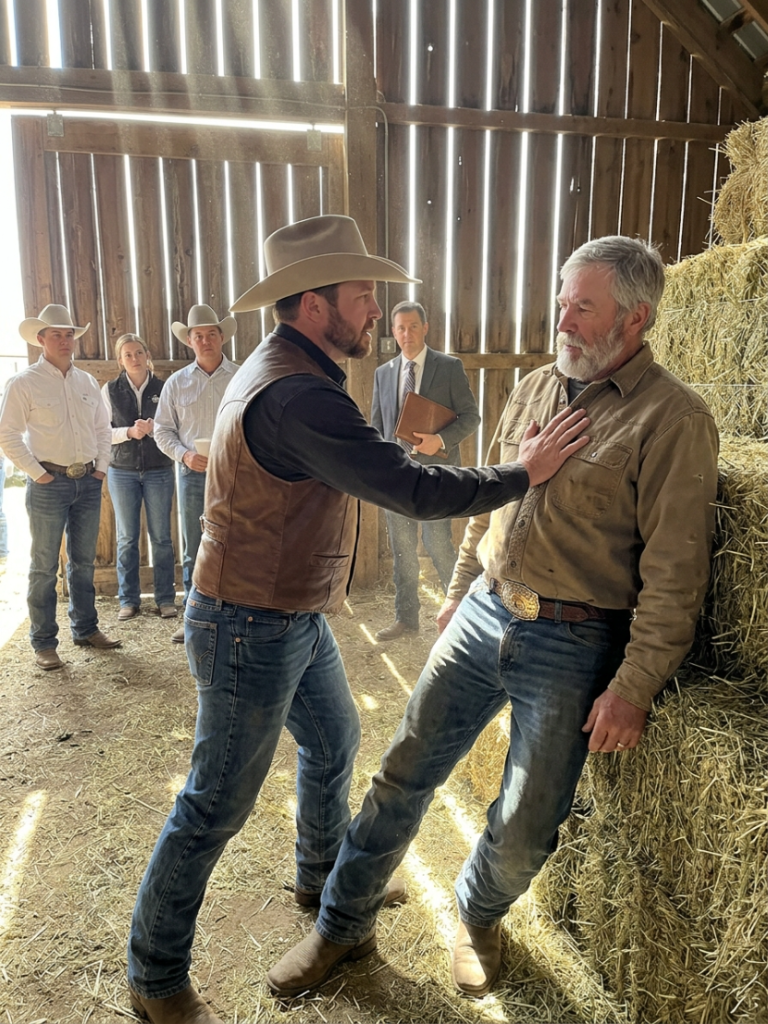
Rick Holloway’s voice cracked on his next insult, and for half a second the Silver Creek Ranch auction barn went quieter than noon dust.
“—and tell your lawyer friend out there he can read paperwork after I finish with—”
“After you finish with what, Rick?” The man in the rumpled suit had already crossed the threshold, leather deed folder tucked under one arm like something that had waited years for this exact slatted light. His boots were not clean. Neither was his patience. “You’re standing in a criminal fraud conversation in front of three witnesses with Texas plates. Choose the next sentence carefully.”
Caleb Dunn stayed against the hay bale where Rick had shoved him, canvas shirt damp with sweat, gray beard catching dust. His left leg bent slightly from the old injury that had never cost him his land — only cost him his son’s respect when greed outgrew gratitude. The ornate belt buckle at his waist caught another blade of sun through the barn slats: the original Silver Creek brand, silver worn smooth by decades of work, not the reproduction buckle Rick wore like a costume.
The buyers near the door did not laugh. They had come to Bozeman looking for distressed acreage and honest water rights. They were not stupid. They were merely late to the real story.
Twenty minutes earlier, Rick had been winning the morning he wanted.
He moved through the auction barn in his cowboy hat and leather vest with the confidence of a man who believed paperwork made morality. Three out-of-state buyers in clean hats trailed him between horse stalls and hay racks while he narrated improvements he had never paid for and fences Caleb had rebuilt after the winter kill three years back. Rick liked audiences. He liked proving who belonged on Silver Creek floorboards.
Caleb belonged there longer than Rick had been alive.
He had mucked stalls that morning before dawn, limp and all, because habit outlasted ownership on paper. When Rick spotted mud near the buyers’ boots — Caleb’s boot, returning from the north pasture gate — Rick saw opportunity. Humiliation in front of money men was currency Rick had spent his whole management career collecting.
“Get your filthy boots off my buyers’ floor!”
The shove came hard enough to steal breath but not balance. Caleb absorbed it the way old timber absorbs weight — silent, structural, still standing. Rick jabbed a finger at the buckle as if it were stolen décor.
“That thing’s not yours either.”
“It was my father’s,” Caleb said.
“Your father’s dead.”
“Which is why your employer forged his signature.”
Rick laughed too loud. One buyer’s smile died mid-rise.
The county lawyer — Eli Paterson — had been sitting in a pickup outside since 6am waiting for Caleb’s signal. Caleb had not wanted spectacle. He had wanted his ranch back without another court delay. Rick’s performance gave him no choice but to walk in mid-shove.
Paterson opened the deed folder on a hay bale, flattening pages with a hand that did not shake. “Power of attorney recorded eighteen months ago. Notarized in Gallatin County. Signature match disputed by three independent experts. Forged after Caleb Dunn’s knee surgery, while he was sedated in St. Vincent’s Billings and his son, Derek, cleaned out the operating accounts.”
Rick’s color changed. “Derek runs operations. That’s legal.”
“Derek stole operations,” Paterson said. “And paid you to keep the old man off the buyer list.”
The buyers stepped closer without being invited. One of them, older, squinted at Caleb’s buckle in the dust light and pulled out his phone — not for spectacle, for a historical registry app he used to verify provenance on heritage cattle brands. The screen loaded a black-and-white archive photo from 1952: same curled S hook through creek line, same notch pattern worn into a younger man’s belt at a county fair.
“That’s the original Silver Creek mark,” the buyer said slowly. “Not registered to Holloway Management.”
Rick reached for the folder. Paterson slapped his wrist with the folder edge — not hard, but enough to make law feel physical. “Touch that again and I add assault to the complaint already filed this morning.”
Caleb finally straightened fully off the hay bale. The limp was real. So was the deed.
“Derek told me you signed,” Rick said, voice smaller now. “Said you wanted out.”
“I signed a surgical consent form,” Caleb replied. “He translated that into selling my cattle, my water rights, and my name to men who never met me.”
One buyer removed his hat. The gesture spread without discussion — respect arriving late but sincerely. Rick looked at the hat in the buyer’s hands and understood his performance had just priced him out of every future contract in three states.
Paterson turned a page. “Temporary restraining order effective immediately. Derek Dunn barred from financial transactions on Silver Creek property pending criminal review. Rick Holloway terminated as acting manager by court order attached here.”
Rick’s vest suddenly looked too new for the barn. “You can’t fire me in front of—”
“I can,” Caleb said, “because I never hired you. My son did, with my forged hand.”
The barn door opened again. Derek Dunn came in fast — forty-one, city jacket over ranch boots, phone already recording as if video could rewrite paper. He stopped when he saw the folder, the buyers’ faces, and his father’s buckle catching slatted light like evidence that refused to stay buried.
“Dad, this is a misunderstanding.”
Caleb looked at his son the way a man looks at weather he can no longer predict. “You sold the north pasture while I was under anesthesia. You told the bank I was incompetent. You paid Rick to keep me limping in the shadows so buyers would think the ranch was distressed and cheap.”
“I was protecting the operation.”
“You were protecting your theft.”
Derek’s phone lowered. Paterson held out a second document. “Sheriff’s office is en route for interview. I suggest you stay.”
The Texas buyers did not bid that afternoon. They asked for water maps Caleb remembered by heart and left their cards on an honest hay bale. One wrote on the back: Call if you run heritage steers again. We pay for provenance.
Rick gathered his hat without being told. Caleb did not watch him go. He watched the brand on his buckle instead — the mark his grandfather had filed in county records when Bozeman was still arguing about railroad lines.
By evening, Caleb stood on the porch he had built with his own hands while Paterson filed the final reinstatement papers. Derek’s truck was gone from the drive. The management office keys lay on the kitchen table where Rick used to hang charts of cattle he never fed.
Three weeks later, Silver Creek held an open gate day for neighbors instead of an auction for strangers. Caleb walked the north fence line with his limp and a thermos, stopping where Derek had posted For Sale signs he had never authorized. The signs came down one by one.
Rick Holloway applied for work in Wyoming under a reference Caleb refused to give. Derek hired a defense attorney and lost the ranch accounts before he lost his freedom. Buyers who had watched the barn that noon sent letters apologizing for almost buying stolen ground.
Caleb kept the original buckle on his belt, silver worn smooth, catching noon light through barn slats whenever he passed through the door he never should have lost and finally, in front of witnesses who knew how to read a brand, took back.