The Foster Boy Ran Every Time It Got Good FULL STORY
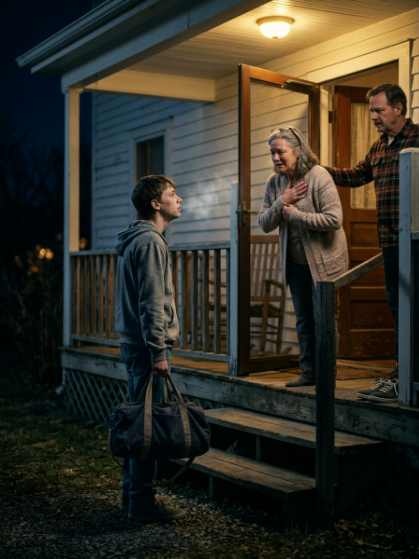
“I didn’t come back just for me,” Marcus said again, and his eyes flicked to the dark behind him like he half expected someone to be there.
I came down off the porch in my slippers, into the cold, and I didn’t touch him because you don’t grab a boy who bolts. I just stood close enough that he’d know I wasn’t going anywhere.
“Then tell me who else,” I said.
It came out of him in the cold, all at once, the way the truth does when a person’s too tired to guard it anymore.
He had a sister. Lily. Eight years old. They’d been taken together when Marcus was eleven, and the system — short on homes that take two, shorter on homes that take a wary boy with a thick file — had split them. Different county. Different family. He got to see her twice a year, supervised, for an hour, in a beige room with a social worker watching the clock.
That was the thing nobody in any of those seven homes ever understood about why he ran.
“Every time it got good,” he said, “I’d be sitting at some dinner table with some nice family, and I’d think about Lily not having that. And I couldn’t. I couldn’t just take a home and a bed and a mom asking about my day when she had none of it. It felt like leaving her behind on purpose. So I’d leave first.”
He ran from us in March, he told me, because he’d turned fifteen and gotten it in his head that if he could just get to her county, get a job, get older, he could be the one to take her. A kid trying to become a guardian with a backpack and forty dollars.
It didn’t work. Of course it didn’t work. He spent a year couch-surfing and washing dishes under the table and sleeping rough when the couches ran out, trying to outrun the system to a little girl it had locked away from him.
“I failed,” he said. His voice broke clean in half. “I can’t get to her. I’m fifteen and I can’t get to her, and I didn’t have anywhere else, and I kept thinking about the porch light. I drove past three times because I figured you’d given up like everybody gives up.”
Tom had come out by then. He stood in the doorway with the case of bulbs practically still warm in his hands, and he heard the whole thing.
“Come inside, son,” Tom said. “We’ll figure out Lily together. But you’re done sleeping in cars.”
We did figure it out. It took eight months and more meetings than I can count.
We learned the system that splits kids will sometimes, if two stubborn old people push hard enough and show up to every single hearing, allow it to put them back together. We learned how to be loud in the right rooms. Our caseworker, bless her, fought beside us like Lily was her own.
The day they brought Lily to our door, Marcus stood on the porch — that same porch — and watched the car come up the drive, and he was shaking worse than the night he came home.
She got out clutching a stuffed rabbit with one ear. She saw him.
“Marcus?” she said, like she wasn’t sure he was real.
He went down on his knees in the yard and she ran into him and he held his little sister the way he’d been trying to hold the whole world together for four years.
I won’t tell you it fixed everything. That’s not how these kids work, and I’d be lying.
Marcus still checks the exits. He still has nights where the old fear wakes him and he stands at the window like he’s deciding whether to run. Lily flinches at raised voices. There are years of damage in both of them that love alone doesn’t iron out — it takes patience, and counselors, and a thousand small ordinary days proving the door isn’t going to slam.
But we adopted them. Both of them. Same day, same courtroom, two kids and two stubborn Callahans, official at last.
Marcus is seventeen now. He doesn’t run anymore. I think it’s because he finally has the one thing worth staying for — not a bed or a meal, but his sister down the hall, safe, in a house that isn’t going to send either of them back.
Tom still keeps that case of bulbs in the drawer. We don’t really need it the way we used to.
But every night, out of habit neither of us will break, one of us still flips on the porch light before bed.
And now there are two pairs of shoes by the door beneath it — a big worn pair and a small one with a rabbit sticker on the toe — waiting for the morning that’s finally, finally coming.