We Found a Letter Sealed in the Wall FULL STORY
I sat on the dusty floor of that gutted room and read the rest of my grandfather’s confession out loud, because Caleb needed to hear it too, and because some things have to be said into the air to be real.
The story we’d been raised on was a lie, top to bottom.
The back field hadn’t been Walter’s to fight over. When their father — my great-great-grandfather — died, his will left the eighty acres to Samuel. The younger brother. The one who’d stayed and worked the land while Walter went off chasing other things.
Walter was named executor. And Walter, the letter admitted in that careful hand, “could not stand to watch the better part of the farm go to the brother everyone already loved more.”
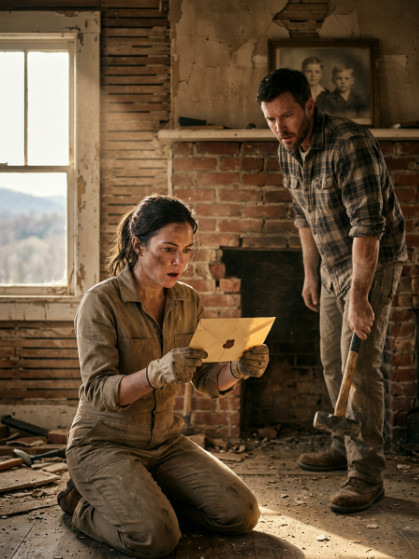
So he did something a twenty-six-year-old man should never have been able to do. He took the original deed from the courthouse file before it was recorded. He hid it. And he told the family that Samuel had forged a claim to land that was rightfully the whole family’s.
In a small Tennessee county in those days, a man’s word against his brother’s was all the trial there ever was.
Samuel couldn’t prove what he couldn’t produce. The deed was simply gone. The family closed around Walter like a fist.
They ran Samuel out. Called him a thief at the church door. His own mother stopped writing to him.
He left the state with nothing and he never came back.
“I meant to fix it every year,” Walter wrote. “Every single year. And every year it got bigger and I got smaller, until I was an old man who had let his only brother die a thief’s death for a crime I committed. If you are reading this, I was too much a coward to fix it while I breathed. So I am leaving it to you.”
The last page held two things.
A name: June Hartley. Samuel’s granddaughter. Walter had hired someone, quietly, in his final years, just to find out if Samuel’s line still existed. It did. A woman in her sixties, two counties over.
And instructions. Under the third floorboard from the cold-air return, wrapped the same way, I would find the original deed. The real one. The one he’d stolen sixty years ago and never had the courage to burn.
It was right where he said.
I held a piece of paper that had ruined a man’s whole life by being hidden in the dark.
It took me two weeks to work up the nerve to drive out to June Hartley’s place.
She lived in a small, tidy house with a sagging porch of her own. When I told her who I was — a Mercer — her face hardened in a way I understood completely. She’d been raised on her side of the same feud. On the shame of a grandfather everyone called a liar.
“I don’t want trouble,” she said, hand on the door.
“I’m not here for trouble,” I said. “I’m here to tell you your grandfather never stole anything. And I have the proof in my car.”
I watched a lifetime of inherited shame fall off a stranger’s shoulders on a stranger’s porch.
June read the letter sitting down, because her legs wouldn’t hold her. She read the deed. She pressed both to her chest and cried for the man she’d been taught to be embarrassed by — the grandfather who’d died believing his own family thought he was a crook.
“He used to tell my mother he didn’t do it,” she whispered. “And she didn’t believe him. She went to her grave not believing him.”
That’s the part that wrecked me. Not the land. The years of people loving each other a little less because of a lie sealed in a wall.
We made it right the only way left to us.
I signed the back field over to June Hartley. Eighty acres, free and clear, returned to Samuel’s line where it should have gone in 1962. My own family was furious. Some of them still don’t speak to me.
Let them. I’d rather be the Mercer who told the truth than another one who kept it.
June and I aren’t strangers anymore. She comes to the farmhouse now. We fixed that sagging porch of hers together last month.
She asked me, once, if I thought Samuel knew. Up there, wherever he is. If he finally knew his name was cleared.
I told her I hoped so. But I think we both understood the truth of it.
Some debts come due too late to pay the person who’s owed.
On a clear evening, June and I walked the field that finally bears her family’s name. The grass was gold and the light was long, and neither of us said much.
She just stood at the fence line her grandfather was exiled from, breathing it in, sixty years after they told him it was never his.