A Therapy Dog Sat With the Man Who Hadn’t Spoken in a Year FULL STORY
The name was “Birdie.”
He said it again, a little louder the second time, his hand never leaving Biscuit’s fur. “Birdie.”
The nurse beside me, Donna, knelt down too. Her eyes were wet. “Walter,” she said gently, “who’s Birdie, hon?”
For a long moment he didn’t answer. The piano kept playing across the room, oblivious. The string lights swayed.
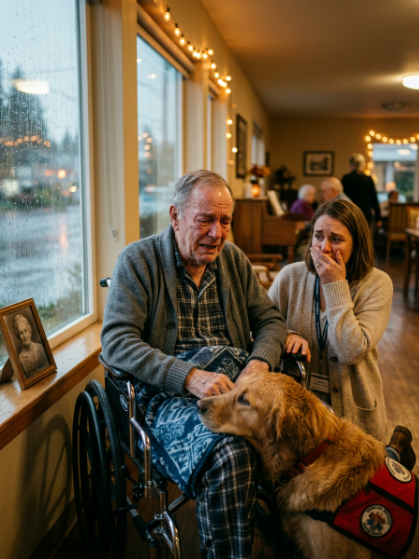
Then Walter looked at the dog — really looked at him, at that russet-gold coat — and the words came loose like something that had been frozen for a very long time.
“My daughter,” he said. “When she was small. She had a puppy this exact color. I gave it to her on her sixth birthday.” His voice shook. “Same gold. Same eyes. I forgot. How did I forget that?”
Donna and I just stayed on the floor with him, afraid to break it.
“Sarah,” he said. “Her name’s Sarah. I haven’t talked to my Birdie in fourteen months.”
It came out in pieces over the next hour, the way grief does when it finally finds a door.
At Eleanor’s funeral, drowning in it, Walter had said something cruel to Sarah. About how she hadn’t visited enough at the end. About how it was easy to grieve loud when you’d been gone. He didn’t even mean it — he was just looking for somewhere to put the pain.
But Sarah had walked out of that church and he’d been too ashamed to call. A week passed. Then a month. Then the words got too heavy to lift, and he just… stopped. Stopped talking to her. Stopped talking at all.
He’d let one bad sentence become fourteen months of silence.
And a dog the color of a puppy from forty years ago had reached past all of it and pulled out her name.
“I need to call her,” he said. “Grace, I need to call my Birdie.”
His hands were shaking too hard to hold a phone. So I held it for him.
It rang four times. I almost lost my nerve.
Then a woman’s voice. Careful. “Cedar Glen? Is everything okay? Is it my dad?”
“Sarah,” Walter said, and his whole face broke open. “Birdie. It’s me. I’m so sorry. I’ve been so sorry for so long.”
I stepped back to give him the room. But I heard her start to cry through the speaker, heard her say “Daddy” the way you only say it when you’d given up on saying it again.
They talked for forty minutes. About Eleanor. About the puppy, whose name was Sunny. About all the Thursdays he’d spent staring at the rain.
Sarah drove up the next morning. She lives three hours away.
She brought her kids — grandkids Walter had never met, because the silence had swallowed them too. She walked into that common room and he held out his arms and she folded into them like no time had passed at all.
Biscuit sat at their feet the whole visit, tail thumping, like he knew exactly what he’d done.
Walter asked me to bring a notepad that afternoon. His hands still wouldn’t hold a pen steady, so I wrote while he talked, and we made a letter for Sarah to keep — the things he wanted her to have in his own words. The puppy named Sunny. The way she used to fall asleep with her face in the dog’s fur. The day at Eleanor’s funeral he’d give anything to take back. He signed the bottom himself, slow and crooked, “Your Dad.”
Sarah told me later it’s framed on her wall now, next to the only photo she has of the four of them — her, her parents, and a golden puppy at her feet.
I’d love to tell you it was a long, happy ending.
It wasn’t long. That’s the part that still sits in my chest.
Walter passed nine days later. In his sleep, peacefully, the staff said. Sarah was there. She’d been there every day since the phone call, making up fourteen months in nine, holding his hand.
She told me, after, that those nine days were the gift of her life. That she’d spent over a year believing her father didn’t love her, and she got to spend his last week knowing the truth — that he loved her so much the loss of her had literally taken his voice.
“You didn’t lose him in the funeral,” she told me, crying and laughing at once. “I almost lost him to it. The dog gave him back.”
I still bring Biscuit to Cedar Glen every Thursday.
He’s older now. Gray coming in around his muzzle. He doesn’t have many working years left, and I think about that more than I’d like to.
But every Thursday, out of habit or memory or something I’ll never understand, he still walks to the window at the end of the hall.
To the chair where Walter used to sit.
And for just a moment, he rests his head where that lap used to be, on the empty cushion by the rain-streaked glass, before he turns and goes to find the next lonely person who needs him.