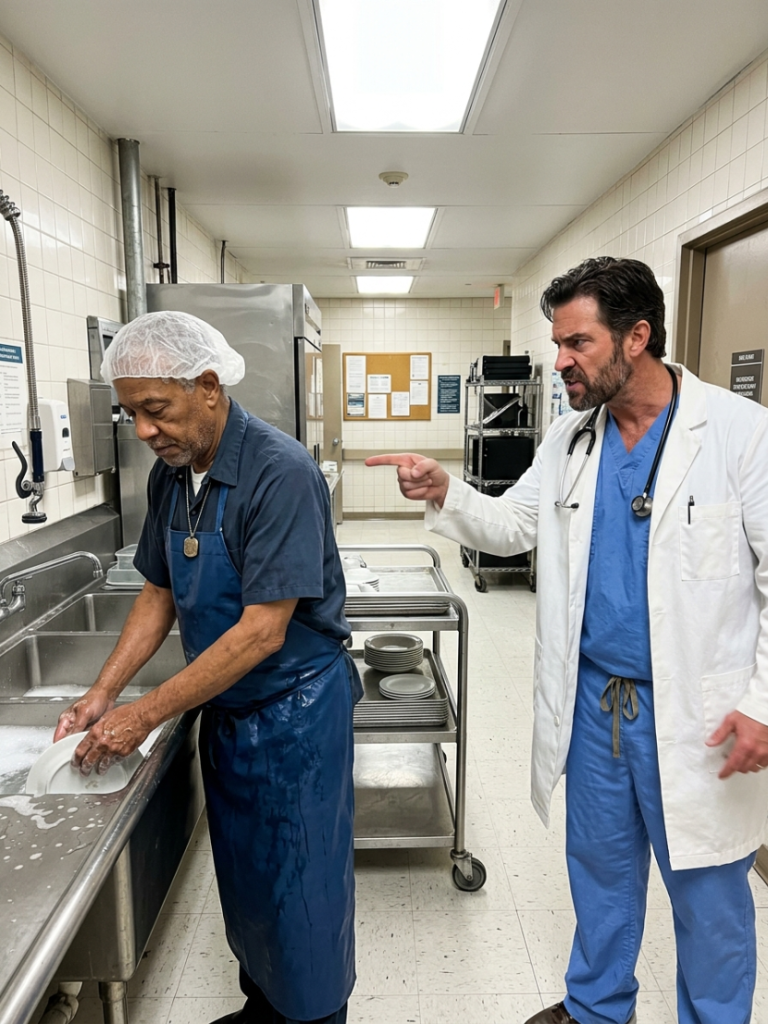
Dr. Ethan Marsh’s pointing hand began to shake before the reprimand left his mouth.
The kitchen corridor at St. Vincent’s held still around him at 6am — white tile, fluorescent hum, the smell of industrial soap and last night’s roux from the cafeteria line. Ethan, forty-four, surgical scrubs, stethoscope at his throat, stood ten feet from Leo Marsh with his finger suspended in accusation like a tool he no longer trusted. Leo, seventy-one, hair net, wet apron, kept his hands in the soapy sink and his eyes level. The worn locket on the chain at his collar swung once and caught the light again, scratched oval of metal that had no business looking familiar.
Ethan had learned early that familiar things could ruin a morning faster than blood.
“Can you not read signage?” he started, then stopped because the melody in his head finished its second line without Leo moving his lips anymore. Soft. Old. The kind of tune parents sang when they believed a child could hear even through hospital walls.
Leo lifted his eyes the way a man lifts something heavy he has carried long enough.
“This is a restricted corridor before OR prep,” Ethan tried again, louder. Nothing in his voice convinced even him. Two dish racks clattered in the background. A night orderly paused with a linen cart and pretended not to watch.
Ethan did not shake in front of kitchen staff before a triple bypass at seven-thirty. Yet his thumb nested against his index finger the way it had at eight in a foster intake office when a social worker hummed down the hall and Ethan pressed his face into a coat sleeve to keep from calling out the only father’s name he knew. Thomas, then. Marsh later, borrowed from the family that adopted him after Louisiana records closed.
Leo returned to the dishes. The locket slipped against his sternum, deliberate as breath.
An hour earlier, Ethan had signed off on staffing for the Marsh Surgical Pavilion — donor brass outside his office, his own endowment cleared eighteen months ago. He had walked this shortcut without coffee, already irritated by anything that interrupted surgical ritual. Humming interrupted ritual.
Nurse Marisol Vega appeared at the corridor junction with a chart folder. “Dr. Marsh, anesthesia is asking—”
“Not now,” Ethan said, too sharp.
Marisol’s gaze dropped to Leo, then to the locket. She had worked St. Vincent’s since 1999. She knew every ghost that walked the night shift.
“That tune,” she said quietly, “I’ve heard it from a cassette in locker twelve for fifteen years.”
Ethan’s head turned so fast his stethoscope slapped his collarbone. “What cassette?”
Marisol looked at Leo. “Thomas.”
Leo’s shoulders dropped a fraction, as if a locked door inside him had finally been named.
Ethan stepped forward until the stainless tray cart between them reflected both their faces in metal. “My father’s name was not a public topic.”
“Your father’s name wasn’t public because he went to Angola in ’98,” Marisol said. “And because the adoption agency told you he was dead.”
Leo dried his hands on his apron, slow. “I told them not to say that. They thought it would be easier on a boy.”
The corridor narrowed around Ethan until it felt like a throat.
He remembered the lullaby word for word — nonsense syllables over storms on Lake Pontchartrain, hands rough from engine grease lifting him onto a kitchen chair. He remembered police at the door, his mother crying, then a new house and a caseworker explaining that grown-ups made choices children had to accept. Thomas Marsh had made his after a bar fight. Twenty years in Angola. Release at sixty-nine with a name he did not use and a son who became everything the visiting room brochures promised was possible.
Leo opened the locket with wet fingers. Inside, yellowed: a baby photo, hospital bracelet ink faded, a young man holding an infant against a winter coat. Ethan’s infant face.
“No,” Ethan whispered.
“Yes,” Leo said. “You grew taller than I thought you would.”
“I funded the wing,” Ethan said, broken.
“I know. When they posted dishwasher openings in the new cafeteria, I used the name on my parole ID. You built this place so children who start where you started don’t eat alone at scholarship tables. Let me stack trays where you saved lives. That was enough until this morning.”
Marisol cleared her throat. “Dr. Morris is holding the bypass.”
Ethan looked at his hands — the same hands that had stilled for a lullaby before they steadied on a sternum saw. “Tell Morris I’ll scrub in six minutes.”
Marisol left at a pace that respected both urgency and privacy.
“I hum when I’m scared,” Leo admitted. “Did that as a father too.”
Ethan closed his eyes. “Consult at noon. Residents’ lounge on four-east.”
“No sugar in your coffee. Still bitter.”
“Still.”
The bypass went clean. At noon, Leo waited with two paper cups and the cassette from locker twelve — plastic case labeled Tommy’s Song. They listened once without speaking: grainy recording, baby Ethan fussing, Thomas humming the same lullaby.
Ethan did not forgive the bar fight. He asked why visitation stopped, why records listed deceased. Leo answered without excuses first, then with them — fear, shame, a belief that a surgeon son needed no chain to a convict father. Marisol had kept the cassette when Thomas asked her the week Ethan entered medical school.
“I watched your name on the donor wall through a service hallway crack,” Leo said. “Prouder than any parole officer report.”
HR sent a cautious email by afternoon. Ethan replied from OR recovery: He is family. He keeps his job.
Three months later, Leo clocked out in his hair net and walked to physician parking as an invited guest. Ethan leaned against his car with two bitter coffees and the locket — finally given, finally accepted — warm in his coat pocket.
The parking lot lights buzzed. Ethan watched his father adjust the chain so it lay flat under streetlight, and understood why some melodies survived every attempt to bury them: they were never only music. They were map.