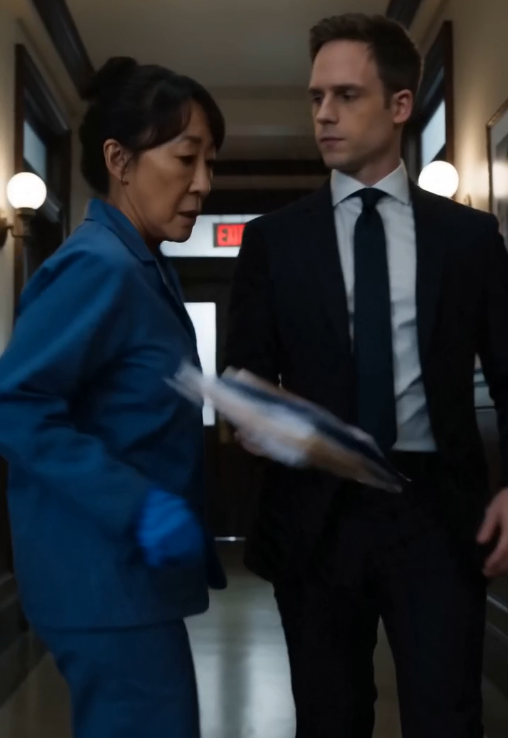
The heavy oak doors locked. The sound echoed through the long, wood-paneled hallway like a gunshot. Julian froze. His hand was still outstretched, hovering inches from the photograph in my blue-gloved hand. The dim brass sconces cast long, jagged shadows across the polished floor.
“What did you just do?” Julian whispered. His voice cracked. The arrogant, booming baritone he had used for the last two minutes was completely gone. He looked at the doors, then at the scattered papers, then at me. His eyes were wide, the pupils dilated in the dim light.
“I secured the perimeter,” I said. My voice was steady. I slowly stood up. My blue janitor uniform suddenly felt like a costume I was ready to shed. I kept my eyes locked on his. “And I secured the evidence.”
Julian scoffed, adjusting his silk tie, trying to regain his footing. “You’re a cleaner. You make fifteen dollars an hour. You don’t know what you’re holding. That’s a private photograph. It’s protected by attorney-client privilege. Give it to me, or I’ll have you arrested for theft.”
“Attorney-client privilege doesn’t apply to treason, Julian,” I said. I held the photograph up. The glossy paper caught the dim light. “And it certainly doesn’t apply when you’re selling F-35 guidance chip schematics to a known arms dealer.”
The silence in the hallway didn’t just fall. It collapsed.
Julian’s face flushed a deep, ugly crimson. He took a half-step back, his polished leather shoes squeaking against the linoleum. “That’s a lie. That’s a fabrication. You’re trying to blackmail me. I’ll ruin you. I’ll make sure you never work in this city again.”
“You can’t ruin me, Julian,” I said. I reached up and pulled the blue hairnet off my head. My dark hair fell around my shoulders. “Because I don’t work in this city. I work for the government.”
I tapped the small, sleek device on my wrist.
Suddenly, the hallway changed. The brass sconces flickered. Holographic blue screens projected from the walls, surrounding Julian. Dozens of security camera feeds appeared in mid-air. They showed Julian in his office. They showed him shredding documents. They showed him making the handoff on the sidewalk. The high-tech surveillance grid trapped him in a cage of blue light.
Julian spun around, panicked. He reached for the doors, but they were solid steel. He was completely enclosed.
“How…” he stammered, his hands trembling as he looked at the floating screens. “How do you have access to this system? This is a private building!”
“I built this system,” I said. I stepped closer to him. The blue light reflected in my eyes. “Three years ago, the DoD contracted my firm to install the security grid in every major legal office in the capital. I’ve been watching you for six months, Julian. I just needed you to drop the physical copy so I could match the handwriting on the envelope.”
Julian slumped against the wall. The arrogant senior partner was gone. In his place stood a trapped animal, sweating through his crisp white shirt, his expensive suit suddenly looking like a cheap costume.
“You’re under arrest,” I said.
The heavy oak doors clicked and swung open. Two men in dark tactical gear stepped into the hallway. They didn’t look at me. They walked straight to Julian. The cold steel of the handcuffs snapped around his wrists. The sound was sharp. Final.
They marched him out, his head bowed, while the holographic screens faded into the dark wood paneling. I looked down at the scattered papers on the floor, the photograph resting in my blue-gloved hand, and pressed my earpiece. “Target secured. Send the cleanup crew.”