The Cassette Tape FULL STORY
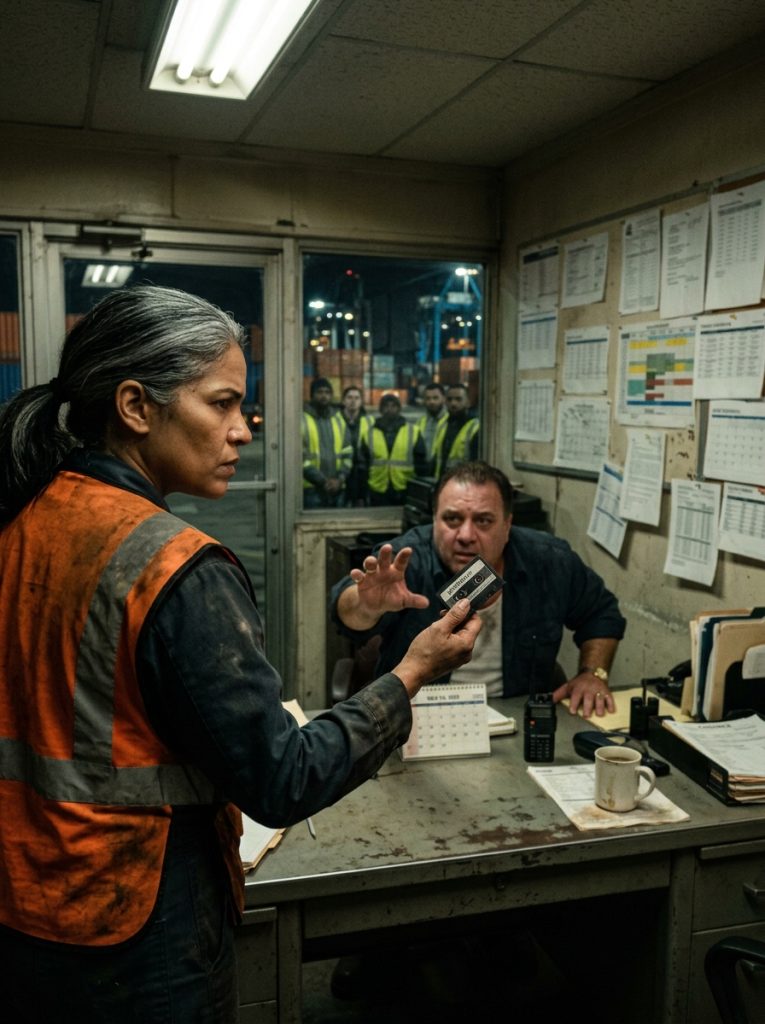
The union rep’s name was Harold Chen, and he’d been trying to bring Frank Morello down for six years.
He just never had the evidence.
Frank’s voice was still crackling through the cassette tape’s tiny speaker — nasal, smug, every word a confession — when Harold walked through the office door and stopped dead.
“Is that…”
“Frank Morello,” I said. “September fourteenth, two years ago. Explaining to his nephew exactly how he falsified the cargo manifest to make it look like I authorized the shipment to a fake warehouse in Jersey.”
Frank lunged at me.
He was fast for a man his size. One thick hand grabbed for the tape. The other shoved me hard against the filing cabinet. I felt the edge dig into my spine.
Harold stepped between us.
“Touch her again,” he said quietly, “and I’ll have you in cuffs before the next ship docks.”
Frank’s face was the color of raw dough. Sweat beaded on his forehead. The gold pinky ring caught the fluorescent light.
“That tape is illegal,” he sputtered. “She recorded me without consent. It’s inadmissible. She’s violating —”
“This isn’t a courtroom, Frank.” Harold picked up the cassette recorder from the desk. “This is a union investigation. And you just confessed to cargo theft, conspiracy, and falsifying federal shipping documents on tape. In front of fifteen witnesses.”
He gestured toward the office window. The dock crew was still watching through the glass — five men in reflective vests, frozen like a photograph. A couple of them had their phones out.
“That tape,” Harold continued, “is going to the Port Authority. The FBI maritime division. And the union disciplinary board. All three. Tonight.”
Frank sagged into his chair. The leather groaned.
“You can’t…” he started.
“I can,” Harold said. “And I will. You framed Diana Reyes two years ago. You humiliated her. You demoted her. You tried to fire her tonight. And you did it because she was the only person on this dock who knew the cargo manifests well enough to figure out what you were stealing.”
He was right.
Six months before the frame-up, I had flagged a discrepancy in the shipping logs. A container that left the terminal with forty-two units but arrived at its destination with thirty-eight. Four units missing. I filed a report. The next week, the manifest had been altered — my name forged on the authorization. Two weeks after that, I was in handcuffs in front of my entire shift, charged with cargo theft.
The charges were dropped — the evidence was too flimsy. But the damage was done. The union believed the paperwork. My reputation was destroyed. Frank demoted me to quartermaster and told me I was lucky he didn’t press for prison time.
I’d been waiting for two years to prove my innocence.
Two years of changing lightbulbs and counting inventory while Frank got richer.
Two years of walking past men who used to call me “Jefa” and now wouldn’t meet my eyes.
Two years of my grandmother’s cassette recorder humming in my pocket.
“There’s more,” I said.
Frank’s head jerked up.
I pulled a folder from my vest. Inside were photocopies of bank statements — three separate accounts under three separate names, each receiving regular deposits from a shell company registered to Frank’s wife’s maiden name. I’d found them six months ago, working late nights in the quartermaster office when nobody else was around.
“That’s nine years of deposits,” I said. “Totaling just under two million dollars. I’ve cross-referenced the dates with the cargo manifests. Every deposit matches a shipment where units went missing.”
Harold took the folder. He flipped through it slowly, his expression getting darker with every page.
“Diana,” he said, “you just ended this man’s career.”
He wasn’t exaggerating.
Within forty-eight hours, Frank Morello was in federal custody. The Port Authority seized his assets. His house in Bergen County. His boat. His pension. The FBI uncovered a fraud ring that went beyond cargo — Frank had been skimming from half a dozen companies that shipped through the terminal, using forged documents and bribed inspectors.
Six other people were arrested, including the dock supervisor who’d signed off on the falsified manifest that almost put me in prison.
As for me, the union held an emergency meeting the following Monday.
I walked into the same hall where I’d been publicly accused two years earlier. The same rows of folding chairs. The same faces. A hundred and twenty dock workers who’d believed the lie.
Harold stood at the podium.
“Two years ago,” he said, “we made a mistake. We believed a man who lied to us. We turned our backs on a woman who had done nothing but her job. Today, we’re going to fix it.”
He called my name.
I walked to the front of the hall.
The room stood.
Every single person.
I didn’t cry until I got home that night. Until I set my grandmother’s cassette recorder on the kitchen table. Until I whispered, “We did it, Abuela. We waited.”
Three months later, I was promoted to Terminal Operations Manager — the position I should have had all along. My first act was to install security cameras in every office, with feeds that backed up to an independent server that nobody in management could tamper with.
My second act was to frame the cassette recorder and mount it on my office wall.
People ask me why I kept it.
I tell them the same thing my grandmother told me.
“The truth always comes out if you’re patient enough to listen.”