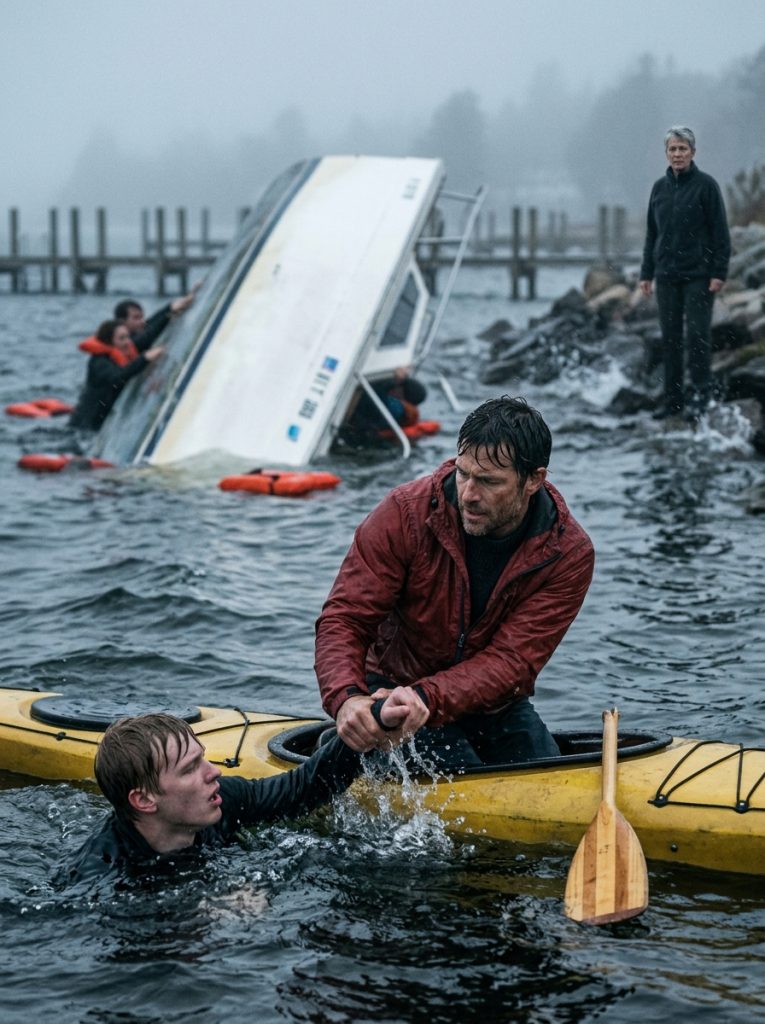
The steel-haired woman I’d pulled from the water knelt over me on the cold rocks, asked my full name, and then she stood up and turned to the knot of stunned men on the shore.
I was still shaking too hard to sit up. Half a broken paddle was still in my fist. I didn’t understand yet why everyone got so quiet when she spoke.
“My name is Dawn Iverson,” she said, and even soaked to the bone she had a voice that made people straighten up. “I spent thirty-one years in the United States Coast Guard. I retired a captain. I have run more search-and-rescue operations than I can count, and I have written the after-action report on more drownings than I will ever forget.” She looked down the line of them. “So believe me when I tell you I know exactly what I just watched happen on this lake.”
Nobody moved.
“I watched a charter operator overload a vessel, fail to brief his passengers, and stow the life jackets where no one could reach them in an emergency,” she said. “I watched that same operator abandon a dozen people in fifty-degree water and swim for his own skin.” Her eyes found Brad Sutter, who was standing apart, wrapped in someone else’s blanket, dripping and silent. “And I watched a man in a twelve-foot kayak — a man you told to take his eyesore somewhere else — make nine trips into that water until his paddle snapped and his arms gave out, and bring every single one of us home.”
She crouched back down next to me.
“Son,” she said, quieter now, just for me. “What you did is not normal. I need you to understand that. People train for years to do what you did on instinct, and most of them still couldn’t. You held a sea kayak steady under panicking adults in chop that should have rolled you a dozen times. You have no idea what you are, do you?”
I didn’t have an answer. I was thirty-four and I fixed docks for a living and my whole body was one cramp.
The ambulances came. The fire department. Then, because Dawn Iverson made the calls, the Coast Guard and the county marine patrol.
And Dawn Iverson did not let it go.
Here’s the thing about leaving a dozen people to drown and swimming for shore. There are witnesses. Twelve of them, in fact, plus one retired captain who knows precisely which questions to ask and which boxes the law requires a charter operator to check.
Brad Sutter, it turned out, had been running unlicensed charters off that “members only” dock for two seasons. No commercial operator’s license. No required safety briefings. Life jackets present but stowed and strapped down to keep the deck looking clean for his well-dressed guests. He’d had eighteen people on a boat rated for twelve, because more guests meant more money, and the extra weight was a big part of why she rolled when the wind came around — exactly the way I’d warned him it would, right before he laughed at me.
The Coast Guard investigation came down hard. His operation was shut down. There were fines that made his gold watch look like pocket change, and a negligence suit from two of the passengers that I’m told he settled rather than let a courtroom hear how he’d swum away.
The marina that let him sneer people off its dock got a very uncomfortable visit from the same investigators, and the “members only” sign came down within the month. Funny how that works.
I saw Brad Sutter exactly once after all of it. Months later, at the hardware store, of all places. He’d lost the boat, the charter dream, and most of the swagger. He looked at me for a long moment and I braced for something ugly. Instead he said, low, “You pulled my niece out of that water. She was the teenager. I never said thank you.” I told him I hadn’t done it for him. He said he knew, and that was somehow the most honest thing I ever heard the man say. We left it there. I don’t hate him. I just hope the lake taught him what I couldn’t.
But Dawn wasn’t only interested in the man who failed.
She was a lot more interested in the one who didn’t.
About three weeks after the accident, when I could lift my arms over my head again, I got a letter. Then a phone call. Then, to my total bewilderment, an invitation to a luncheon I had no business attending.
Dawn Iverson, it turned out, sat on the board of a regional water-safety foundation — the kind that funds rescue training and puts life jackets in loaner stations at public launches all over the state. She’d told them my story. All of it. The nine trips. The snapped paddle. The man who said my kayak didn’t belong.
They gave me an award. I’m not going to lie to you, I cried, which is embarrassing for a grown man in a borrowed sport coat, but every single person I’d pulled out of that water was in the room, and a few of them cried too, so I figure we’re even.
The older man I’d carried on the first trip stood up and said he had grandchildren because of me. The teenage girl gave me a card her whole family had signed. The woman who couldn’t feel her legs in the water walked across the room on those same legs to shake my hand.
And then the foundation offered me a job.
A real one. Running their loaner-vest program and teaching cold-water rescue for the northern lakes — paid, full-time, with benefits, doing the thing I apparently do on instinct, except now I get to teach other people to do it on purpose. Dawn Iverson is technically my boss, which means I get yelled at by a retired Coast Guard captain on a regular basis, and I have never been happier.
The first cold-water class I taught, twelve people showed up in wetsuits on a freezing morning to practice the exact thing that had nearly killed me to do on instinct. Halfway through, a kid — maybe nineteen, scrawny, the kind of kid people look right past — nailed a rescue drill that grown men twice his size had fumbled all morning. I watched the others’ faces change as they clocked it. I knew that look. I’d been on the wrong end of it my whole life. I pulled him aside after and told him exactly what Dawn told me on the rocks: you have no idea what you are, do you. He grinned like I’d handed him the keys to something.
They tried to buy me a new boat, too. A nice one. Fast. Stable. The kind of kayak I could never have afforded in a hundred years of fixing docks.
I said thank you, and I took it, because I’m not a fool.
But I kept the old yellow one.
It’s hanging in my shop now, the beat-up thing Brad Sutter called an eyesore. I won’t ever sell it. It pulled nine people out of a lake that wanted to keep them.
And the paddle — the one that snapped in my hands on the eighth trip, the one I told you about at the very start — that’s on the wall above my workbench, both halves, mounted clean.
People still ask me why I’d hang up a broken paddle like it’s something to be proud of.
I tell them the truth.
A man with a gold watch looked at me and decided I was nothing. An hour later, that “nothing” was the only thing standing between a dozen strangers and the bottom of Crystal Lake.
So when somebody tells you that you don’t belong — that your boat’s too small, your truck’s too old, that you’re not the kind of person who matters — you smile, and you remember there’s a snapped paddle on a wall in northern Michigan, and you go put your little boat in the water anyway.
You never know who’s going to need you out there.
And the lake doesn’t check your bank account before it decides to let you save somebody.