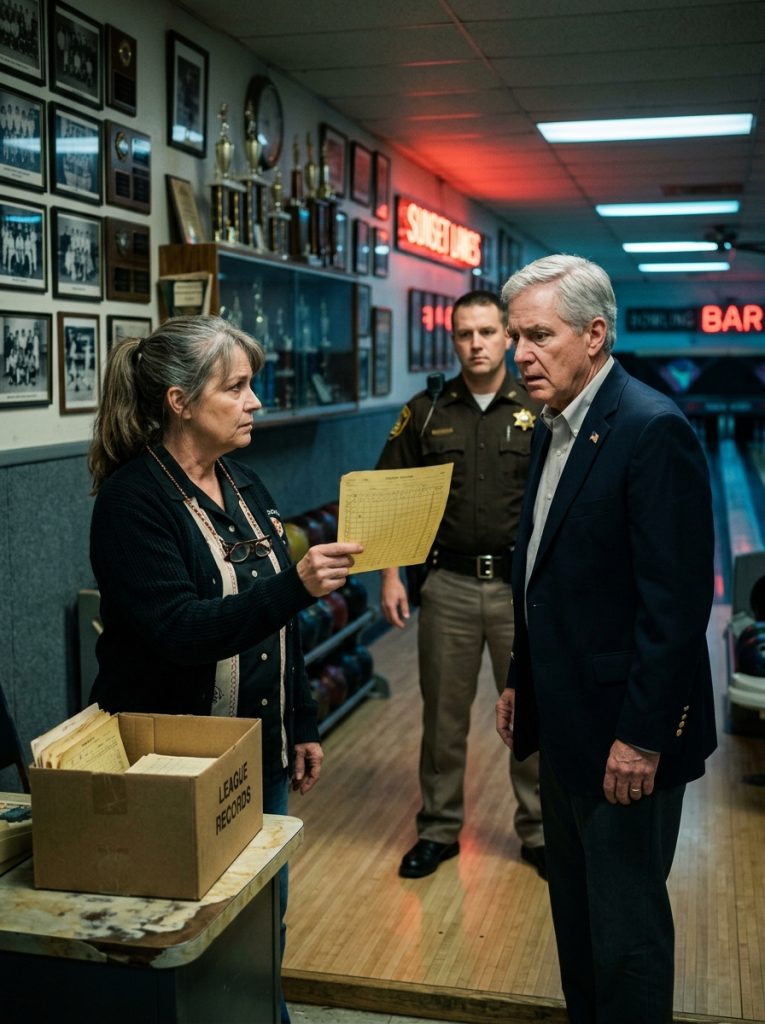
Mayor Dale Renner stared at the yellowed score sheet in my hand, and for the length of one long breath, the only sound in Sunset Lanes was the hum of the neon.
Eleven years of silence, and I’d finally walked out from behind my own counter to break it.
“Lorna,” he said, recovering, reaching for the warm voice that had won him three elections. “What is that? Put it down. You’re embarrassing yourself in front of—”
“It’s a league sheet,” I said. “From the night of the Hadley Mill fire. The night you told the whole town you were here. Bowling your whole set.” I held it higher so the people gathered for his little ceremony could see. “Your team was the Pin Pals. Lane seven. And this is the scorecard.”
“So I bowled,” Renner said. “I told everyone that. What’s your point?”
“My point,” I said, “is that you didn’t.”
I’d brought Deputy Pat Sowell with me. I’d called him that afternoon, told him to come in his uniform, told him to bring whoever decides these things. He stepped forward now, quiet and fair the way he’s always been.
“There’s a notation in your frames, Mr. Mayor,” I said. “My father taught me to always mark it. When a regular doesn’t show and somebody bowls in his place, we write ‘sub’ and the substitute’s initials, so the league standings stay honest.” I pointed. “Your frames that night are marked ‘sub.’ Initials R.T. You weren’t on lane seven. Ronnie Tate bowled your spot because you never came.”
The color was gone from Renner’s face now. The campaign smile was a memory.
“That’s — that scrap of paper proves nothing,” he said. “It’s eleven years old. Ronnie Tate is—”
“Right here,” said a voice from the back.
Because I’d called Ronnie too.
Ronnie Tate is seventy now, walks with a cane, sharp as a tack. He shuffled up the lane approach and looked Dale Renner dead in the eye.
“I bowled your spot that night, Dale,” Ronnie said. “Remember? You called me at the last minute. Said something came up. I figured you had a date. I bowled a one-thirty-eight and you bought my beers the next week to say thanks.” He shook his head slowly. “I never put it together. All these years. You told everybody you were here, and I was the man who took your lane, and not once did I think about what that meant.”
The room had gone from a ceremony to a trial.
“It means,” Deputy Sowell said carefully, “that the mayor did not have the alibi he gave at a public meeting eleven years ago. The alibi that, by my reading of the old file, is the reason the investigation turned away from him and toward somebody else.”
Toward my brother.
I have to stop here and tell you about Danny.
For eleven years, my brother carried the weight of a fire he didn’t set. He lost his job at the mill, then every job after, because in a town this size a whisper is a sentence. His wife left, worn down by the looks in the grocery store. He moved three states away and took work where nobody knew his name, and even then I’d hear it in his voice on the phone at Christmas — that flatness, that thing they’d broken in him.
He never set that fire. I always knew it. But “I know my brother” isn’t evidence, and so I’d kept my certainty and my score sheets to myself, because who listens to the lady at the bowling alley?
Turns out the lady at the bowling alley keeps better records than the county.
The investigation reopened within the week. And once it did, the rest came apart fast, the way these things do when somebody finally pulls the right thread.
Eleven years ago, Dale Renner was a councilman drowning in debt nobody knew about. He’d quietly bought up land along the river — cheap land, worthless land, right next to the Hadley Mill. Worthless, that is, unless the mill ever closed and the riverfront got rezoned for development.
The mill wasn’t going to close. It employed half the town.
Until it burned.
The fire that destroyed Briar Creek made Dale Renner’s worthless riverfront land valuable. He sold it off in pieces over the following years — quietly, through the same kind of shell arrangements he was good at — and that money launched the career that took him from councilman to mayor. He built a life on the ashes of the building my brother got blamed for.
The state fire marshal’s office, with new reason to look, found what the rushed original investigation had missed: the fire’s origin point didn’t match the story they’d told about Danny at all. It matched someone with keys, someone who knew the building, someone who’d been there that night when he swore to a roomful of people that he was bowling a few blocks away.
I’m not going to pretend I understand all the legal language that followed. Arson has a statute of limitations; fraud is more complicated; and Dale Renner has expensive lawyers. The criminal case is still grinding through the courts as I write this, and I’ve learned not to promise anyone how it ends.
But some things have already ended.
Dale Renner resigned as mayor within a month. The community center will not bear his name; the plaque was quietly never cast. The land deals are being unwound. The people who crossed the street to avoid my brother for eleven years are now crossing it to avoid the man they made mayor.
And Danny came home.
He drove into town on a gray Tuesday in his old truck, and I met him in the parking lot of Sunset Lanes, and my fifty-five-year-old brother put his face in his hands and cried like a boy.
“They believe me now,” he said. “After all this time. They actually believe me.”
“I always believed you,” I said.
“I know you did, Lorna.” He gripped my shoulders. “But you did more than believe me. You kept the proof. For eleven years. You kept the box.”
The town held a thing for Danny. I won’t call it an apology, because a town can’t really apologize; it doesn’t have a mouth. But the mayor’s old supporters showed up at the diner, one by one, and looked my brother in the eye, and told him they were sorry, and most of them meant it. The ones who didn’t, he forgave anyway, because Danny is a better man than the place that ran him out.
He works at the lanes with me now. He’s the one who oils the machines and resets the temperamental pinsetter on lane nine. He’s slow to laugh still — they took something from him that doesn’t fully grow back — but it’s coming. Last week I heard him razzing a league bowler about a gutter ball, and the sound of it nearly put me on the floor.
People ask me how I knew to keep all those sheets. Forty years of league nights, boxed and dated in a back room nobody ever visits.
I tell them the truth. I didn’t keep them because I thought they’d matter. I kept them because my father kept them, because honest scores are honest scores, because you write down what really happened even when nobody’s checking.
Especially when nobody’s checking.
That’s the whole thing, isn’t it. The mayor built an empire on a lie he told one night, betting that nobody had bothered to write down the truth.
He bet wrong.
The truth was in a cardboard box in the back of a bowling alley, in pencil, in my father’s careful hand, waiting eleven years for somebody to look.
Sunset Lanes is busier than it’s ever been now. Folks come from two counties over. They say it’s the nachos.
It’s not the nachos.
It’s that this is the place where the truth was kept, and people like to bowl somewhere honest.
My brother stands behind the counter most nights, handing out rental shoes, writing scores in pencil.
The way we’ve always done it.
The way that, in the end, brought him home.