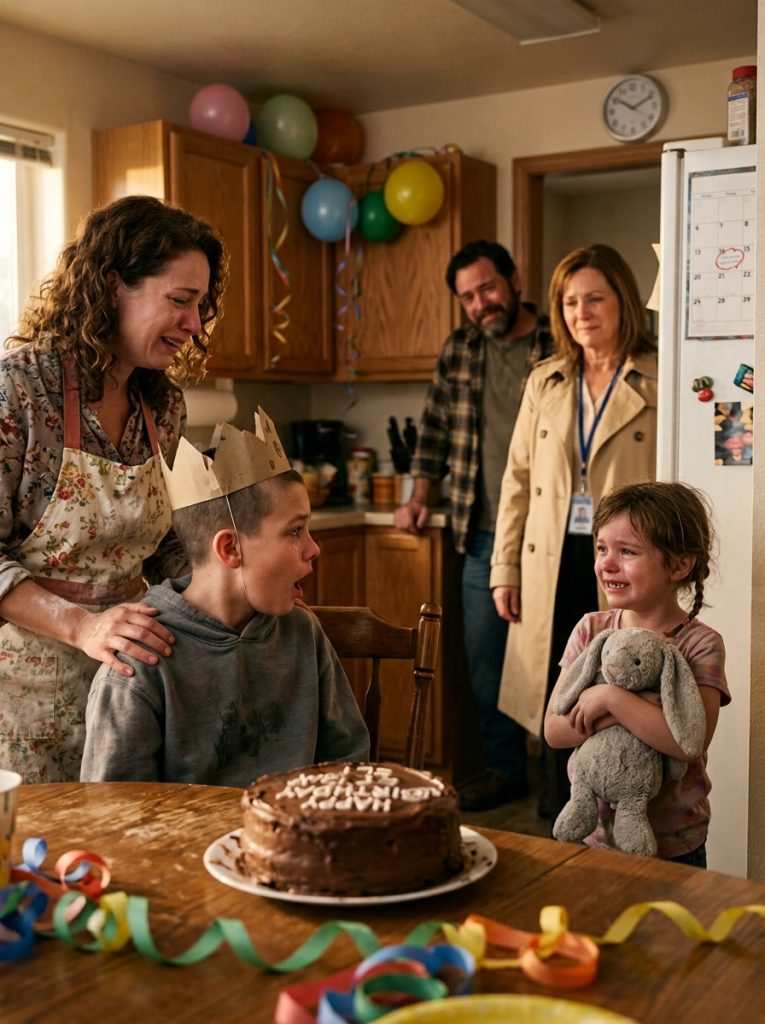
“Eli?”
That was the word. Just his name, turned into a question, in a six-year-old’s voice that hadn’t said it out loud in two years.
My son went very still. The paper crown slid sideways on his head and he didn’t fix it. He stared at the little girl on the porch like she might vanish if he blinked.
“Sophie?” he whispered.
And then they were both moving, and I had to step back fast, because Eli crossed that porch and dropped to his knees and wrapped his arms around his little sister so hard the stuffed rabbit got crushed between them, and neither of them was making any sound at all. That was the part that undid me. No crying. No words. Just two kids holding on like they’d each thought the other was a thing they’d dreamed.
Brenda Coyle, the caseworker who never forgot them, stood on my porch with her hand over her mouth, and her eyes were as wet as mine.
Let me tell you how it happened. Because it wasn’t luck, and it wasn’t the system working the way it’s supposed to. It was one stubborn woman refusing to let two children disappear into paperwork.
When their mother died — and I’ll get to that, because Eli deserves to have it said plainly — the siblings were placed in an emergency rush, the way it always goes, and there were no homes that could take both. A ten-year-old boy and a four-year-old girl went to different counties, different families, different lives. The plan, on paper, was to “reunify when feasible.”
It was never feasible. There was always a reason. A full home. A move. A missing form. Two years went by, and the only thing connecting them was a line in a file that nobody read.
Except Brenda read it. Brenda had been the intake worker the night they were separated, and she told me later she’d carried their faces home with her and never put them down. When I started making calls, hers was the name everyone gave me, half as a warning. “Brenda Coyle will move heaven and earth,” they said, “but don’t get the boy’s hopes up.”
I didn’t get his hopes up. I got mine up, quietly, and I let Brenda do what Brenda does.
She found Sophie. She found that Sophie’s foster placement was a kind older couple who’d been wanting to do right by her but had no idea she even had a brother — the connection had fallen out of the file somewhere along the way. When Brenda told them, they cried. They drove Sophie three hours to my front door on the day my son had circled in red crayon, and they stood back and let her run to him, and there is not a medal big enough for people like that.
Now. About their mother.
Eli’s mom was named Crystal. She was twenty-eight when she died. She got sick — really sick, the fast and unfair kind — and she spent the last months of her life fighting a system that wanted to take her kids before she was even gone, because she had no family to leave them to and no money to fight with.
Eli was the one who found her, the morning she didn’t wake up. Ten years old. He called 911 himself and then sat with his little sister so she wouldn’t be scared until the ambulance came.
He’d never told me that. He told me that night, after Sophie was asleep on our couch with the rabbit tucked under her chin, while he and I sat at the kitchen table with the lopsided cake going stale between us.
“I used to think it was my fault we got split up,” he said. “Like if I’d been better, somebody would’ve kept us together.”
“It was never your fault, baby,” I said. “Not one second of it.”
“I know that now,” he said. And then, quietly: “I picked June for my birthday because it’s the day I came here. But that’s not the only reason.” He looked at his hands. “Mom’s birthday was in January. The day they gave me — the fake one. I didn’t want my day to be anywhere near a month that hurts. I wanted a new one. A good one. With you guys.”
I had to go check the oven. There was nothing in the oven. There hasn’t been anything in that oven the whole time I’ve known this boy. It’s just where I go so my kids don’t have to watch their mother fall apart.
Here is how it turned out.
Sophie’s foster couple, the kind ones, sat down with Mark and me and Brenda, and we made a decision together that I will be grateful for until the day I die. They were older. They’d talked about it the whole drive up. They wanted Sophie to grow up with her brother more than they wanted to be the ones who raised her — and that is a kind of love most people never have to find out whether they’re capable of.
We started the process that week. It took the better part of a year. There were home studies and hearings and a mountain of forms, and Brenda walked us through every single one, often after hours, often off the clock.
Those months weren’t a fairy tale. Sophie woke screaming some nights, reaching for a mother who wasn’t coming. Eli would be out of his bed and at her door before Mark or I even stirred, sitting on the floor in the hallway, talking low until she settled. He’d appointed himself her protector at ten years old, in the worst hour of his life, and no court order had ever relieved him of the job. Watching him do it at eleven — safe now, in a house with a night-light in every hall — was the closest thing to grace I have ever seen.
This past spring, in a courtroom with bad lighting and a judge who actually smiled, Mark and I adopted them both. Eli and Sophie Reyes. Brother and sister, under one roof, for good.
Sophie’s foster couple came to the finalization. They sit at our Thanksgiving table now. We call them Sophie’s grandparents, because that’s what they are.
Eli is twelve now. He’s not careful anymore — not the painful kind of careful. He leaves his shoes in the hallway and argues about bedtime and laughs with his whole body, and every time he does, I think about the boy with the trash bag who flinched at the word birthday.
We celebrate four birthdays in this house. Mine, Mark’s, and the two days our kids chose for themselves — because Sophie wanted one too, once she saw she was allowed, and she picked a Tuesday in October for reasons known only to a six-year-old, and we don’t ask, we just bake.
But there’s a fifth day we mark now, and it was Eli’s idea.
Every January, on his mother’s birthday — the month he ran from, the month they stamped onto his file like a brand — we light a candle for Crystal. We tell Sophie stories about her, because Sophie was too little to keep many of her own. Eli remembers enough for both of them. He tells her how their mom sang off-key on purpose to make them laugh. How she called them her “two good things.”
The first January we did it, Sophie asked if her mom could see the candle.
Eli didn’t miss a beat.
“She can see you,” he said. “That’s the important part.”
So no, his birthday was never really his. A clerk gave him a leftover day and called it easy to remember.
But my son took a red crayon and circled a square on a kitchen calendar, and he turned a stranger’s filing error into the day his whole family began.
He didn’t just get a real birthday.
He gave one to his sister, and a candle to his mother, and a reason to a house that didn’t know, until those two walked into it, how much room it had been waiting to fill.