“That One’s Not Going Home with Anyone,” the Volunteer Said FULL STORY
The volunteer crouched down next to Lacey, and her voice went soft in a way that told me the news before the words did.
“Sweetheart,” she said, “I have to tell you something true about Scout, okay? Because you deserve true.”
Lacey nodded. She was good at bracing. Too good, for eleven.
“Scout’s heart isn’t strong anymore,” Marisol said. “The vet checked him last week. He’s got maybe a year. Could be less. That’s why nobody’s taken him. People want a dog that grows up with their kids, not one that—” She stopped herself. “He’s a goodbye dog. I won’t lie to you about that.”
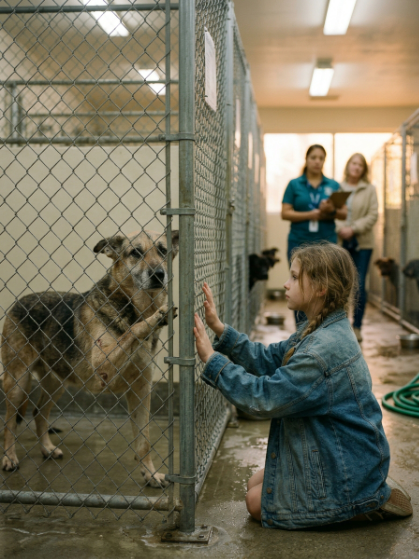
I watched Lacey’s face. I expected it to close. I’d seen it close on the drive over, when I’d said something too hopeful and she’d shut down like a store at night.
It didn’t close.
She looked at Scout, who hadn’t taken his gray head off her hand, and she said the thing that rearranged my whole life.
“Everybody’s a goodbye,” she said. “I’ve had seven goodbyes. At least he wants to be mine for his.”
I’m forty-nine years old. I have a steady job and a paid-off car and a list of perfectly sensible reasons I’d told myself I was “just looking.” A first-time foster placement should be easy, everyone said. Don’t start with a hard-to-place eleven-year-old and a dying dog. Start with easy.
Standing in that kennel run, I understood that I had been looking for easy my whole life, and easy had never once made me brave.
“We’ll take them both,” I said.
Marisol looked up. “Carol—the dog’s medical care, it’s going to be—”
“Both,” I said. “Today, if the paperwork lets us.”
Lacey turned around and stared at me like I’d spoken a language she didn’t believe existed.
“You don’t even know me,” she said. It wasn’t an argument. It was a test. Her eighth.
“No,” I said. “But I’d like to. And he’s not coming home without you, and you’re not coming home without him, so it seems like we’d better all go figure it out together.”
She didn’t hug me. Not that day. She wasn’t ready, and I didn’t push. But she let me sign the papers, and she held Scout’s leash on the way to the car like it was the rope keeping her from going over a cliff.
We had Scout for fourteen months.
The vet was wrong about the year, in the good direction.
They were the months Lacey needed and didn’t know how to ask for. A child who flinched at raised voices learned that in our house, nobody raised them. A child who hoarded food in her pillowcase the first week — I never said a word about it, just kept the pantry full until she stopped — learned that the food would still be there tomorrow. And every single night, that old shepherd climbed the stairs he wasn’t supposed to be able to climb and slept across her doorway like he’d appointed himself the guard of a kingdom he’d chosen.
He chose her. Out of a whole shelter of people walking past, on a body that was already failing him, he got up and chose the one kid the world kept handing back.
I think he knew what she was. I think dogs know.
When it was time — and you always know, with the goodbye dogs, they tell you — we were both with him on the kitchen floor, on his favorite blanket. Lacey held his gray head the same way she had at the kennel gate, fingers in his fur, and she told him he was a good boy and that he could rest now, that she’d be okay, that he’d taught her how.
He went easy. He’d done what he came to do.
We cried for a week. Then Lacey asked, very carefully, if “goodbye dogs” was a thing we could keep doing. If our house could be the place old dogs come to not be alone at the end.
So that’s what we are now.
We foster the seniors. The gray-muzzled ones nobody picks. The ones with a year or less. Lacey names every one and loves every one all the way to the door, and then we cry, and then we do it again, because she taught me that loving something all the way to the goodbye is not the sad version of love.
It’s the whole thing.
Her adoption — mine of her, I mean — finalized last spring. She picked the date. December 3rd, the day we met Scout at the kennel. She wears a little tag on a chain now, shaped like a dog bone, with his name on it.
She’s twelve now. She doesn’t flinch anymore.
“That one’s not going home with anyone,” the volunteer had said.
She was wrong about the dog.
She was wrong about the girl.
They both came home. They came home to each other, and they brought me with them.