Twenty Years Ago My Father Walked Out FULL STORY
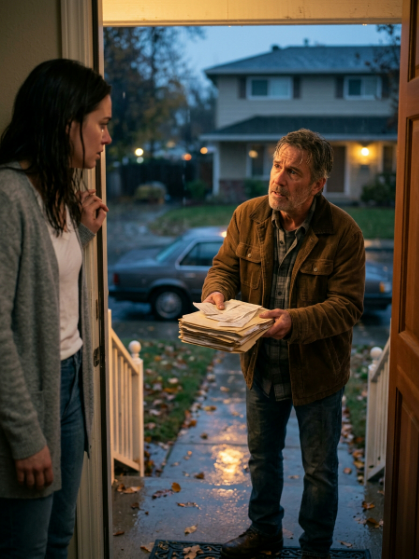
I didn’t take the folder right away.
I made him stand on the porch in the drizzle while I decided whether twenty years of certainty could survive one cardboard folder.
Then I stepped back and let him in. Not because I forgave him. Because the neighbors were starting to look.
He sat at my kitchen table the way a man sits in a church he doesn’t belong to. Careful. Hands folded. He didn’t touch the coffee I made out of habit.
He opened the folder and laid it out, piece by piece, like evidence.
Money order stubs. Hundreds of them. Bank carbons. Cashed checks, front and back, the endorsement signature on the reverse the same on every one.
My mother’s signature.
“I sent it to her account,” he said quietly. “Every month. First through a lawyer, then directly, because she said the lawyer fees were eating into what you got. I believed her. I believed everything she told me, for too long.”
I picked up a check from 2009. The year I’d worn shoes a size too small because Mom said we couldn’t afford new ones. The year she told me, crying at this very table, that my father didn’t send a dime, that we were on our own, that men like him forget you exist.
The check was for six hundred dollars. Cashed. Her signature on the back.
“Why?” My voice came out wrong. “Why would she lie about getting money?”
He was quiet for a long time.
“Because the money was never really what she wanted to keep from you,” he said. “She wanted to keep me from you. And as long as you believed I’d abandoned you, you’d never go looking.”
He told me the rest slowly, watching my face for the moment it became too much.
He hadn’t walked out. There’d been a bad year, a separation, things said on both sides he didn’t excuse. But he’d wanted joint custody. He’d shown up to the exchanges. And then one day my mother moved, and didn’t leave a forwarding address, and changed her number, and the next time he found us I was fourteen and she’d already told me he was dangerous, that there was a restraining order, that I should hang up if he ever called.
“There was a restraining order,” he admitted. “For eight months. Based on a complaint that was later dismissed. I have that too.” He touched a different folder. “I didn’t fight harder because every time I tried, you got hurt worse. She’d tell you I’d shown up to scare you. You’d cry. I decided — wrongly — that the kindest thing was to wait until you were grown and could hear it yourself.” He looked up. “That was the mistake. I should never have let you grow up thinking you weren’t wanted. There is no math where that was the right call. I’m not here to tell you I was right. I’m here to tell you that you were wanted. Every single day.”
I didn’t cry in front of him. I’m my mother’s daughter in at least that one way.
I waited until he left — and he did leave, when I asked him to, no argument, just a nod and a quiet “thank you for opening the door” — and then I sat on my kitchen floor and cried for the eleven-year-old who’d decided her own father didn’t love her.
I called my mother that week. I didn’t yell. I just asked her about the checks. The line went quiet, and then defensive, and then quiet again, and in that quiet I heard the confirmation I didn’t want.
“I did it to protect you,” she said finally. The same words he’d predicted she’d use.
“You did it to keep me angry at him so I’d stay close to you,” I said. “Those aren’t the same thing, Mom.”
We’re not estranged now, my mother and I. But something shifted that I can’t shift back. I see her clearly now, and clear sight has a cost.
My father and I are not a movie reunion. There’s no swelling music. Twenty years is twenty years, and you don’t get them back with one folder and one pot of coffee.
But he comes for dinner now, once a month. He’s teaching me to fix things around the house — he was always good with his hands, apparently, another thing I never got to know. Last week he fixed the porch light. The one he stood under in the rain.
The first time he came back, he stood on that porch holding twenty years of paper, asking only that I look at it once.
I’m glad I opened the door.
Not because everything is healed.
Because I finally know which parent was lying. And it wasn’t the one I’d spent my whole life blaming.