On the Night We Read My Father’s Will FULL STORY
Mr. Quinn turned the logbook to the final page and read the tally in the same flat, fair voice.
“Over the past six years,” he said, “the deceased recorded two hundred and ninety-one visits. Of those, two hundred and seventy-eight were made by his daughter, Grace Mallory.”
Trent laughed, an ugly disbelieving sound. “He was counting? That’s — that’s not normal, that’s manipulation, she manipulated a sick old man—”
“Eleven visits,” Mr. Quinn continued, “were made by his son, Trent. Nine of those occurred in December, in years when he stayed for a single meal. Two visits were made by his daughter, Sloane. Both within the last month of his life.”
Sloane’s sunglasses slid down off her head. She didn’t catch them.
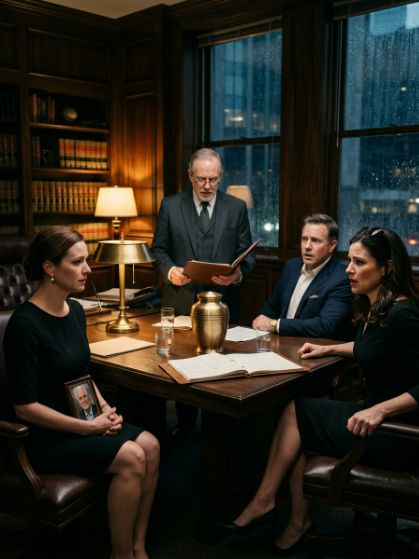
“Your father was very clear,” Mr. Quinn said. “He told me, and I quote from my notes, ‘I don’t want to punish anyone. I want the truth on paper. Let the math do what I couldn’t make myself say out loud.'”
He opened the brass urn’s accompanying paperwork.
“His ashes are to be divided in exact proportion to the visits logged. Grace receives the great majority, to be interred wherever she chooses. Trent and Sloane each receive a measured portion — a teaspoon, in his words — ‘so they have somewhere to put the father they were always too busy to come see.'”
The room was silent.
I should have felt vindicated. For six years I’d driven across town every Tuesday after work. I’d learned the names of all his nurses. I’d held the bowl when he was sick and read him the sports page when he couldn’t hold it himself. I’d done it because he was my dad, not because anyone was keeping score.
But he had been keeping score. Quietly. In a logbook by his bed.
“The estate follows the same principle,” Mr. Quinn said. “The house, the accounts, the investments — distributed in the same proportion as the visits. Grace is the primary beneficiary. Trent and Sloane each receive a nominal sum and a copy of the visitor log.”
Trent stood up so fast his chair scraped. “I’ll contest this. He wasn’t of sound mind. Counting visits like a — like a child keeping a chart—”
“He anticipated that,” Mr. Quinn said mildly. He slid a sealed envelope across the table to Trent. “He left each of you a letter. He asked that you read them before you decide whether to spend your inheritance fighting for more of it.”
Trent tore his open. I watched his eyes move down the page. I watched his jaw tighten, then loosen, then start to tremble.
He didn’t tell us what it said. He folded it back up with shaking hands and sat down and didn’t say another word about contesting anything.
Sloane read hers in the car afterward. She called me that night, crying, the first real conversation we’d had in years. She didn’t ask about money. She asked if Dad had talked about her at the end. If he’d been angry.
“He wasn’t angry,” I told her, honestly. “He was just waiting. Every Tuesday he asked if anyone else might come.”
She cried harder at that.
Here’s the thing the logbook couldn’t capture, the thing I didn’t understand until I’d had time to sit with all of it:
My father didn’t write down the visits to reward me. He wrote them down because, near the end, the days blurred together, and the visits were the only way he could still tell time. Tuesday meant Grace. Tuesday meant he wasn’t alone. The log was never a weapon. It was a calendar of the only thing he had left to look forward to.
I kept the largest share of the ashes. I had them placed in the garden of the house I now own — the house I grew up in, that I’ll probably move back into.
But I did one thing my father didn’t plan for.
I invited Trent and Sloane to the interment. All of us, together, in the garden, on a Tuesday.
They came. Of course they came. Now that there was nothing left to be too busy for.
We stood there, the three of us, and I let them help me place him in the ground.
The math had already been done. The estate was settled. There was nothing to win by including them.
I did it because somewhere in those two hundred and seventy-eight Tuesdays, sitting with a dying man who just wanted his children to walk through the door, I’d learned the one lesson my brother and sister were finally, too late, learning too.
You don’t get the time back.
You only get to decide what you do with what’s left.