Judge Nolan leaned forward and asked me to approach with the folder.
I left the folded flag on the table. It had already said the first thing that needed saying.
“Captain Daley,” the judge said, reading my rank off the DD-214 now in her hands. “These appear to be certified service records. The court will have them authenticated, but for the record — eight years, three deployments, an honorable discharge, and a Purple Heart citation dated six years ago.”
“Yes, Your Honor.”
Behind me, I heard my mother’s chair creak. I didn’t turn around.
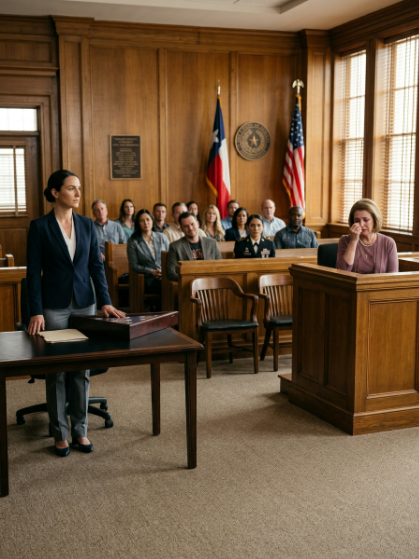
“Your mother has testified, under oath, that you fabricated your military service to claim your late father’s veterans’ trust.” The judge’s voice was even, but there was steel under it now. “Do you have any response?”
“Two, Your Honor,” I said. “Documentary and testimonial.”
I asked permission to call Sergeant First Class Lena Ortiz, who was already on her feet in the gallery in her dress blues. Lena hadn’t told me she was coming. She’d flown in from Fort Campbell on her own dime when she heard what my family was doing.
Lena was sworn in. She testified that she served beside me on two deployments. That she was three feet away the day the IED hit our convoy, that she helped pull me out, that the scar along my collarbone came from shrapnel that could just as easily have killed me. She testified that she’d visited my father in his last year, in this very county, and that he’d shown her my Purple Heart and wept telling her how proud he was.
The gallery had gone dead silent. The kind of silence that has weight.
My mother had stopped crying her dry tears. My brother Wade was studying the floor like it might offer him a way out.
Then the trust’s own attorney, a careful man named Okwu, stood and addressed the court. He’d done his due diligence. He produced the trust document my father had signed.
And he read the clause my mother had been praying didn’t exist.
My father, it turned out, had seen this coming. The trust didn’t just leave his veterans’ benefits and survivor assets to “his children.” It left them, specifically, to “any child of mine who has served honorably in the Armed Forces of the United States, as I did, and as my father did before me.” If no child qualified, the money went to a veterans’ charity.
Wade had never served. My mother had spent years telling the county I hadn’t either — because if she could erase my service on paper, the trust would fail, and as surviving spouse she’d inherit the residual.
The whole lawsuit wasn’t about whether I lied.
It was about making everyone else believe I had, so that the one thing my father left specifically for the daughter who followed him into uniform could be taken by the two who’d mocked her for it.
Judge Nolan set down the papers.
“Ms. Daley,” she said to my mother. “You testified under oath that your daughter never served. The court now has certified records, a decorated eyewitness, and the trust’s own counsel establishing the opposite. I’m referring the question of perjury to the district attorney’s office.”
My mother made a sound I’d never heard her make.
The judge ruled from the bench. The trust passed to me, the qualifying veteran, exactly as my father wrote it. My mother’s claim was dismissed. Wade’s smirk was long gone; he left before it was over.
I should have felt triumphant. Mostly I felt hollow, the way you do when you win a fight you wish you’d never had to have with people who were supposed to love you.
Outside the courthouse, Lena walked with me to my car.
“Your dad would’ve stood up in that gallery and saluted you,” she said.
“He’d have been embarrassed by the whole thing,” I said. “He hated a scene.”
“He’d have been proud.”
I opened the flag case in the passenger seat. Tucked into the back of it, where I’d kept it through the whole trial because I couldn’t bring myself to read it aloud in front of those people, was the letter the funeral director had handed me with the flag.
My father’s handwriting. Shaky at the end, but his.
“Ruthie — They’ll come for it. You know they will. Don’t argue with them. Just show them who you are and let the truth do the rest. I set it up so it can only go to a soldier, because I know my own children, and I know which one of you understood what the uniform costs. Wear it well. You always did. — Dad.”
He’d known. He’d known his wife and his son would try, and he’d quietly built the one wall they couldn’t climb. Not money. A standard. The same standard he’d lived by, and his father before him.
I drove to his grave that afternoon, in my blazer, with the flag on the seat beside me.
I didn’t say much. We were never a family of speeches, the two of us.
“They tried,” I told the stone. “It didn’t work. You made sure of that.”
The wind moved the flags along the row of veterans’ markers.
I sat with him until the sun got low. Then I set my hand on the cold granite, the way I’d set it on the flag in that courtroom, and I told him the only thing left to say.
“I showed them who I am, Dad. Just like you said.”
And for the first time since they handed me that folded triangle, it didn’t feel like a weight.
It felt like a hand on my shoulder.