By the time the sun was fully up, I had made my decision.
I’m going to tell you what it was, but first I have to tell you what nearly happened without me.
The screenshot of Kayla R.’s comment — Maybe if you’d been a better mother, he’d still be alive — moved faster than grief. Other bereaved parents in the online memorial group had seen it. Someone recognized her profile. Someone else found that her public page listed her job: patient-services representative at a regional children’s clinic two towns over, the very page that bragged about compassion and putting families first.
By 7 a.m., a parent I’d never met messaged me. She had the clinic’s front-desk email, the manager’s name, the whole thing ready to send. “Say the word,” she wrote. “We’ll make sure her boss sees exactly who she is.”
I understood the impulse completely. Part of me wanted it like I wanted air.
Daniel had been gone eight days. He died in a single-car accident on a wet road coming home from a friend’s house — no alcohol, no phone, just rain and bad luck and a curve he’d driven a hundred times. There was nothing I could have done. The state trooper told me that. The grief counselor told me that. I almost believed it.
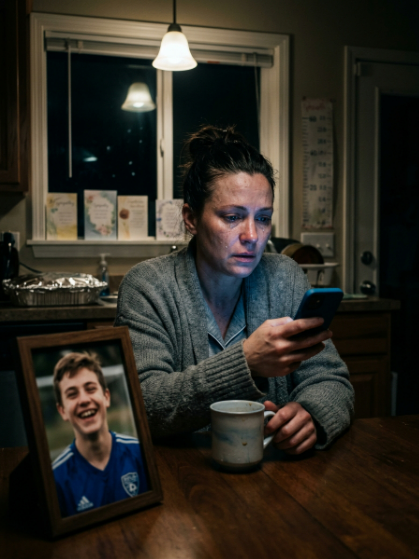
And then a stranger named Kayla typed the one sentence that says the thing I scream at myself at 3 a.m.
So no, I didn’t feel merciful. I felt like setting a fire.
But I kept thinking about the clinic.
About the sick kids who come through that lobby. About the terrified parents who sit in those chairs at the worst moment of their own lives and need the person at the desk to be kind to them.
If I got Kayla fired in a viral pile-on, I’d feel powerful for about an hour. And then I’d be a grieving mother who used her dead son to end a stranger’s livelihood. Daniel would have hated that. He was the kid who made the new students sit at our lunch table. He once gave his jacket to a boy who was getting teased for not having one. Using his memorial as a weapon would have been a betrayal of the exact thing I was mourning.
But doing nothing felt like letting cruelty win.
So I found a third road.
I didn’t send the screenshot to her employer. I asked the parent who had it ready to hold off, and she did.
Instead, I messaged Kayla directly. One message. No audience.
I told her who Daniel was. I attached a photo — the soccer one, the gap-toothed grin. I told her how he died, that there was nothing anyone could have done, that I already torture myself with the question she’d typed so casually. And I told her the truth: that a dozen people had her workplace ready to receive a screenshot, and that I had asked them to stop.
“I’m not going to send it,” I wrote. “Not because you don’t deserve consequences. Because my son was kind, and I’d rather honor him than punish you. But I need you to understand what your nine words did to a mother at 2 a.m. eight days after she buried her child.”
I didn’t expect a reply.
I got one an hour later. It was long, and it was a mess, and it was real.
She told me she’d lost a child too. Years ago. That she’d never grieved it right, that seeing memorial posts sent her somewhere ugly, that she typed the comment in a blackout of her own pain and went to bed and woke up sick about it. She said she’d already deleted it. She said she would never excuse it. She asked what Daniel’s name was so she could remember it.
I sat at the same kitchen table where I’d read her cruelty and I read her apology and I cried for a completely different reason.
Two broken mothers. One who said the unforgivable thing, one who chose not to make it the end of the story.
Here’s what I want to be clear about, because the internet loves a clean ending and this isn’t quite one.
I didn’t forgive her, exactly. Forgiveness is a longer road than one email. But I refused her the version of myself that would have ruined her, because that version wasn’t me — it was just my grief wearing my face.
The cruel comment never reached her boss. The pile-on never happened. The group, when I explained, mostly understood; a few were angry I’d let her “off.” I get that.
But Kayla now volunteers with a bereavement group in her town. She told me that, months later, in the last message we exchanged. She signs her name to it. She uses her real story now instead of hiding it and lashing out from the dark.
And every year, on Daniel’s birthday, a card arrives in my mailbox from two towns over. No long message. Just his name, in a stranger’s handwriting, and the words: Still remembered.
I keep them in the box with his things.
My son spent seventeen years making room at the table for people who didn’t have a seat.
The least I could do, in his name, was not slam one shut.