Once Walter was wrapped in my coat and the space blanket both, the words came easier to him.
“My buddy Ray told me to wait by the road,” he said. “Said somebody’d come. I waited a long time, son. So many cars. Then I got cold and Ray said go to the trees.”
There was no Ray. The deputies told me later Walter’s wife Ray had passed eleven years ago. He’d been walking toward a voice that wasn’t there for nine days, sleeping in barns and culverts, kept alive by a string of small mercies — a farmer’s open shed, a creek that hadn’t frozen, a stranger days back who’d given him that space blanket and then, like everyone, driven on.
The ambulance came. Then a sheriff’s truck, then another, then a search-and-rescue volunteer who got out of his car and just stood there staring, because they’d stopped looking for a living man.
“We called it two days ago,” he admitted to me, quiet, while they loaded Walter up. “Statistically, after that long, in that cold…” He couldn’t finish. “You stopped for a parked car.”
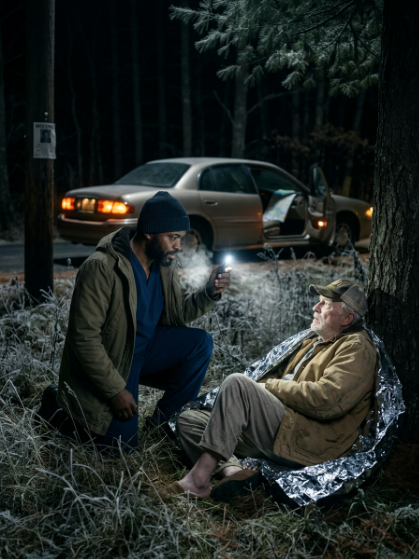
“Hazards were on,” I said, like that explained it. Like anybody else’s hazards hadn’t been on too.
He told me how it happened, the way these things happen. Walter had taken his daughter’s car keys off the hook nine days ago while she slept, certain he was late to pick Ray up from a shift at a mill that had closed in the nineties. He’d driven until the tank ran dry, coasted onto the County Road 12 shoulder, put on his hazards the way Ray had taught him sixty years before, and gone looking for her on foot.
The car had sat there nine days. People had reported it as abandoned. A tow had even been scheduled. Nobody connected a dead Buick on a dark road to a missing old man, because nobody looked twice. A parked car with its hazards on is the easiest thing in the world to drive past.
Walter Pruitt spent four days at the hospital where I work — I made sure of that — treated for exposure and dehydration and not much else. The man was eighty-one and tough as a fence post. His daughter Diane flew in from Phoenix. She’d been here the first week of the search and had gone home to plan a funeral she now got to cancel.
She found me in the break room at 3 a.m., still in my scrubs.
She didn’t say anything for a second. Then she just put her arms around me and held on, the way you hold onto something you’d already let yourself lose.
“Everybody drove past,” she said into my shoulder. “For nine days. Everybody. Why did you stop?”
I’ve been asked that a lot since. The local paper asked. A TV crew asked. Strangers online asked, mostly kindly, some of them clearly wondering what made me different.
I’m not different. That’s the thing I keep trying to say.
But I do have a reason. And I gave it to Diane that night because she’d earned it.
“When I was nine,” I told her, “back home, my mother’s car broke down on a road outside our town at night. She was pregnant with my sister. She stood by that car with her hazards on for three hours. Hundreds of cars. It was a busy road.” I had to stop a second. “Somebody finally stopped. A man on his way home from a night shift. He drove her to the hospital. My sister’s alive because one tired man didn’t tell himself somebody else would do it.”
Diane was crying again.
“I never even got his name,” I said. “My mother tried for years to find him. Couldn’t. So she told me the only way to pay a stranger back is to be one. I made her a promise when I was old enough to understand the story. I stop. Every time. Most of the time it’s nothing — a flat, a guy out of gas, somebody on the phone with a tow already coming. I’ve stopped for a hundred nothings.”
“And one Walter,” she said.
“And one Walter.”
He’s home now. With Diane, in Phoenix, where he can’t wander off into a Massachusetts winter. There’s a proper plan in place now — door alarms, a bracelet, an adult day program he actually likes because there’s a man there who used to work the mills and they talk for hours. She sends me a photo every few weeks. Walter in a sun hat. Walter with a slice of cake. Walter, alive, in the warm.
The county started a small thing after this, too. They call it a wellness flag now — an abandoned vehicle reported in the same spot more than twenty-four hours gets cross-checked against active missing-person reports. One clerk’s extra phone call. It already found a second person this spring, a diabetic woman whose car died on a back road. She made it. Because somebody looked twice at a parked car.
The VFW cap I found him in — the one half-knocked off his head under that oak — Diane mailed back to me in a box with a note.
“Dad wants you to have this. He says a man who comes when you call should get to keep the hat.”
I keep it on the dash of my car now.
So that every time I drive County Road 12 in the dark, and I see hazards blinking on the shoulder, and the tired voice in me says somebody else will stop —
I see that cap.
And I pull over.
Every time.