The first page was a directed-donor registration form.
Dated twenty-two years ago. My father’s name. Two recipients listed: Eli Karras. Priya Karras.
Us. Both of us. Since before I was old enough to remember his face.
“He registered the year he left,” Renata said quietly. “A directed living donor means he committed his organs, his marrow, his blood — specifically to you two, ahead of anyone else, for the rest of his life. He’s renewed it every year. He drove four hours each way to keep it current at our center because this is where your mother’s records were.”
I turned the page. Then another.
A bone-marrow donation. Sixteen years ago. Recipient: a pediatric patient, name redacted, but the date matched the worst winter of my childhood — the winter Priya was in the hospital for months and I was told a “donor program” had saved her.
That donor was him.
He’d been in the same building. And no one told me.
“Why,” I said. My voice didn’t sound like mine. “Why would he leave and then—”
“I can’t tell you why he left,” Renata said. “That’s not in here. But I can tell you he never stopped showing up for the parts you couldn’t see.”
I looked up at my father.
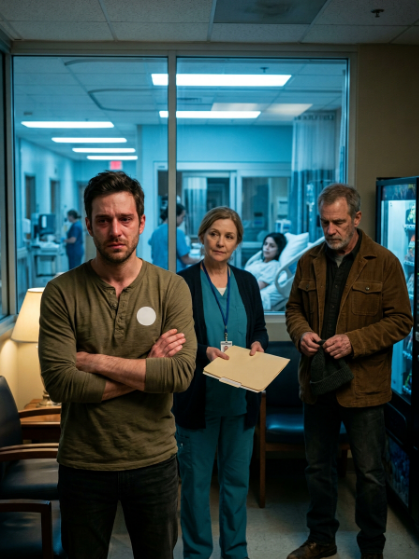
Marcus hadn’t moved. He stood by the vending machine, knit cap twisting, ready to be told to go.
I walked over with the folder shaking in my hand.
“You signed away contact,” I said. “There’s a clause. You agreed never to contact us. Who makes you agree to that?”
For the first time, something in his face cracked.
“Your grandfather,” he said. “Your mom’s father. After the business failed and I got us buried in debt, he offered to clear all of it. Save the house. Put you both through school. On one condition.” He swallowed. “That I disappear and never tell you why. He didn’t think I was good enough. Maybe he was right. But the offer saved your childhood, Eli. So I took it.”
“Mom said you abandoned us.”
“Your mother didn’t know either,” he said. “That was part of it. I let all of you hate me because the alternative was you losing everything. I figured one man’s reputation was a cheap price.”
I thought about the house we kept. The college neither of us could have afforded. The “scholarships” and “programs” and “anonymous help” that had threaded through our whole lives like a current I never questioned.
It had a name. It had a face. The face was standing in front of me, sixty-one and afraid.
“The registration,” I said. “Why keep that secret too?”
“Because if you found it, you’d find me,” he said simply. “And I wasn’t allowed to be found. But I wasn’t going to let some rule stop me from being a match if either of you ever needed one.” He looked toward the glass, at Priya. “She needs one now. I’m here. Test me. That’s all I came to do. You don’t have to forgive me to use my liver.”
They tested him that night.
He wasn’t a full match for a living liver donation — the years and his own health had seen to that. But his blood type and his registry status moved Priya’s case, and the advocacy of a coordinator who’d watched a man drive eight hours a year for two decades did the rest. A deceased-donor organ came through within the week. The doctors said the timing was luck.
I’ve stopped believing in luck.
Priya woke up four days after surgery. I was the one who told her. All of it — the debt, the grandfather, the clause, the marrow, the man in the corduroy jacket who’d been a ghost in our own success story.
She cried. Then she asked to see him.
He came in slow, that cap still in his hands.
“You gave me your bones when I was nine,” Priya whispered.
“I’d give you the rest,” he said. “Whatever’s left of me. It was always yours.”
I won’t pretend twenty-two years closed in one hospital room. They didn’t. There’s a lot I’m still angry about — not at him now, but at a proud old man who decided love was something you could buy and silence with the same check.
But I think about the math my father did when I was twelve and he was gone.
He could have stayed and let us drown. He chose to be hated and let us swim.
I used to call that abandonment.
Now I drive him to his registry renewal. Four hours each way. We don’t talk much. We don’t have to.
I just don’t let him make the drive alone anymore.