Richard’s smile froze. The charcoal suit suddenly looked two sizes too big. He gripped the edge of the mahogany podium. His knuckles turned white. The massive LED screen behind him pulsed with the blue layers of the stolen architecture. The complex routing nodes glowed in the dark auditorium.
“Security,” Richard said. His voice was tight. It cracked slightly on the second syllable. “We have a disruptor in the audience. Escort him out.”
Two men in dark blazers started moving down the center aisle. Their rubber soles squeaked against the carpet. They were big men, built like linebackers. They moved with a quiet, terrifying efficiency.
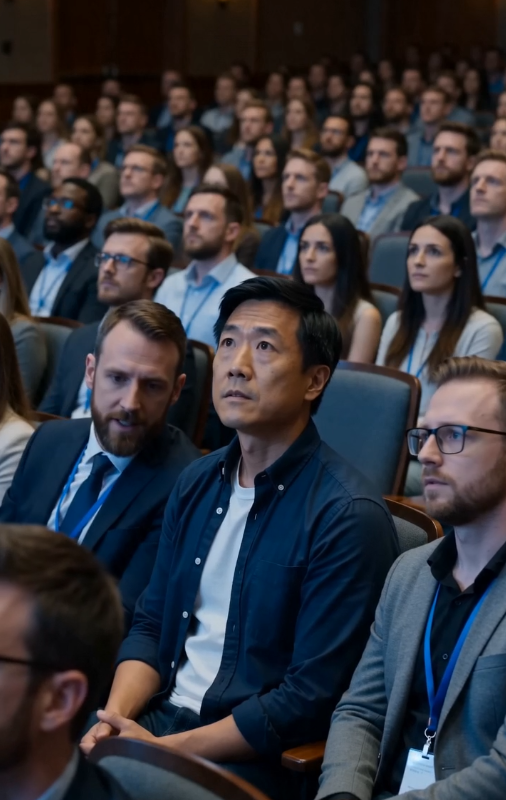
“I’m not a disruptor,” I said. I didn’t sit down. I stepped fully into the aisle. The harsh spotlight hit my blue shirt. It felt hot against my skin. “I’m the architect. And if you call security, I’ll trigger the kill switch right now. The entire demo will crash. The fifty million dollar valuation will drop to zero in three seconds.”
The investors in the front row stopped taking notes. A woman in a grey blazer lowered her phone. The man next to her, a lead partner from Sequoia, leaned forward. The silence in the auditorium wasn’t just quiet. It was heavy. It pressed against my eardrums, thick and suffocating.
Richard’s face flushed a deep, angry purple. The veins in his neck bulged against his crisp white collar. “You’re bluffing,” he sneered. He pointed a shaking finger at me. “You’re a junior dev. You were fired for incompetence. You don’t have root access to the mainframe.”
“I don’t need root access,” I said. My voice didn’t rise. It just filled the space, bouncing off the acoustic panels. “I built the physical routing layer. The one you copied from my private GitHub repo before you wiped my name from the commit history.”
I reached into the pocket of my jeans. The denim was rough against my fingertips. I pulled out a small, black hardware token. The metal caught the stage lights, gleaming like a tiny, bright star.
“This is the cryptographic key,” I said. I held it up. The audience leaned forward. “It’s hardwired into the Node 4 logic gate. The one you labeled ‘Ferry Center’ on the slide. You didn’t know why it was called that. It’s because my dad worked at the ferry terminal. It’s a backdoor I built to protect my work.”
Richard stepped back from the podium. He looked at the token, then at the screen, then at the investors. The arrogant energy that had fueled him for the last hour suddenly evaporated. He looked small. Defeated.
“Watch,” I said.
I pressed the single button on the token.
The LED screen flickered. The complex blue diagram froze. The hum of the cooling fans on the stage racks pitched up, whining like a jet engine. Then, the layers started to dissolve. The text scrambled into gibberish. The routing lines turned from blue to a harsh, flashing red.
A single line of code appeared in bright red across the center of the screen, fifty feet tall: PROPERTY OF DAVID LIN. UNAUTHORIZED ACCESS DETECTED. SYSTEM PURGING.
The auditorium erupted. The investors stood up. The woman in the grey blazer started clapping. Then the man next to her. Then the entire front row. The sound rolled up to the rafters, a deafening wave of applause. It vibrated through the floorboards and up my legs.
Richard didn’t fight. He didn’t scream. He just unclipped his lapel microphone and dropped it on the stage. It hit the wood with a loud, hollow thud. He walked off the side of the stage, his head down, disappearing into the shadows of the wings.
The two security guards stopped in the aisle. They looked at me, then at the empty stage. They didn’t know what to do.
The lead investor from Sequoia walked down the aisle. He stopped in front of me. He extended his hand.
“Mr. Lin,” he said. “We need to talk about funding your own company.”
I shook his hand. I slipped the black token back into my pocket. I walked down the aisle, the applause vibrating through the floorboards, and stepped out into the San Francisco afternoon. The fog was rolling over the hills, and the sun was just starting to break through.