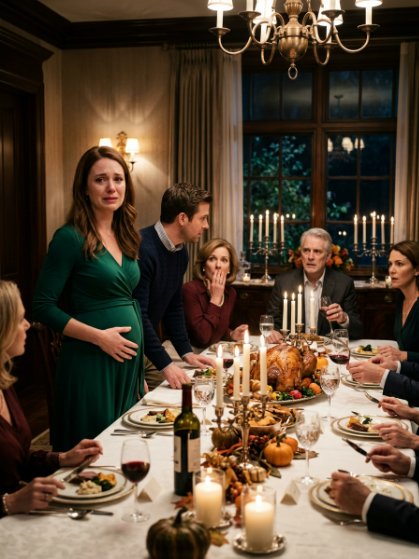
Gerald set his glass down with a click and tried to put his face back together.
“Well,” he said. “This is — wonderful news. A toast, everyone.”
Nobody lifted a glass. They were all watching him now, because they had all seen the color drain out of him, and a table full of Donnellys can smell blood in the water.
“Actually, Gerald,” I said, and my voice didn’t shake the way I’d been afraid it would, “before we toast — I think the family should hear what you’ve been planning for this baby. Since before there was a baby.”
Three weeks earlier, I had gone into Gerald’s study looking for a phone charger.
What I found instead was a folder he’d left out on the blotter, too sure of his own house to bother locking anything.
A draft amendment to the Donnelly family trust. Drawn up by his attorney. Quietly redirecting Will’s entire share to his sister’s son, Preston — on the grounds that Will’s marriage was “unlikely to produce a legitimate heir” and represented “a temporary lapse in judgment.”
Beneath it sat a report from a private investigator Gerald had hired to dig into me. Pages of it. My student loans. My mother’s old bankruptcy. A tidy list of every reason I was unsuitable to carry the Donnelly name.
And paper-clipped to the front, in Gerald’s own block handwriting, a note to his lawyer about timing the change “before any children complicate the trust.”
Because here is what Gerald knew, and what I’d had to learn on my own.
The trust was never his to rewrite. His own father had built it, and the founder’s version held a clause Gerald could not touch: a direct bloodline grandchild of the founder inherits ahead of any nephew, automatically.
A baby didn’t merely “complicate” his plan.
A baby ended it.
That is why my husband’s father went white at the sight of my hand resting on my belly. It wasn’t grief. It wasn’t even greed, exactly.
It was the clock. He had run out of time to disinherit his own son, and he could see in my face that I knew it.
I’d photographed every page that night and left the folder exactly as I found it. I hadn’t told Will. I’d wanted to be certain. And some small, hopeful, cowardly part of me had prayed I was wrong about his father.
Now, at the table, I slid my phone across the linen and let Will read it for himself.
I watched my husband’s face change in a way I will never forget. He looked at the screen. He looked down the table at his father. He looked at Preston, who had suddenly found his napkin fascinating.
“Dad,” Will said, very quietly. “You hired someone to investigate my wife. You were going to cut me out. And you were doing it while you sat at my table calling her ‘sweetheart.'”
Gerald reached for authority the way a falling man reaches for a railing. “Everything I have ever done has been to protect this family’s—”
“You did it to protect the money from your own son,” Will said. “Say the real word, Dad.”
Then Eleanor — Will’s mother, the woman who had spent two years politely freezing me out of every room — set down her fork. She looked at her husband for a long, cold moment.
“Gerald,” she said. “You did this behind my back, too.”
It came apart quickly after that, the way these things do once the man holding them together loses the room.
Eleanor, as it turned out, had her own standing in the family trust and her own firm opinion about a husband who would lie to her for a year. Preston and his branch left before dessert was served. Gerald spent the rest of that evening alone in the study he’d been too arrogant to lock.
Will and I drove home that night and sat in our own driveway for an hour, not talking, just breathing.
Our daughter was born in the spring. We named her after my mother — the one with the old bankruptcy in Gerald’s little file.
Gerald has met his granddaughter exactly twice, both times with Eleanor present, who runs the family now in everything but title. He is unfailingly, carefully polite to me these days.
He should be.
I am the mother of the only person who was ever going to inherit a thing from him.
He spent a year and a small fortune trying to prove I would never belong in his family.
He simply never counted on his family belonging to me.