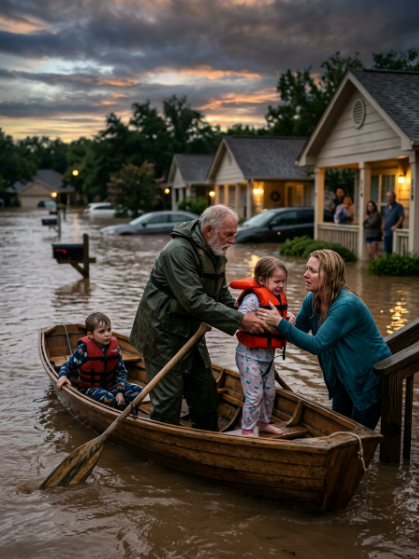
The morning after the water went down, our street looked like a battlefield. Furniture caught in tree branches. A sedan resting on somebody’s porch. The smell of river mud laid over everything we owned.
Hollis Webb was already out in it, dragging debris off the road, calm as ever.
I walked up to him with no idea what to say. “Thank you” felt like a teaspoon held up against the ocean.
“You saved my kids,” I managed. “You saved everyone on this street. And I tried to take your boat away nine times.”
He kept coiling a rope. “Ten. But who’s counting.”
Then he told me why he built it.
When Hollis was nine years old, a river took his family’s house in the middle of the night. His little brother, Danny, was seven. The two of them sat on the roof in the dark and waited for a boat. The boat came. It just came too late for Danny.
Hollis spent fifty years barely able to say his brother’s name out loud.
And he spent the last three of them building a boat in his driveway, by hand, one board at a time — because somewhere along the way he had promised himself that if the water ever came for his neighbors, there would be a boat. Ready. Waiting. So that nobody’s little brother would ever again sit on a roof watching the dark for help that didn’t arrive in time.
“She’ll float someday,” he kept telling me.
He didn’t mean someday she’d be finished.
He meant someday she’d be needed.
I had printed our bylaws. I had highlighted “unsightly stored equipment.” I had filed nine complaints against a grieving man’s promise to a dead seven-year-old boy.
I sat down on the wet curb and cried in a way I’m not proud of, and am not ashamed of either.
The story moved through the cul-de-sac fast. By the end of that week, the same neighbors who had signed my complaints were lined up in Hollis’s yard with sandpaper and varnish, fixing the scrapes the rescue had torn into the hull. People who’d never spoken in ten years of waving from cars were kneeling on a driveway together, sanding a boat.
The HOA — the same board I had weaponized against him — called an emergency meeting. I stood up at that meeting, because I was the one who’d started all of it, and I asked them to do two things.
One: strike every “eyesore” rule that could ever again stop a person from keeping a boat ready.
Two: read into the official record exactly what that boat had done in the flood, and exactly what I had spent a year trying to do to it.
They voted yes on both. Unanimous. Not one hand stayed down.
Somebody started calling it Danny’s Boat. The name stuck to it like paint. Hollis didn’t say much when he first heard it. He just had to stand there and look up at the sky for a minute, working his jaw.
My husband made it home two days later, once the roads opened. He stood in the middle of our wrecked living room and listened to our daughter tell him, in the breathless way six-year-olds tell things, how Mr. Hollis came through the dark in a boat and lifted her up over the water. My husband had read every one of my complaint emails. He’d helped me word a couple of them. He didn’t say anything for a long time. Then he walked straight across the street and shook Hollis’s hand for so long that both grown men finally gave up pretending they weren’t crying.
And the Castillos — the elderly couple at the end of the cul-de-sac — Hollis went back for them last, after the rest of us swore the current was too high to risk another trip. He went anyway. Mr. Castillo never learned to swim, and Mrs. Castillo wouldn’t leave without him, so a sixty-three-year-old man rowed into a black current one more time for two people who, like all the rest of us, had signed their names to a paper calling his life’s work an eyesore.
My kids are fine. My six-year-old tells everyone she meets that “Mr. Hollis is a real pirate.” My eight-year-old asked if he could learn to build a boat too someday. Hollis told him to come by on Saturday, and he meant it, and now there’s a boy on our street learning to measure twice and cut once from the best man I know.
There’s a new rule on Cypress Court now. Unwritten, but ironclad.
You don’t ask a man why he keeps something that looks like junk in his yard. You don’t know what it’s for. You don’t know who he’s keeping it ready for.
I filed nine complaints about an eyesore in my neighbor’s driveway.
It turned out to be the most beautiful thing anyone on our street has ever built — and the only reason I still get to tuck my children in at night.