“Nora,” I said. My own voice came out like a stranger’s. “It’s me. I’m here.”
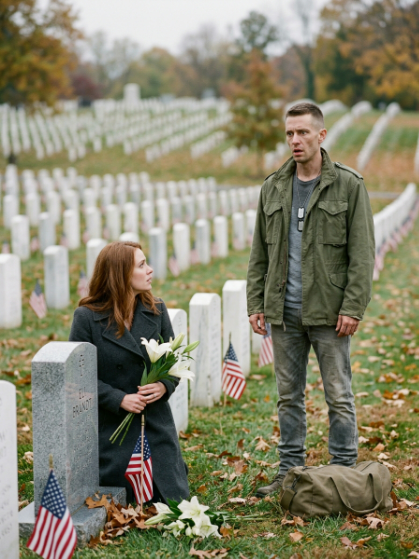
She didn’t run to me. That’s not how it happens when the dead come back. She rose to her feet slowly, one hand out like she was steadying herself against the air, and she touched my face — my jaw, the long scar the gauze used to cover — like she needed to be sure I had edges.
“They gave me a flag,” she whispered. “A folded flag and a closed casket, and they told me there were remains. I buried you, Eli. I stood on this exact spot and I buried you.”
“It wasn’t me,” I said. “It was never me.”
And then, from a stroller parked on the path behind her — one I hadn’t even seen — a small voice said, “Mama?”
Everything in me went still.
Nora turned and lifted out a little girl. Maybe a year and a half old, in a knit hat, clutching the folded blanket I’d spotted in the wet grass. The second, smaller bouquet had never been for me at all. It was the one my daughter liked to carry.
“Eli,” Nora said, and her voice broke clean in half. “This is Mae. I found out I was pregnant three weeks after your unit shipped out. She was born after they told me you were gone.”
A daughter. I had a daughter.
She had been visiting my grave her entire short life. Nora brought her every Sunday. My little girl had been raised on a photograph and a name cut into stone, taught to wave at the granite and say “hi, Daddy” — to a man who was, the whole time, alive in a hospital bed across an ocean, trying to remember his own name.
I went down on my knees in front of my own headstone and looked at this child who had her mother’s nose and, God help me, my mother’s eyes, and I couldn’t make a single sound.
Mae studied me with the frank suspicion of a toddler. Then she leaned out of Nora’s arms and laid her small hand flat on my chest, right over the dog tags.
“Daddy’s at the park,” she informed me, very seriously. A cemetery was the only place she had ever known her father to live.
“No, baby,” Nora said, laughing and sobbing at once. “Daddy’s right here. Daddy came home.”
I won’t lie to you and tell you it was a fairy tale after that. The easy version isn’t the true one.
Nora had spent two years learning to live without me. There had been grief counseling, and a support group, and a kind man from that group — a widower named Tom — who had started to matter to her. Nothing had happened that she needed to be ashamed of. But she’d been inching toward a life that didn’t have me in it, because the Army had handed her a flag and a casket and sworn that it couldn’t.
When I came back, she had to grieve a second time. Grieve the future she’d finally forced herself to imagine. It sounds impossible, that a man can return from the dead and still cost his wife something. But he can. I watched it cost her.
So we did the work. Months of it. We sat across from a counselor and said hard, true things out loud. Tom, to his great credit, stepped back like a gentleman and wished her peace.
And the Army? The Army had declared me dead on paper, which meant I spent the better part of a year proving I was alive to reclaim my own name, my own bank account, my own life. I had to sign a form swearing I was not deceased. I framed a copy of it. Gallows humor is the last weapon a soldier sets down.
We took the headstone down together.
Nora wanted to take a sledgehammer to it. I wanted to keep it. We compromised. It sits in our garage now — my name, and a date that turned out to be a lie — a reminder of exactly how close I came to losing all of this without ever once knowing it existed.
Mae calls me Daddy now without being reminded. It took a few weeks. The first time she did it on her own, unprompted, across a kitchen, I had to walk out of the room so she wouldn’t see her father fall apart.
I still go back to that cemetery once a month. Not for me anymore.
For Travis. My friend, the one who truly didn’t make it out of that convoy. I stand at his real grave and I tell him about my daughter, and about the wife who waited two years and then found it in her to wait a little longer, and about the strange, clerical mercy that sent the wrong man home in a box and let me walk out alive.
Some men come home to a parade.
I came home to a headstone with my own name on it, my wife on her knees in the leaves, and a little girl who was sure her daddy lived at the park.
I’ll take it. Every single day I have left, I’ll take it.