The first page in that folder wasn’t a will. It was a letter, in shaky blue ballpoint.
“Junie — if a man in a suit is reading you this, then I’ve gone and done the thing we all do eventually. Don’t cry in the cooler. I always knew about the cooler.”
I laughed and cried at the same time, right there in the booth.
Then the lawyer let me read the rest, and the floor of my whole understanding shifted.
Albert Hale was not a poor man.
He’d spent forty years as a tool-and-die machinist. Never married money, never spent a dollar he didn’t have to. He bought one small house in 1974 and paid it off. He drove the same sedan for twenty years. His wife, Marian, died young, and the two children they’d hoped for never came.
When Marian got sick, Albert learned something about people. The ones who assumed he had money were warm to him. The ones who assumed he had nothing looked straight through him, like he was a coat rack.
So after she passed, he ran a quiet experiment for the rest of his life. He dressed plain. He ate cheap. And he watched how strangers treated an old man they were sure had nothing left to give them.
Most people failed. The letter said it plainly. In all those years, only a handful ever passed.
I was one of them.
The half-meals weren’t poverty. They were a habit left over from the lean years nursing Marian, a habit he never shook — and, he admitted on the page, a test he never told me I was taking. He’d box up half his dinner and carry it out just to see whether anyone noticed, and whether noticing would turn into pity or into something better.
I’d done neither. I’d just quietly fed him more and pretended I hadn’t seen a thing.
“You never once made me feel like a charity case,” he wrote. “You made me feel like a regular. Do you know how long it had been since anybody made me feel like a regular?”
Then the lawyer turned the page, and turned my life over with it.
Albert left me his house. Paid off, clear, mine.
He left me an investment account he’d been quietly growing for thirty years — a number with enough zeros that I read it four times and still made the lawyer say it out loud.
And he left one more instruction, separate from the rest.
The Bluebird had been weeks from closing. Sal, the owner, was buried in debt and about to sell the lot to a developer who’d already drawn up plans for a parking structure. I hadn’t known. Albert knew. Albert noticed everything from that window booth.
He left a sum, in trust, to buy the diner outright and keep the lights on — on one condition.
That I be the one to run it.
“Feed the ones who look like they’ve got nothing,” the letter said. “Some of them are testing you, same as I was. Most of them are just hungry. Either way, you’ll know what to do. You always did.”
The lawyer said there was a second, smaller envelope too — one Albert had asked him to read to me alone.
It named the people who had failed him over the years. Not cruelly. Albert was never cruel. Just honestly. A former manager at the Bluebird, a man named Doyle, had once told Albert to “order more or move along, this isn’t a soup kitchen,” and walked him to the door by the elbow. Albert wrote the date down. Doyle had been fired years back for skimming the register, long before any of this. Albert only noted, in that dry way of his, that the world tends to balance its own books if a man is patient enough to wait.
And Sal — Sal cried when I told him the diner was saved. Big, ugly, relieved crying, right there by the grill, into a dish towel. He’d been carrying that debt alone for two years, too proud to tell any of us, smiling through it the same way Albert smiled through his boxed-up dinners. Two proud men, starving in their own separate ways, ten feet apart at the counter every afternoon, and neither one of them ever said a word to the other.
I think that, more than the money, was the thing Albert was really trying to teach me.
I own the Bluebird now.
There’s a booth by the window I don’t let anyone sit in unless they’re alone and the world’s clearly been hard on them lately. The meatloaf plate at that booth is always free. Nobody but me knows why, and that’s how Albert would have wanted it.
His flat cap hangs on a hook behind the register. I touch the brim some mornings before we unlock the doors.
The new girl — the one I used to hide from in the walk-in cooler — she’s a shift manager now. The first thing I taught her wasn’t the register, or the fryer, or the closing count.
It was how to notice people.
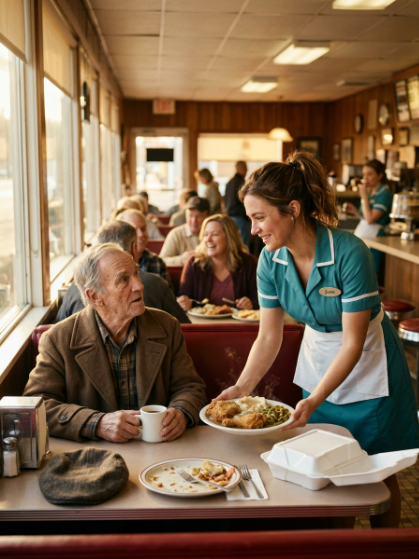
For eight years, folks walked into my diner and saw a tired waitress and a poor old man splitting a plate of meatloaf by the window.
What was actually happening at that table was the richest thing I will ever be part of.
He left me a fortune, in the end.
But the day I finally learned his name meant something, I already had the part that mattered.