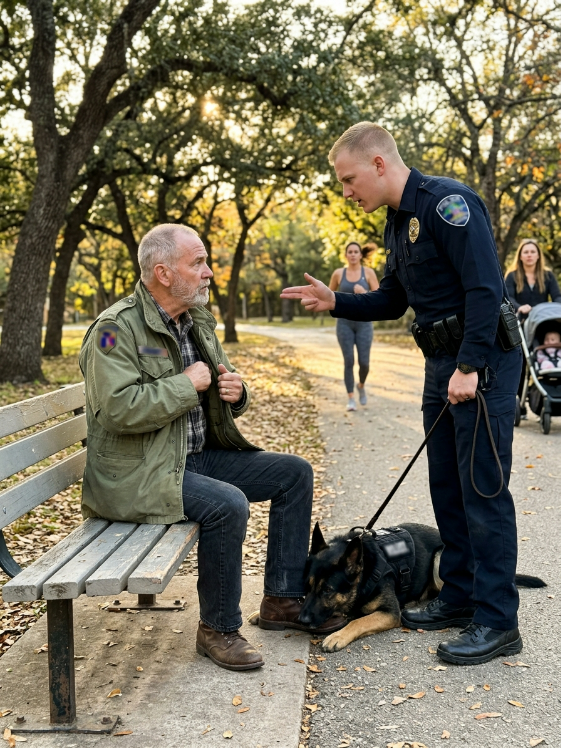
The first thing Officer Tyler Brooks noticed about the man on the bench was that he had already finished his sandwich. The sandwich paper was folded twice, very neatly, and tucked under his thigh so the wind wouldn’t take it. The second thing he noticed was that the man had not looked up when he said good afternoon — not because he was being rude, but because he was watching the K9 the way a man watches a horse he used to own.
“Sir,” Tyler said, friendly enough. “You can’t sleep on this bench. Park ordinance. Let’s go.”
The man on the bench — gray beard trimmed close, faded olive Army field jacket with a small subdued unit patch over the chest pocket, dark blue jeans, brown work boots scuffed at the toe — said, “I’m not sleeping. I’m finishing my coffee.”
There was no coffee. Tyler started to say so. He did not get to.
Ranger, his K9 partner, broke heel.
It happened in one motion. The dog, who had been pacing at Tyler’s left side for the last half hour the way he had paced for three thousand walks before, took two careful steps forward, stopped, smelled the man’s right boot, and lay down. Not next to the boot. Pressed against it. Head down on his paws. Ears forward but not alert. Like a dog who has come home.
Tyler tugged the leash. Ranger did not move.
Tyler tugged it again, harder. Ranger turned his head an eighth of an inch and looked at Tyler the way a teacher looks at a student who has not done the reading.
The whole park, in the slow Austin October afternoon — the jogger paused mid-step on the path, the woman with the stroller stopped, the two retirees on the next bench frozen with their newspapers open — watched.
Tyler keyed his shoulder mic. “Dispatch, this is Brooks. I have a — a situation. Park bench, north side, fifth and Lamar.”
“Go ahead, Brooks.”
The right words were: my dog won’t come to me. Which sounded, even in his own head, like something you don’t put on the radio.
“Stand by,” he said.
The man on the bench had still not moved. His left hand was loose on his knee. His right hand was sliding, very slowly, into the inside pocket of his field jacket. Tyler’s free hand went to his belt — that small reflex motion you make when your training tells you to be ready and your gut is telling you something else entirely.
The man’s right hand came out of his pocket holding a leather case. A small one, the size of a deck of cards, worn at the corners. He did not open it. He set it on his thigh, on top of the folded sandwich paper, and put his hand back on his knee.
“You don’t have to call your sergeant,” the man said. He had a Texas voice. Soft, slow, no hurry in it. “He’s coming. He saw your truck.”
Tyler turned. There it was — the K9 unit supervisor’s truck in the lot. Sergeant Ray Velasquez was already out of it, in plain clothes, walking very fast. Velasquez was a man who, in eighteen years on the job, had never moved fast unless someone was bleeding.
He was walking very fast now.
Ranger, against Tyler’s right boot, did not look at Velasquez. Ranger had not moved his head at all in three minutes. He was breathing slow and even, the way he breathed in his crate at home, as if he had simply decided that this — the boot, the bench, the man — was where he was going to be.
Velasquez stopped four feet from the bench. He did not look at Tyler. He looked at the man on the bench. He looked at the dog at the man’s boot. He looked back at the man.
“Master Sergeant Donnelly,” Velasquez said, very quietly.
The man on the bench — Frank Donnelly, sixty-eight years old — looked up for the first time. His eyes were a cold pale gray. He did not smile. He did not stand.
“Velasquez,” Frank said. “You got fat.”
“Yes sir,” Velasquez said. “I did.”
Velasquez came to attention. Right there on the path, next to a public park bench in Austin Texas in the slanting October light. Heels together. Spine straight. He turned his head ten degrees toward Tyler.
“Brooks,” he said. “This is Master Sergeant Frank Donnelly, US Army, retired. He certified Ranger’s grandfather, his father, and Ranger himself. He ran the K9 program at Lackland from ninety-six to two thousand eight. Every dog in our unit traces its training lineage to him. He is the reason Ranger comes home alive every shift. He is the reason you will.”
Tyler’s hand, which had been hovering at his belt, fell to his side.
“He doesn’t have a residence,” Velasquez continued. “We have known about it for eleven months. Our department was working on getting him into transitional housing. We did not know he was coming to this park.”
Frank Donnelly opened the leather case on his thigh. Inside: military ID, expired by twenty years but valid the way old IDs are valid for the men who carried them. A unit patch. A 2003 photograph of a younger Frank kneeling on a desert ramp next to a black-and-tan shepherd with a vest. The shepherd in the photograph had the same head shape as the dog at his boot.
“His name was Bandit,” Frank said, to no one in particular. “He pulled four men out of a culvert in Mosul in October two thousand four. He came home with me. He died in two thousand twelve in my kitchen with his head in my lap.” He looked at Ranger. “This is his great-grandson. I knew it the second I smelled him.”
Ranger, very slightly, leaned harder against Frank’s boot.
Velasquez crouched. He did not crowd Frank. He crouched the way you crouch beside an old horse.
“Master Sergeant,” he said. “I’m going to ask you to come with me to the precinct. I’m not arresting you. I’m asking. We have a couch in the K9 office. We have a shower. The transitional housing slot is open. Has been open for two months. We just couldn’t find you.”
Frank looked at him for a long time.
“My wife threw me out in two thousand seven,” Frank said. “I don’t blame her. The dog they assigned me after Bandit was named Casey. I lost her in two thousand nine. I wasn’t fit for it anymore. I have not slept in a bed since two thousand fourteen. I don’t know if I can sleep in one now.”
“You can have a cot, sir,” Velasquez said. “We will get you a cot.”
Frank nodded, once.
He looked down at Ranger, who had not moved since he had lain down. He put his hand, very gently, on Ranger’s head.
“Up, son,” he said.
Ranger stood. He shook himself once, the long full body shake of a working dog releasing tension. He looked at Tyler. He looked at Velasquez. He looked at Frank. Then he sat at Frank’s left side, on Frank’s heel, the way a service dog sits at heel — perfect form, head up, eyes forward.
“He hasn’t forgotten anything,” Frank said.
“No sir,” Velasquez said. “His blood didn’t.”
Tyler, who had said nothing for ninety seconds, said, “Sir, can I help you with anything?”
Frank looked at him. The cold gray eyes thawed by an inch.
“You can carry the sandwich paper,” Frank said. “I don’t litter.”
That was the November of the year the Austin K9 unit, on Sergeant Velasquez’s quiet recommendation, named the new training kennel after Master Sergeant Frank Donnelly. Frank cut the ribbon himself, in a clean dress shirt, hair and beard trimmed, a navy field cap with a small subdued unit patch on the front. Ranger was at his heel. Ranger would be at his heel for the next four years until he retired into Frank’s small cottage two blocks from the precinct, and for another two years after that, until he died of old age in Frank’s kitchen with his head in Frank’s lap.
Officer Tyler Brooks was at the ribbon cutting too. He brought a folded sandwich paper in his coat pocket — the one Frank had left on the bench that October afternoon — flattened, sealed in a small plastic sleeve. He gave it to Frank without saying anything. Frank tucked it into the inside pocket of his field jacket, against his chest, where his hand had reached the day his second life began.
He did not say thank you. He did not need to. Ranger leaned, very lightly, against the boot of the man who had finally come home.