The letter was from the union benefits office, and it was dated nine years ago.
I read it four times on the floor of that bedroom before the words would hold still.
It said my father was a confirmed member of a class — men who’d worked the coke ovens and the open hearth in the years when nobody told them what they were breathing. It said a trust had been established. It said Frank Delaney was entitled to file a claim, and that based on his work history and his diagnosis, the estimated award was a number with five digits in front of the decimal.
He never opened it. He never filed. He carried it in his coat for nine years and let it go yellow in the dark.
I know exactly why. I can hear him.
Don’t trust anything that comes free. Don’t go begging. Don’t be a burden.
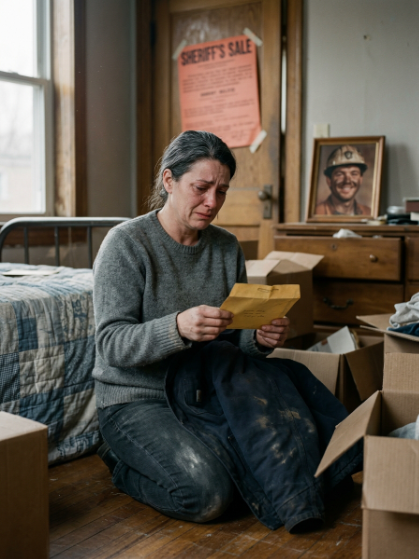
So instead he rationed his heat. He skipped the cardiologist. He waved me off every time I begged him to see somebody, and he told me he was fine, and he died in March believing the only thing he was leaving his daughter was a house the bank was about to take.
I had five days.
I didn’t sleep that night. At eight the next morning I was outside a legal aid office in Pittsburgh with the letter in a sandwich bag like it was evidence, which it was.
The lawyer’s name was Ms. Okonkwo. She read it, and then she read it again, and then she got very quiet and asked me to sit down.
“Mrs. Buchanan,” she said. “This trust is still active. Your father’s claim died with him unfiled, but the estate’s right to it didn’t. There’s a probate path. It’s tight, but it’s real.”
“I have four days until they sell his house,” I said.
She picked up her phone.
I will spare you the part with the courthouse and the recorder of deeds and the three different offices and the woman who told me it couldn’t be expedited and the second woman, an hour later, who decided that it could. I will spare you the call to the mortgage company, and the fax — an actual fax, in this century — and the hold music I will hear in my nightmares.
Here’s what matters.
On the fourth day, with eighteen hours on the clock, a judge signed an order pausing the sheriff’s sale pending the estate’s claim against the trust.
The house did not sell on the courthouse steps.
The claim took another seven months to pay out. When it did, it was more than the letter estimated. Enough to clear the mortgage in full. Enough to clear the medical bills he’d hidden from me in a shoebox. Enough, with what was left, to put a new roof on the house he was so sure he’d failed to keep.
I should be able to tell you this is a happy ending. In the ledger, it is. The house is saved. The debt is gone. My kids have their grandfather’s home to come back to.
But I can’t stop doing the other math.
If he’d opened one envelope nine years ago, he’d have had money for the doctor. He’d have had the surgery he told me we couldn’t afford. He might have had years.
He died poor in a house full of a fortune he refused to believe was his, because somewhere along the line this country taught a generation of working men that needing help was the same as failing.
It wasn’t a fortune that was missing from my father’s life.
It was permission.
I framed his mill photo and hung it in the front hall of the house his pride almost lost and his pride almost saved. Hard hat. Soot on his face. That tired, stubborn, proud smile.
I had the union letter framed too, and I hung it right next to him, unfolded now, flat, where the light can reach it. Where it can’t hide in a coat pocket anymore.
I do one more thing.
Whenever I meet an old man who waves off a doctor, or a young one too proud to file for the help he’s earned, I tell them about my father.
I tell them about the coat.
I tell them that the bravest thing a working man ever did for me was nothing I could put on a headstone — it was a candy hidden in a pocket for a little girl, and the cruelest thing the world ever taught him was that the same hands weren’t allowed to reach out for himself.
Open the envelope, I tell them. Whatever it is. Open it.
My father waited nine years and ran out of time with the answer in his pocket the whole while.
Don’t make his daughter tell your daughter the same story.