The first page was the one I’d thrown away at eighteen. He’d kept a copy.
“I’m taking my shot, Caleb. You’ll land on your feet. You always do.”
For twenty years that was the whole letter to me. Six lines of a brother choosing himself.
But there was a second page. There had always been a second page. I’d crumpled the note that night before I ever turned it over.
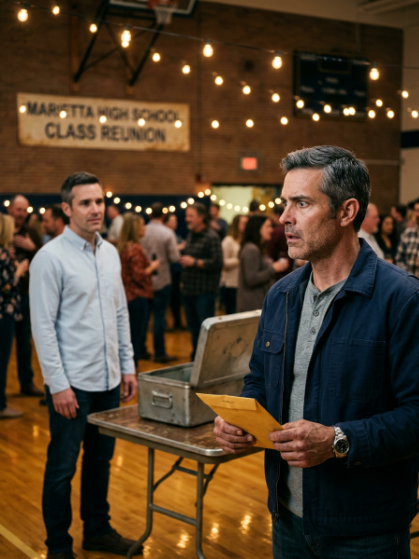
I stood in the middle of that gym with the string lights swimming and I read what my brother actually wrote.
“By the time you read the rest of this, I’ll be gone, and I need you to not come looking, because you’d talk me out of it and I can’t be talked out of it.
There’s only enough in Dad’s fund for one of us. We both know it. You’ve wanted to be an engineer since you were nine. I’ve wanted to get out of this town since I was twelve, and the Army will pay me to do it.
So I’m enlisting. Don’t be a hero about it. Take the fund. Go to State. Build the bridges.
I’ll send money home for the garage when I can. Don’t ask where it comes from and don’t try to pay it back. If I make it about money, you’ll fight me, and I’m too tired to fight you tonight.
Tell Dad’s old customers we’re keeping the place open. We are. I’ll make sure of it.
I’m not leaving because I’m better than this town, Caleb. I’m leaving so you don’t have to. That’s the only way I know how to be your brother right now.
— O.”
I have not been able to breathe right since.
Because here is what I did with those twenty years.
I took the fund. I told myself I’d “had no choice” because my deadbeat brother ran off. I went to State. I became an engineer for exactly two years before Dad’s garage started sinking and I came home to save it, furious the whole time that Owen never sent a dime.
Except.
Three times in twenty years, when the garage was weeks from closing, an envelope showed up. Cash. No name. Once a cashier’s check from a bank two states away. I told everyone it was “a loyal customer.” I told myself it was luck.
It was him. It was always him. Deployment pay and combat pay and the careful savings of a man eating in mess halls so his brother could keep their father’s name on a sign in Marietta, Ohio.
I looked up from the letter and Owen was still standing across the gym floor. Older. Leaner. Watching me with our father’s eyes, waiting to see if twenty years of my silence was about to get longer.
I walked across that floor. My legs didn’t feel like mine.
“You let me hate you,” I said. My voice cracked in half. “You let me hate you for twenty years.”
“It was easier,” he said quietly. “If you knew, you’d have given the fund back. You’d have followed me to a recruiter. I needed one of us to get the life Dad wanted for us. I picked you.”
“The envelopes—”
“I didn’t want you to know that either.” He almost smiled. “You’re a stubborn man, Caleb. You’d have mailed it all back.”
“I would have.”
“I know. That’s why.”
I grabbed my brother in the middle of a high-school reunion and I held onto him like the floor was tilting, and we were both forty kinds of a mess, two grown men with the same face crying under a banner.
He’d served twenty years. He had a bad knee and a quiet way of going still at loud noises and a wall of nobody, because he’d spent his youth funding a life he wasn’t living.
I’d had the wife, the kids, the house, the degree — built on a sacrifice I spent two decades resenting the man who made it.
We have a lot of years we can’t get back. I won’t pretend otherwise. You can’t un-live being a stranger to your own twin.
But Owen’s home now. He works the front desk at the garage three days a week — our dad’s garage, the one his money kept alive — and the regulars can’t tell us apart, which he thinks is the funniest thing in the world.
I gave him our father’s watch. He tried to refuse it. I told him he’d been the one keeping Dad’s promise the whole time; he’d earned the right to keep Dad’s time.
My kids call him Uncle O. My youngest can’t tell which of us is which in the old photos either.
I keep both pages of the letter in a frame on the wall of the garage office now. The crumpled one and the one I never read.
People ask why I’d frame a thing that cost me twenty years.
I tell them it didn’t cost me twenty years.
My pride did that. The letter’s the thing that gave me back my brother.
I just had to be willing, finally, to turn the page over.