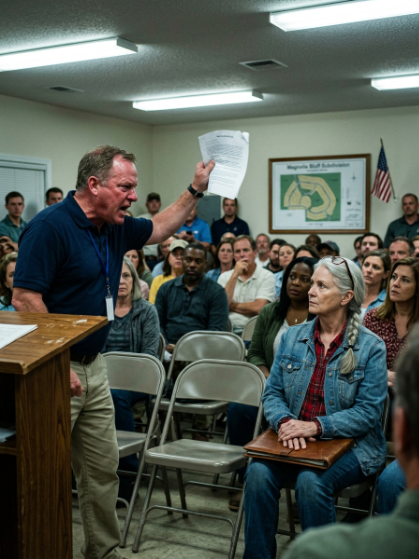
Gerald let me have the floor because he thought he was being magnanimous in front of his audience. A king lets the peasant speak so everyone can watch her lose.
I stood up slowly. My knees aren’t what they were.
“Before you spend two thousand dollars a house suing me,” I said, “I want to make sure everyone here understands what you’d be suing me over. So let’s talk about that road out front.”
I opened Walt’s leather folder.
“My husband built the first homes on this street in 1974,” I said. “He sold the lots one at a time. But he kept two things in his own name, recorded down at the county, and they passed to me when he died.”
I held up the first page. Not so anyone could read it — just so they could see it was real.
“The first is the strip of land the entrance road sits on. The road every single one of you drives in and out on. It’s not county-maintained. It’s not HOA property. It’s mine. You’ve all been crossing it for years under a handshake easement my husband never bothered to formalize, because Walt was neighborly and Gerald here hadn’t been invented yet.”
The room had gone very still.
“The second,” I said, “is the easement for the well line. The main that feeds water to every tap in this subdivision runs under my back acreage. Also mine.”
Gerald’s face did something complicated.
“That’s— that’s not— you can’t just—” he sputtered.
“I had the county surveyor out last month,” I said. “Funny timing, I know. He’ll confirm every word. So will the register of deeds. I brought their letters.”
I set them on the folding table.
“So here’s where we are,” I said, and I kept my voice as gentle as I could, because most of the people in that room had never done a thing to me. “If this association sues me — if you make me an enemy instead of a neighbor — I will have every legal right to close that handshake easement. No more road across my land. No more water main under it. You’d be looking at private engineering, new utility access, easement litigation that makes two thousand dollars a household look like a parking ticket. For years.”
You could have heard a pin drop.
“Or,” I said, “we can all go home, and Gerald can stop taping notices to my door over my bees, and we can go back to being a street.”
I sat down.
The meeting did not go the way Gerald planned.
A man named Phillips, three houses down, stood up and asked the question I’d been waiting for: “Gerald — did you know about any of this before you put us all on the hook for a lawsuit?”
Gerald hadn’t. He’d never read the original plat. He’d never read much of anything; he just liked the word “bylaws” in his mouth.
A woman in the back asked how many of his fines against me had ever actually been valid. Turned out, when people started checking, that almost none of them were. He’d been making half of it up, banking on the fact that nobody fights an HOA.
The special assessment died that night, sixty-something to four.
Within two months there was a recall petition. It reached quorum faster than anything in the subdivision’s history. Gerald Pruitt is no longer the HOA president. He’s just a man on a cul-de-sac who has to wave at me when he gets his mail, which he does, stiffly, every single day.
Here’s the part that surprised people.
I didn’t close the easement. I never wanted to. I’m sixty-three and I like my neighbors; I just didn’t like being bullied.
Instead I had Walt’s lawyer draw it up properly, at last. I granted the subdivision a permanent, recorded easement for the road and the water line — for one dollar — with a single condition written into it.
The condition is that the association can never again levy a special assessment to sue a homeowner without a two-thirds vote of every household, in person, by secret ballot.
I made it so the next Gerald can’t do to anyone what this one tried to do to me.
The new board president is the man named Phillips. He came by with a pie to thank me. We sat on my porch and watched my bees work the clover, and he admitted he’d voted for two of Gerald’s fines against me back in the day, and he was sorry.
I told him the truth.
I wasn’t angry at the fines. People do what the loud man tells them when they’re afraid he’ll come for them next. I’ve watched it my whole life.
I was angry that not one of them ever asked me my side before they turned around in their chairs to look at me like a thief.
That’s the thing about a quiet old widow at the end of the street.
Everybody assumes she’s got nothing.
My Walt spent his whole life making sure that the day somebody tried to prove it, I’d be holding the one piece of paper that mattered.
I keep his folder on the shelf by the door now. Right where I can reach it.
I haven’t needed it since. That’s rather the point of letting them all know it’s there.