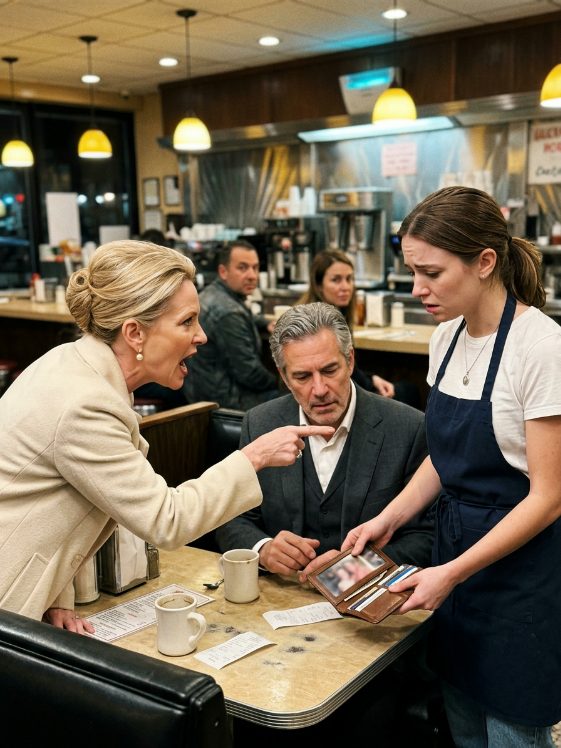
The wallet had been on the floor of booth six since 12:47 a.m. Mia Carter saw it when she crouched to wipe up a spilled cup of coffee. She picked it up, slid it into her apron pocket, and finished the table. She didn’t open it. That wasn’t the kind of thing she did.
By the time the man’s wife stopped her — pearl earrings, blond chignon, cream cashmere coat that had no business in a Brooklyn diner at one in the morning — Mia had already decided she would walk it over to the host stand and wait for someone to claim it.
“You picked something up,” the wife said. It was not a question.
“Your husband’s wallet, ma’am. I was going to —”
“Open it,” the wife said. “Right here. So we can see.”
Mia opened it. The man — gray hair going silver at the temples, charcoal three-piece suit with no tie — was already half-turned in the booth, a tired apology forming on his face. His wife didn’t see it. His wife was already counting hundreds out loud, like a teacher checking homework, voice climbing. The two patrons in the next booth turned their heads. Robert Hale, the husband, said quietly, “Vivian,” and his wife did not stop counting.
It was while Mia held the open wallet at her hip, eyes politely on the chrome counter, that she saw the photograph.
It was tucked behind the credit cards, in the worn slot people use for receipts they cannot throw away. A 2001 print, edges soft from being slid in and out for twenty-four years. A young woman in a hospital gown holding a baby wrapped in a thin pink blanket. Around the baby’s throat, on a thin silver chain, was a locket Mia had been wearing every single day of her life.
She did not gasp. She did not say anything. She kept her hand still around the wallet because she was twenty-four years old and she had learned, at fifteen, that adults make worse decisions when you give them a reason to.
“You’re missing forty,” Vivian said. “There were nine hundred. There are eight-sixty.”
“Vivian, please,” Robert said. He was watching Mia now. The way Mia’s hand had gone still around the wallet. The way she was looking at one specific spot inside it, not the cash.
“She had it for ten minutes alone,” Vivian said. “Ten minutes, Robert. In her apron.” She turned to Mia. “Empty your apron.”
The diner had gone very quiet. The cook at the line had put down his spatula. Dawn, the waitress who had hired Mia ten months ago on a Sunday with nothing on her résumé but a high school diploma and a steady look in her eye, was standing by the coffee machine with both hands flat on the counter.
Mia did not empty her apron. She did, slowly, set the wallet down on the Formica between Robert and Vivian, photo-side angled toward Robert. Then she reached up to her collarbone and lifted the silver locket out from under the navy diner-apron strap.
“Ma’am,” she said, very evenly. “I didn’t take anything. But you should look at the photograph in your husband’s wallet. Behind the cards.”
Robert was already looking at it. His mouth had gone slack.
He lifted the photograph out of the wallet. He held it up under the warm yellow pendant light. He looked at the photograph. He looked at the locket against Mia’s white tee. He looked at the photograph again.
He said, carefully, like a man speaking through a dream, “What’s your name, please?”
“Mia Carter.”
“And your birthday.”
“March third, two thousand and one.”
Robert’s hand closed slowly around the edge of the booth table. Vivian stopped counting cash mid-bill. The whole diner was watching now.
“Carter is your adoptive name,” Robert said.
“Yes.”
“Where were you born.”
“Mount Sinai. Manhattan.”
“Three twenty-two a.m.”
“Yes.”
Vivian put the cash down on the table. She looked at Mia. She looked at the photograph, finally, the way she should have looked the moment she saw her husband’s face shift. Her mouth opened and nothing came out of it.
Robert reached into his inside breast pocket and drew out a thin leather folio. From it he took a second photograph — older, more worn — of the same young woman in the same hospital gown holding the same baby in the same blanket. He laid it next to the first.
“This is my sister,” Robert said, to the whole booth, to Mia, to no one. “Eleanor. She had a baby on March third, two thousand and one, at Mount Sinai. The locket was her grandmother’s. We have been looking for the baby for twenty-four years.”
Mia did not sit down. She did not cry. She just said, very quietly, “She didn’t keep me.”
Robert shook his head. “She couldn’t. She was nineteen. Our father —” He stopped. His hand was shaking. “She wrote to you every birthday. The letters were never delivered. The agency was —” He stopped again. He looked at the locket on Mia’s neck. “She wore that locket from the day she was born until the day she gave you to them. She told them to put it on you the second they handed you off.”
Vivian stood up. She did not know what to do with her hands. The cash was still on the table. Eight-sixty. Forty short. The forty had been in Robert’s coat pocket the entire time, where he had moved it after dinner so the valet wouldn’t take it. Vivian had not thought to ask him.
“I’m so sorry,” Vivian said, to Mia. “I’m —”
“Sit down, Vivian,” Robert said. He was crying now, quietly, the way men of his generation cry: the eyes going wet, the mouth not moving. He looked at Mia. “Eleanor died of a brain aneurysm in 2014. She was thirty-two. The last thing she said to me, in the hospital, was your birthday. Just the date. March third, two thousand and one. She made me write it down. She made me promise.”
He held out the photograph. He did not push it across the table. He just held it out. Mia took it. She held it next to her own face for a moment, instinctively, the way you check a passport photo. The eyes matched. The mouth matched. The line of the jaw matched.
“She named you Margaret,” Robert said. “After our mother. We had a room ready in the house. A crib. A blanket she knit herself. The agency wouldn’t tell us anything. They said it was sealed.”
Mia sat down. She had to. Her legs decided it before she did. She sat across from Robert, in Vivian’s spot, and Vivian very quietly moved over to the empty chair at the end of the booth and let her have it.
“I have a locket,” Mia said. “My adoptive mother gave it to me when I was eleven. She said it came in the envelope. She said it was the only thing in the envelope.”
“That was Eleanor’s,” Robert said. “She wore it from the day she was born.”
Mia opened the locket. Inside, on the left side, was a photograph the size of a fingernail — a young woman she had stared at for thirteen years without knowing the woman’s name. On the right side was a single date scratched into the metal in a young woman’s handwriting: 3/3/01.
Robert reached across the table. He did not touch her. He just put his hand flat on the Formica, palm up, halfway between them. He waited.
After a long time, Mia put her hand on his.
Three weeks later, Mia gave her notice at the diner. Dawn hugged her at the door and told her she had always been too good for the night shift. Mia walked out into a gray Brooklyn morning carrying a paper bag with her last apron and a Tupperware of leftover pie.
Robert was waiting at the curb in a town car. He had a folder on his lap with twenty-four birthday letters, a deed to a small house upstate, and a photograph of Eleanor at eighteen, laughing at something just outside the frame.
He folded the letters into Mia’s hands and said, “She’d have wanted you to read these on the train.”
Mia got in the car. She tucked the locket inside her shirt, where it had always lived. She held the folder against her chest. The car pulled away from the diner and turned south, toward the bridge, into a morning that — for the first time in twenty-four years — knew where she was going.