Dale’s hand hung in the air over the empty tablecloth.
He looked at the place setting in front of him — the china, the folded napkin, the empty little brass holder where a name card should have been — and then he looked down the table at the four cards that did exist.
Reuben. Tasha. And the two others who’d climbed my stairs.
“Marcus,” he said, laughing the way you laugh when you’re not sure yet if something is a joke. “Where’s everybody supposed to sit?”
“Wherever you can find a spot,” I said. “Most of you will be standing.”
The room got quiet in waves, the way a crowd quiets when it slowly understands.
I didn’t yell. I’d planned this for weeks, and I’d promised myself I wouldn’t yell.
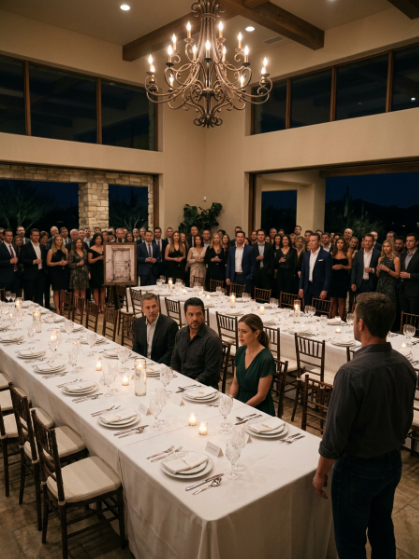
I climbed onto the hearth so they could all see me, two hundred people in their best clothes, and I told them the truth in a calm voice.
“Thank you for coming,” I said. “Really. It’s a beautiful turnout. Better than the turnout I had two years ago, when I lived in a three-hundred-square-foot apartment off McDowell Road and couldn’t get up to use the bathroom on my own.”
Nobody laughed now.
“Four people visited me in that apartment,” I said. “Four. They’re sitting at this table. Everyone else in this room either ghosted me, told me I was faking, or said — and I’m quoting my own brother — that I was ‘milking it.'”
Dale’s face went the color of the tablecloth.
“I’m not angry,” I said, and I meant it. “I just wanted you to feel, for about thirty seconds, what it’s like to show up somewhere expecting a seat and finding out there isn’t one for you. I lived in that feeling for two years.”
I gestured at the easel. The photo of my old apartment door, paint peeling, the number hanging crooked.
“That door was open to anyone,” I said. “Almost nobody walked through it.”
Then I told the caterers to open the buffet, because I’m not a monster, and I let them all eat standing up in a beautiful house, holding their little plates, not quite able to look at me.
Dale found me by the windows an hour later.
“That was cruel,” he said.
“It was honest,” I said. “You taught me the difference doesn’t matter to the person on the receiving end. I learned that at your barbecue. The one I wasn’t invited to.”
He didn’t have anything for that.
“I’ll pay you back,” he said finally. “Whatever you think I owe—”
“You don’t owe me money, Dale.” I was tired suddenly. “That’s the part you still don’t get. I never wanted money from you. I wanted you to show up. A phone call. One visit. It was free. It was always free, and you still wouldn’t pay it.”
He left before dessert.
A lot of them did. By ten o’clock, the great room had thinned out to maybe twenty people. By eleven, it was the four.
Reuben pulled a chair next to mine and handed me a beer.
“You okay, man?” he asked. “That took something out of you. I could see it.”
I told him the truth: I didn’t feel triumphant. I’d imagined I would. I’d pictured the look on Dale’s face for two years, and now I’d seen it, and it just felt like watching a door close on a room I’d already left.
Tasha sat on my other side and put her head on my shoulder, the way she used to in the waiting rooms.
“You know what’s funny,” she said. “You could’ve just had a small party. Invited the four of us. Skipped all the drama.”
“I know.”
“So why didn’t you?”
I thought about it.
“Because for two years I told myself I didn’t matter to anybody,” I said. “I needed to see it. I needed to count it with my own eyes. I needed to know who was real before I spent the rest of my life with money making it impossible to tell.”
She squeezed my hand. “And now you know.”
“Now I know.”
Here’s what I did after.
I didn’t cut Dale off with a dramatic speech. I just stopped chasing. No more reaching out, no more hoping. If he wanted a seat, he knew where the door was. He’s never knocked.
I paid off Reuben’s truck, quietly, because he’d never have let me if I’d asked first. I put Tasha’s daughter’s college money in an account and didn’t tell her until the deposit cleared.
And I took that photo of my old apartment door off the easel and hung it in the front hall of the new house, right where you can’t miss it walking in.
People ask about it. The fancy ones get uncomfortable. They think it’s strange to frame a picture of a place you were miserable.
But it’s not a picture of where I was miserable.
It’s a picture of the door four people walked through when there was nothing on the other side worth coming for.
That’s the most expensive thing I own.
And it cost them nothing but the willingness to climb the stairs.