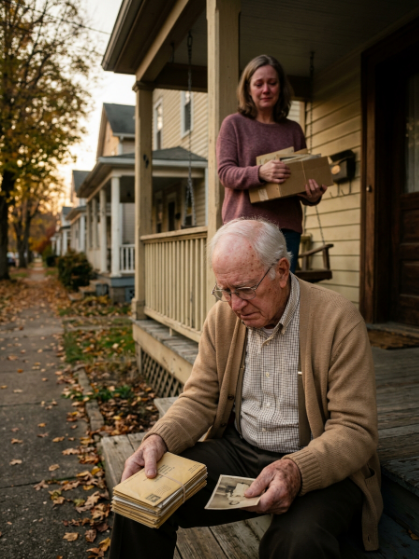
“You have Eleanor’s eyes,” I said, like a fool, standing on a stranger’s porch with a tin of dead letters under my arm.
The woman’s hand went to her mouth. “And you,” she said, “are Arthur. Arthur Penhallow.” Not a question. “She described you so many times I’d know you in the dark.”
Her name was Margaret. Eleanor’s daughter.
She invited me in the way you invite in someone you’ve been half expecting for years. Tea I didn’t drink. A front room with a piano and a wall of photographs.
We had parted on a train platform in the autumn of 1965. She was leaving for a nursing program two states away; I had one more year of school and no money to follow. We were nineteen and certain, the way only nineteen can be, that we’d find our way back. I wrote down her new address on the back of a ticket stub in a hurry, with a train pulling out and her hand slipping out of mine.
One wrong digit. That was all it took. One number copied down wrong on a moving platform, and four decades went where they went.
And there, on the mantel, a small framed picture of an old woman with white hair and a laugh I’d have known at any age.
“She passed in the winter,” Margaret said softly. “February. It was peaceful. I’m sorry — I can see on your face you were hoping.”
I was. God help me, at seventy-nine, walking one block, I’d let myself hope.
I told her about the letters. About the wrong digit I’d copied down at nineteen, about forty years of envelopes coming back stamped in red, about a granddaughter and a county record and the impossible discovery that Eleanor Voss had lived one street away from me since 1984.
Margaret listened. And then she got very quiet, stood, and left the room.
She came back with a shoebox.
It was soft at the corners the way mine was. She set it in my lap and lifted the lid, and I stopped breathing for the second time that day.
Letters. Dozens of them. All addressed in Eleanor’s hand to Arthur Penhallow — at 14 Cresswell Road.
My boyhood home. The house my parents sold in 1979.
“She wrote you too,” Margaret said, and her voice broke on it. “Every year. She mailed them to the only address she ever had for you, and every year they came back. She thought you’d moved on. Married. She told me she didn’t have the right to chase a man who’d built a life. So she just — wrote. And put them in the box.”
We sat there, the two of us, with two shoeboxes of the same forty years.
She had written to a house I’d left.
I had written to a house she’d left.
And the whole time, we’d been one block apart — close enough that on still summer nights, with the windows open, we might have heard the same dog bark, the same train, the same church bell.
“She used to slow down at the corner of Maple,” Margaret said. “Every walk. I asked her once why, and she just said an old friend used to live near here. She never said your name to me until the end. But she said it then.” Margaret wiped her eyes. “She made me promise that if a man named Arthur ever came looking, I wasn’t to tell him she’d waited. She didn’t want it to sound like an accusation. She wanted it to sound like a gift.”
I thought about all the times I must have passed her at the market, two strangers reaching for the same shelf, forty years of near-misses neither of us could feel.
Margaret let me read the last one. Eleanor wrote it in November, three months before she died, in a shakier version of the hand I remembered from when we were young.
She wrote that she still thought of a boy at a train platform in 1965. That she hoped, wherever he was, he’d been loved as well as he deserved. That she’d had a good life, a good daughter, and only one regret, and she’d made her peace with even that.
She signed it the way she signed all of them.
Still here, Eleanor.
Still here. One street over. The whole time.
I asked Margaret if I might keep that one letter, and she said her mother would have wanted me to have all of them, and I said no — one was enough, the rest belonged with her daughter.
There is a bench now between our two streets, in the little green where the blocks meet. Margaret and I had it put there. No grand plaque. Just two names and two dates, hers complete and mine still waiting.
I sit there most evenings. I can see the back of the house where she lived, and if I turn my head, the back of the house where I still do. A block. A single block I never thought to cross.
People ask me if I’m angry — at the post office, at the wrong number, at all that wasted nearness.
I’m not. Anger is for people who have time to spare.
I just sit on the bench at dusk, between the two streets, and I keep the only promise I have left.
Still here, Eleanor.
Still here.