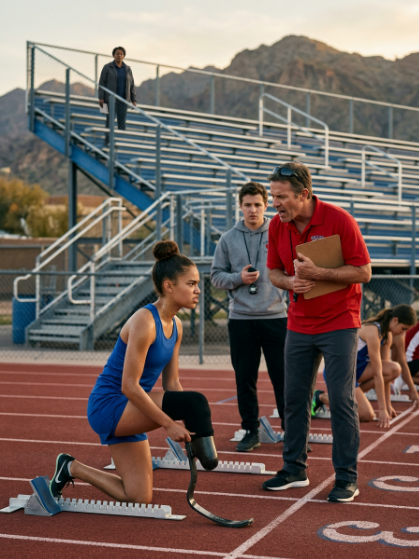
The blocks kicked the field forward, and for ten meters I held my breath, waiting to be proven a sentimental old woman.
I wasn’t.
By the thirty-meter mark, Maya Ellison was even with the pack. By the curve, the blade was doing exactly what it was built to do — turning every ounce of that girl’s fury into ground. She didn’t run like someone trying to belong on the track. She ran like someone who already knew she did and was tired of arguing about it.
She crossed the line first.
Not close. First.
The assistant coach looked down at his stopwatch, then looked at it again. His mouth moved before any sound came out.
“That’s — Coach, that’s under the regional standard.”
Silence on the track. The kind that has weight to it.
Coach Maddox recovered the way men like him always do. By moving the line.
“Wind-aided,” he said. “And the others weren’t pushing. It’s a tryout, not a meet. Doesn’t count for anything.”
Maya stood at the far end, hands on her knees, chest heaving, the blade catching the last of the gold light. She didn’t celebrate. She just looked at him like she’d heard this exact sentence her whole life.
“It counts,” I said.
My voice carried farther than I expected across the empty stands. Every head turned up toward the lone woman in the windbreaker climbing down the bleacher steps with a spiral notebook in her hand.
“Ma’am, this is a closed practice,” Maddox started.
“It’s not closed to me.”
I reached the fence and clipped my lanyard out from under my jacket so he could see the badge I’d kept tucked away all afternoon.
I watched it land on his face.
“Gloria Hammond. I chair the regional athletics board. I sit in on one unannounced session a season. Today was yours.”
The red drained right out of him.
“The time was legal,” I went on. “Hand-timed by your own assistant, into a headwind I’ve been feeling on my neck for an hour. But that isn’t actually what I came down here about.”
I turned to Maya.
“What’s your event, Miss Ellison?”
“Two hundred and four hundred, ma’am.” Her voice was steady. “I qualified in both last spring at my old school. Then we moved districts.”
“And here?”
She glanced at Maddox. “Here I got told I was a liability before I got told my locker number.”
I wrote that down. I made sure he saw me write it down.
Then I asked the question that mattered, the one I already suspected the answer to.
“Coach. How many other athletes have you cut this season without a single timed trial?”
He didn’t answer. He didn’t have to. Devin, the assistant, did — quietly, eyes on his shoes.
“Six,” he said. “All of them kids who needed an accommodation. A seizure plan. A hearing aid. The wheelchair kid who wanted to throw seated shot put.”
“Devin,” Maddox snapped.
“No,” Devin said. “I’ve been writing them down too.”
He pulled a folded sheet out of his own clipboard. It nearly matched mine.
That is how these things actually turn. Not with a stranger’s speech. With the one person on the inside who was tired of looking away.
I spent the next twenty minutes on the phone in the parking lot while the sun went down. By the time I left, three things were true.
Maya Ellison was officially entered in the regional qualifying meet, her spring marks reinstated, her eligibility confirmed in both events.
Brett Maddox was suspended from coaching pending a district review of every roster decision he’d made that season — a review I would be signing off on personally.
And a new line had been added to our regional bylaws, effective immediately, the one I drafted standing against my car with the engine ticking: no athlete may be removed from a tryout for a disability without a timed, documented trial and a written appeal. We’re calling it the Ellison rule. I didn’t ask her first. I should have. When I told her later, she just nodded like it was overdue.
Maya ran at regionals four weeks after that afternoon.
I drove out to watch — in the open this time, in the front row, in a board jacket with my name on it, because some days the job is to be seen.
She didn’t win. She finished third in the 400, half a second off the school record, against girls who’d been training on full scholarships since they were ten.
Third in the state region, off a track where a grown man had told her she couldn’t run at all.
She found me in the stands afterward, blade slung over her shoulder, medal already shoved in her bag like it embarrassed her.
“You didn’t have to come down that day,” she said.
“Yes, I did,” I told her. “That’s the whole job. Most people just forget the watching part.”
She thought about that.
“Coach Maddox said it was for my own good.”
“People who underestimate you almost always say that,” I said. “It’s never for your good. It’s for their comfort.”
She laughed — the first time I’d heard it.
The college letters started in the spring. I know, because two of the coaches called me to confirm her marks were real.
I told them what I’d tell anyone.
I watched her run with my own eyes, from an empty bleacher, on a gold afternoon, when she thought no one with any power was looking.
That’s exactly when you find out who somebody is.