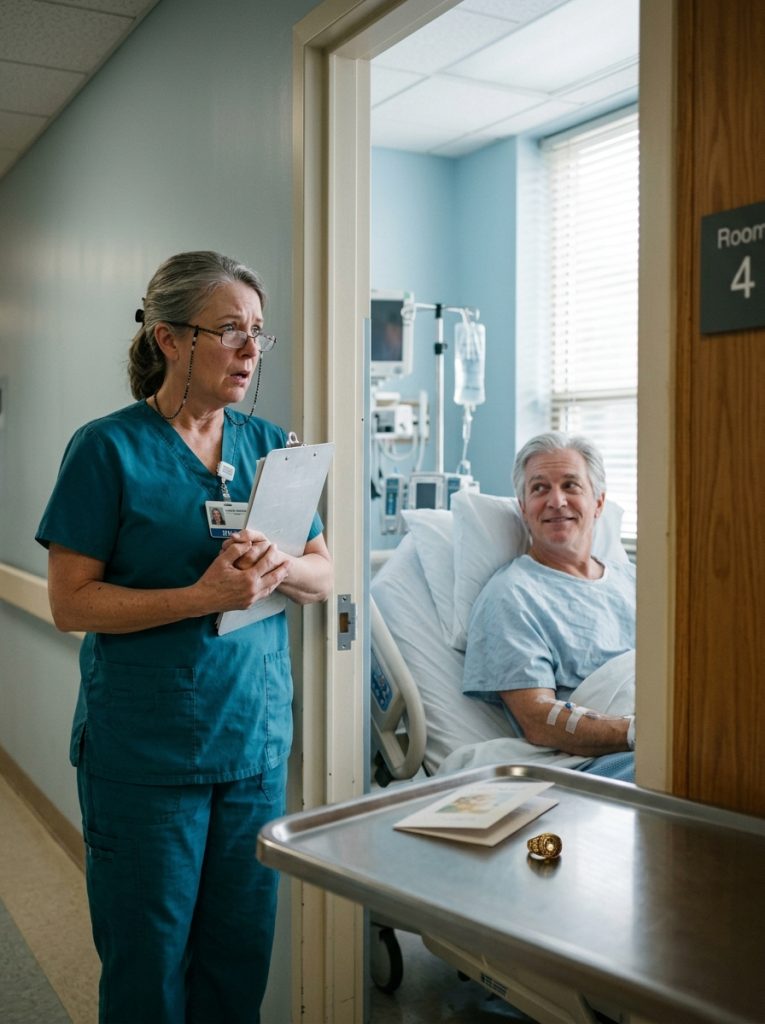
I closed the door of Room 4. Sat down in the chair by his bed. Set the clipboard on the floor where I couldn’t hide behind it.
“Tell me,” I said.
So James told me.
He did write. That summer he left for basic training, he wrote me every week. Long letters, the kind a nervous nineteen-year-old writes when he’s trying to sound braver than he is. He addressed them to my parents’ house on Bellweather Road, because that was the only address I had.
I never got a single one.
“I thought you were ignoring me,” he said. “I figured a small-town girl moves on when a boy ships out. I told myself it was kinder not to keep bothering you.” He looked down at his hands. “I stopped writing in September. I’m sorry I stopped. I’ve been sorry for forty years.”
It was my mother.
I knew it the second he said the address. She’d never liked James. Wrong family, wrong side of the county, a boy headed for the Army instead of the college she’d decided I’d attend. She used to bring in the mail before I was up. It would have been the easiest thing in the world.
She passed in 2009. I sat in that hospital chair and felt forty years of anger arrive at a grave, with nowhere left to put itself.
“She thought she was protecting me,” I said. The words tasted like ash. “She took my whole life and rerouted it and called it love.”
James reached over and put his hand on mine. The IV line shifted. His skin was papery and warm and exactly as familiar as it had been under the bleachers in 1983.
“Hey,” he said gently. “Lindy. Look what we got. Out of all the hospitals and all the wards and all the nurses in Virginia, you walked into my room reading my name.”
I’d love to tell you it was a fairy tale after that. It mostly wasn’t. He was in my ward because his heart was failing — the slow kind, the kind we manage instead of cure. I knew exactly what his chart meant in a way he was still learning to.
But here is what we did with the time the letters stole and then, somehow, handed back.
He recovered enough to go home that spring, and I drove him, because his license had lapsed and there was no one else. He’d lost his wife six years back; I’d buried my husband, a good man, in 2015. We were two people with a lot of evenings and not much left to be cautious about.
We started over at fifty-eight and sixty, which is a ridiculous and wonderful age to fall in love with the same person twice. He took me dancing badly. I learned to cook for his sodium-restricted heart. We drove out to the old county roads where he’d taught me to drive, and we parked, and we laughed at how brave we used to be.
He gave me back my class ring. I wear it on a chain now, next to my reading glasses, so I always know where both are.
I told my daughter about him over coffee one Sunday. She’s thirty-one, a mother herself, and she listened to the whole story — the letters, the address on Bellweather Road, her grandmother’s hand on the mailbox — and then she was quiet for a long time.
“Are you angry at Grandma?” she asked.
I thought about it honestly, the way you have to at my age.
“I was,” I said. “For about a week. Then I realized being angry at a dead woman is just a way of staying in the past with her. I’d rather spend what I’ve got left in the present, with him.”
That’s the thing nobody tells you about getting the truth forty years late. It doesn’t only hand you back the man. It hands you back the years you spent believing you weren’t worth writing to — and you get to decide, finally, what to do with them. I decided to stop carrying them.
We drove out to my mother’s grave together, once. James waited a respectful step behind while I stood there. I didn’t have a speech. I just said, out loud, “I understand why you did it. I don’t agree. But I forgive you, because I’m too happy right now to do anything else.” Then James took my hand, and we walked back to the car, and I never needed to go back.
We don’t talk much about the years we lost. There’s no profit in it, and we’re short on time to waste on accounting. But some nights, when his breathing is bad and I’m counting it without letting him see, I think about the girl on Bellweather Road waiting for a letter that her own mother had already carried out to the trash.
And then I think: it came. It came forty years late, in a teal scrub top, pushing a med cart into Room 4.
It still came.
Last Sunday we sat on his porch and watched the light go long across the yard, his hand in mine, the ring catching the sun on its chain.
“Any regrets, Lindy?” he asked.
“One,” I said. “I should’ve checked my own mailbox.”
He laughed until he coughed, and I rubbed his back until it passed, and we stayed out there together until the fireflies came up — two old kids who finally got the summer back, even if it arrived in autumn.