I waited until everyone had a full plate.
My father’s chair was at the head of the table. Kyle was sitting in it.
That was the thing nobody in that house wanted to look at directly. My dad died of a heart attack the spring I turned twenty-five. And somewhere in the fog of the two years since, without anyone ever deciding it out loud, I had become the one who kept the lights on.
Kyle carved the turkey like he’d raised it himself.
“So, Rachel,” Brooke said, passing the stuffing past me — to Kyle first — “Mom says you couldn’t even swing Christmas. Work that crazy?”
“Something like that,” I said.
“Kyle’s been such a help around here,” my mother added quickly, the way she said it whenever the silence got too honest. “He fixed the gutters. He set up the whole office. It’s so nice having someone handy in the house again.”
Someone. In the house. Again.
I looked at my father’s chair.
I set down my fork.
“Mom,” I said. “How much is the mortgage on this house?”
She blinked. “What kind of question is that at the dinner table?”
“Eleven hundred and forty dollars,” I said. “It comes out on the first of every month. I know the exact number, because it comes out of my account.”
The table went very quiet. Kyle stopped chewing.
“After Dad died,” I said, “the insurance didn’t cover what we thought it would. The bank sent the first default notice that June. I was standing in this kitchen when you cried and said you were going to lose the house, Mom. Do you remember?”
She didn’t answer. She remembered.
“So I set up the payment from my account. I never said anything because I didn’t want it to feel like charity. I’ve made it every month for two years. I also cover your heart medication — the one the new insurance stopped paying for. It’s ninety dollars. It’s on the same card.”
Brooke’s face had gone pale. “I didn’t— Mom, did you know that?”
My mother’s hands were in her lap. “I knew about the mortgage,” she said quietly. “I didn’t know about the medicine.”
“It’s fine,” I said, and I meant it. “I’d do it again tomorrow. That’s not why I’m telling you.”
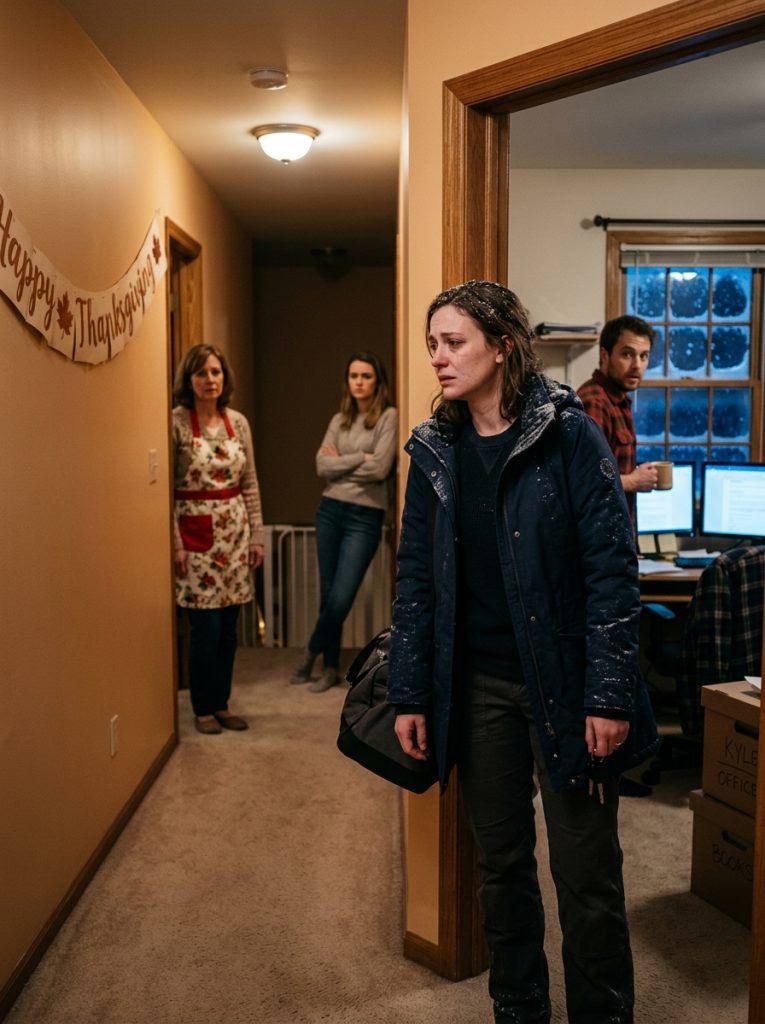
I turned and looked at my old room through the doorway, at the glow of Kyle’s monitors where my bed used to be.
“I’m telling you because I drove eight hours through a snowstorm to surprise the people I’ve been quietly holding up for two years. And I walked in to find that the one small square of this house that was still mine had been boxed up and handed to someone I’ve met exactly twice. Without a single phone call.”
“Rachel—” my mother started.
“I don’t want the house, Mom. I don’t want a thank-you parade. I just needed you to know that the easy daughter, the one who never asks for anything, has been carrying this family on her back. And I’m not angry. I’m just done being invisible while I do it.”
It was Kyle, of all people, who moved first.
He stood up — out of my father’s chair — and he said, “I’ll have the office cleared out tonight. I shouldn’t have taken your room. I didn’t know any of this. I’m sorry.”
It wasn’t his apology to give, really. But it broke something open at that table.
My mother started to cry. Not the performance kind. The real kind, the kind I hadn’t seen since the funeral. She came around the table and held my face in both hands and said the words I’d stopped expecting two years ago.
“I’m so glad you came home. I’m so sorry it took this for me to say it.”
We didn’t fix everything that night. Families don’t work like that. But we made a start.
Brooke and Kyle carried the boxes marked “Rachel” back up the stairs after dinner while my mother and I did the dishes side by side, the way we used to. Brooke set up a budget the next morning so the mortgage wasn’t all on me anymore — her idea, before I could even raise it.
And Kyle moved his office down to the basement, where, he admitted, the light was better for his work anyway.
The next day was the day after Thanksgiving. I woke up late, disoriented, in a room that smelled faintly of fresh paint where Kyle had touched up the walls before he left.
My bed was back under the window. My books were back on the shelf. The early sun came up off the new snow and filled the whole room with a clean white light.
For the first time in two years, I was home in the place I grew up — not as the one who pays for it, but as the daughter who belongs in it.
I lay there a while and let myself feel it.
Then I went downstairs, where my mother was already making coffee for two, and she had set my father’s chair back at the head of the table, empty, where it belonged.