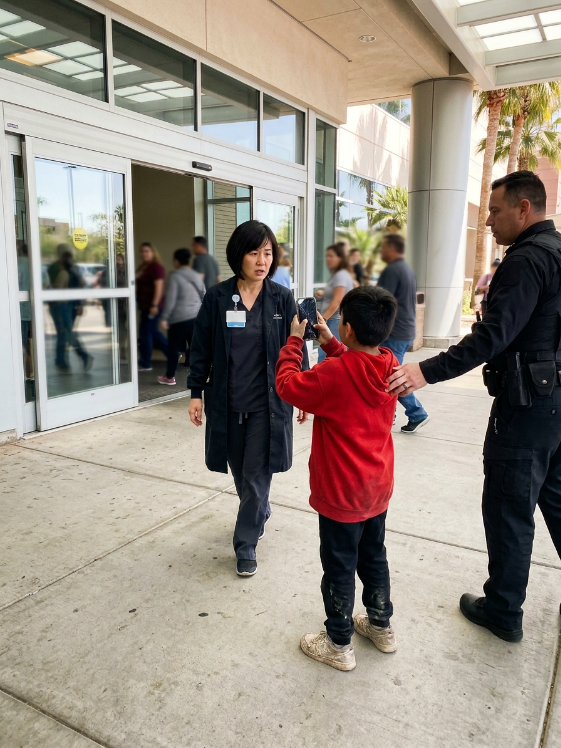
Mateo Cruz did not run when the security guard reached for his shoulder. He stayed in the hospital walkway with both hands lifted, cracked phone trembling in the desert glare, trying to make one rushed surgeon look at a picture nobody else seemed willing to see. Visitors moved around him like he was another delay at the sliding doors.
Dr. Helen Park had already turned halfway toward the entrance when the light cut across the phone screen. Mateo’s oversized red hoodie hung loose on his small frame, dusty sneakers planted on the pale concrete, but his arms stayed raised. The screen was angled toward her, not the crowd, and whatever she saw there made her stop mid-stride. The guard’s hand hovered inches from the boy’s shoulder.
Mateo swallowed hard and held the phone higher. Helen’s eyes moved from the blurry baby photo to his face, then back again. Her badge had twisted sideways against her coat, and for the first time that morning, she forgot the doors behind her were still opening.
Comment ‘YES’ if you want the full story!! ➡️
[FULL STORY — 7993 chars]
Dr. Helen Park forgot the sliding doors were still opening behind her.
Mateo Cruz stood on the pale concrete outside Mercy Children’s Hospital with both hands raised, cracked phone trembling in the desert glare. He was eleven, in an oversized red hoodie and dusty sneakers. A security guard’s hand hovered inches from his shoulder, waiting for Helen to decide whether the boy was a patient, a nuisance, or someone else’s problem.
Helen had been halfway through turning away when sunlight cut across the phone screen. The picture was blurry, tilted, and fractured by the crack in the glass, but one detail pulled her back by the ribs: a tiny neonatal bracelet, half-hidden against a blanket, beside a crescent scar under the baby’s left collarbone.
Her own hands had closed that skin.
‘Where did you get this?’ she asked.
Mateo held the phone higher. ‘It’s my sister.’
The guard shifted. ‘Doctor, he’s been stopping staff at the entrance for twenty minutes.’
‘Let go of him,’ Helen said.
‘I haven’t touched him.’
‘Good. Keep it that way.’
Visitors flowed around them with coffee cups and discharge bags. The glass doors opened and closed, spilling cold air into the brutal late morning heat. Helen’s badge had twisted sideways against her surgical coat. She did not fix it.
Mateo swallowed. ‘Her name is Sofia. My mom said you were the doctor. She said if I found you, you’d remember.’
Helen did remember. Not the name. The night.
Seven years earlier, a newborn had arrived after midnight from a rural clinic transfer, underweight, cyanotic, with a heart defect that should have been caught before birth. The family had no insurance card that matched the hospital system, no specialist appointment, no time. Helen had been the attending surgeon called in from home, hands steady only because there was no room for fear.
The operation lasted four hours. The baby survived. Helen paid for the uncovered medication afterward through the quiet charity fund she used when billing threatened to undo what surgery had saved.
Then the family vanished from follow-up.
At least that was what the chart said.
‘Where is Sofia now?’ Helen asked.
Mateo’s face tightened. ‘That’s why I’m here. My mom brought her last month because she was coughing and turning blue at night. They said there was no record. They said we had the wrong hospital. Then a lady in billing told my mom to stop making scenes.’
The guard looked uncomfortable now. ‘I wasn’t on that shift.’
Helen took the phone carefully. The screen was warm from Mateo’s hands. She zoomed around the cracked glass. The bracelet number was not fully readable, but the scar was. Her scar. Her work. A thin curve made when she had chosen a smaller incision because the baby was too fragile for anything else.
‘Come inside,’ she said.
Mateo did not move. ‘Are you going to take my phone?’
‘No.’
‘Are you going to call security on my mom?’
Helen looked at the guard until he stepped back.
‘No,’ she said again. ‘I’m going to find your sister.’
Inside, the lobby smelled of sanitizer and hot pavement dragged in on shoes. Mateo stayed close to the wall, phone clutched to his chest, while Helen led him to a side consultation room instead of the public desk. She called pediatrics, records, then the old surgical archive. The first two calls produced polite nothing. The third produced a pause.
‘Why are you asking about that case?’ the records supervisor said.
Helen closed the door. ‘Because the patient’s brother is sitting in front of me.’
Another pause. Then: ‘You need admin approval.’
Helen looked at Mateo. He was staring at a framed hospital donor photo like it might decide whether he belonged.
‘No,’ she said. ‘I need the chart.’
The chart came twenty minutes later, not from records but from a nurse named Priya who had worked nights long enough to know which closets held paper no one wanted digitized. She slipped a folder under Helen’s arm in the hallway and whispered, ‘If anyone asks, I didn’t find it.’
The name on the old chart was Baby Girl Cruz. Mother: Ana Cruz. Procedure: Park neonatal repair. Charity override approved.
Then, six weeks after discharge, a second entry appeared. Missed follow-up. Unable to contact. Family noncompliant.
Priya tapped the page. ‘That’s not your handwriting.’
It was not. Helen’s follow-up notes were blunt and cramped. This entry was smooth, administrative, final.
Mateo leaned over the table. ‘My mom went to every appointment they gave her. I was little, but I remember buses.’
Helen turned the page. A social work referral had been canceled. A medication voucher had been marked fulfilled. At the bottom, under billing review, was the name D. Halpern.
The hospital administrator who now ran patient finance.
Helen found Halpern in a glass office above the lobby, eating a salad at his desk. He looked annoyed before she finished the first sentence.
‘That old charity case?’ he said. ‘Helen, we had dozens. Families disappear.’
‘This one came back. Your office told them there was no record.’
He set down his fork. ‘We have protocols for undocumented claims.’
‘Her brother has a photo.’
‘A cracked phone image is not a medical record.’
Helen placed the copied chart on his desk. ‘No. This is.’
Halpern’s eyes moved to the canceled voucher, the false follow-up note, his own name. For the first time, his mouth stopped organizing excuses.
The truth was uglier than negligence and smaller than conspiracy. Halpern had buried several unfunded neonatal follow-ups after a donor audit questioned charity spending. Sofia Cruz’s medication vouchers were marked complete to close the account before the fiscal report. When Ana Cruz returned asking for help, staff were instructed to route her through general intake, where no one could find a file because the charity chart had been archived under review.
A child survived surgery and was almost lost to accounting.
Helen called the chief medical officer from Halpern’s office. Then she called Ana Cruz using the number Mateo recited from memory because his phone battery had dropped to three percent. Ana arrived forty minutes later carrying Sofia, now seven, thin and wheezing, hair braided with two red beads. Helen recognized the scar before she recognized the face.
Sofia looked at her and whispered, ‘Are you the lady from the picture?’
Helen had no idea what that meant until Ana pulled a folded discharge photo from her purse: Helen in wrinkled scrubs, holding the newborn’s tiny hand beside an incubator. Someone had printed it for the family the morning Sofia went home.
‘I told them you wouldn’t forget her,’ Ana said. Her voice did not accuse. That made it worse.
Sofia was admitted before sunset. This time the chart stayed visible. Cardiology adjusted her medication, social work reopened the family file, and Helen signed the charity authorization in ink so dark it bled through the page. Halpern was suspended that night pending review. By the end of the week, he was gone, along with two policies designed to make poor families prove they deserved memory.
Advertisement
The hospital issued no glossy apology. Helen refused to let public relations write one before Ana read it. The final letter named the failure plainly: Mercy Children’s had hidden a living patient’s history behind billing procedure. The Cruz family received covered care, transportation support, and a direct clinic contact who answered her own phone.
Months later, Sofia ran across the hospital garden after a follow-up appointment, red beads clicking at the ends of her braids. Mateo chased her with the same cracked phone, now held together by a blue case Helen had bought from the gift shop because he refused a new one.
‘This one works,’ he told her. ‘It found you.’
Helen watched them from the walkway. Her badge was straight this time. When Mateo lifted the phone for a picture, she stepped into frame beside Sofia, who pulled down her collar just enough to show the thin crescent scar.
Still cracked, the image held.