The heavy brass coin sat on the laminate desk, gleaming under the harsh fluorescent lights. Captain Hayes stared at it. The blue pen slipped from his fingers, rolling across the paperwork and clattering onto the floor. The silence in the small medical office didn’t just fall. It collapsed.
“Where did you get that?” Hayes whispered. His voice was completely stripped of its previous booming authority. He looked up at me, his eyes wide, the pupils dilated in the sterile light.
I didn’t answer right away. I just looked at Private Miller. “Take a breath, kid,” I said softly. “You’re not signing anything.”
Miller dropped the clipboard. The plastic hit the desk with a loud slap. He slumped back in his chair, letting out a shaky exhale.
Hayes stood up abruptly. His chair scraped violently against the linoleum. He reached for the coin, his hand trembling. “This is military property. You have no right to possess this. Give it to me.”
I placed my hand over the coin. My palm was flat, covering the engraved face.
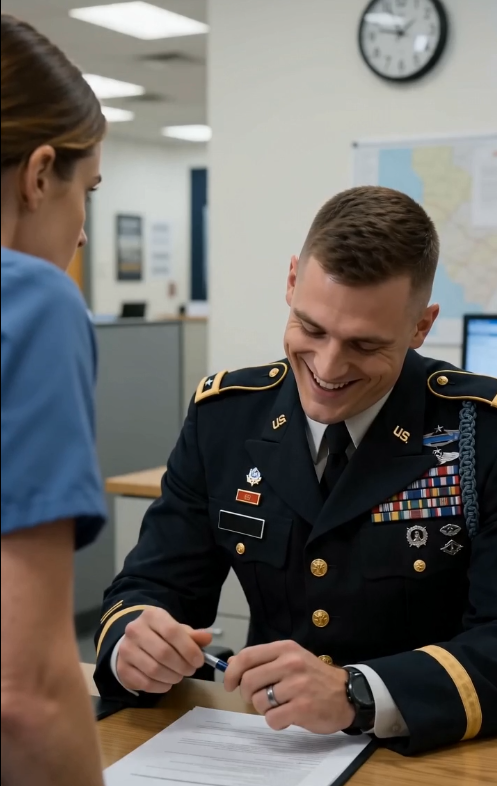
“It belongs to Sergeant First Class Marcus Davis,” I said. My voice was steady, echoing off the cinderblock walls. “He was your squad leader in the Arghandab River valley. He died in an IED attack six months ago.”
Hayes swallowed hard. He adjusted the collar of his dress uniform, his fingers fumbling with the gold braids. “That was a tragic loss. A random strike. We mourned him. I wrote the commendation for his widow.”
“You wrote a lot of things, Captain,” I said. I flipped the coin over. The back was heavily scratched, the brass worn down to the dull copper underneath. “But you didn’t write this.”
I slid the coin across the desk. It stopped right in front of him.
“Read the engraving, Captain.”
Hayes looked down. His chest heaved. He read the jagged, hand-scratched letters. GPS: 32.4412, 64.8891. You left him.
The air in the room felt thick, suffocating. The hum of the HVAC system suddenly sounded like a roaring jet engine.
“His widow mailed this to me,” I continued, my voice dropping to a harsh whisper. “She found it in his footlocker. Along with the dashcam footage from your Humvee. The footage you said was destroyed in the blast.”
Hayes took a step back. His polished black shoes squeaked against the floor. “That’s… that’s a fabrication. You’re a nurse. You don’t understand combat operations. You’re trying to ruin my career because I denied a medical waiver.”
“I understand that you ordered the patrol into a known kill zone,” I said, stepping closer to him. “Because you wanted to secure the valley for your promotion packet. I understand that when the IED hit, you ordered the driver to reverse. You left Sergeant Davis bleeding out in the dirt to save your own skin.”
“Liar!” Hayes shouted. His face flushed a deep, ugly crimson. He lunged forward, his hand reaching for my arm. “You’re making this up! I’ll have you court-martialed for insubordination! I’ll have you thrown in the brig!”
“You won’t do anything, Captain,” a new voice said.
The heavy oak door to the office swung open. Standing in the doorway was Colonel Vance, the base Provost Marshal. He was flanked by two military police officers in full tactical gear. Their hands rested on their duty belts.
Colonel Vance stepped into the room. He didn’t look at me. He looked at Hayes. His expression was carved from granite.
“Captain Hayes,” Vance said, his voice flat, devoid of any sympathy. “You are relieved of command. Effective immediately.”
Hayes froze. He looked at the Colonel, then at the MPs, then at the coin on the desk. “Colonel, this is a misunderstanding. This nurse is fabricating evidence. She’s trying to protect a malingerer—”
“Save it for the hearing, Captain,” Vance interrupted. He nodded to the MPs. “Escort him to the holding facility. Confiscate his sidearm and his access badges.”
The MPs stepped forward. The cold steel of the handcuffs clicked loudly as they snapped around Hayes’s wrists. The sound was sharp. Final.
Hayes didn’t fight. He just slumped, his expensive dress uniform suddenly looking like a cheap costume. They marched him out of the office, his polished shoes dragging slightly on the linoleum. He didn’t look back.
Colonel Vance turned to me. He looked at the clipboard on the desk, then at Private Miller.
“Nurse Jenkins,” Vance said softly. “Process the Private for immediate medical evacuation. He’s going home.”
I nodded. I picked up the heavy brass coin from the desk. It was warm from my palm. I walked over to the window, watching the MPs load Hayes into the back of the transport vehicle, the brass coin resting heavy against my thumb.