Gordon Pike’s gavel came down anyway, because a man like Gordon would rather finish the gesture than understand the sentence.
“This meeting is — the vote stands — the petition is denied,” he said, and even he could hear it landing wrong.
I rolled the site plan back up. I didn’t need it anymore. I’d only brought it so the room could watch his face while he looked at it.
“You can deny the petition all night, Gordon,” I said. “There’s no petition. We’re not asking the HOA for anything. I came to tell you, as a courtesy, that the lot at the end of Cottonwood Lane is private property now, zoned separately, outside your bylaws, and my family is building a dog park on it. Fence, gravel, water, shade. Open to every resident here and their dogs. Free.”
The room did something Gordon hadn’t heard in years.
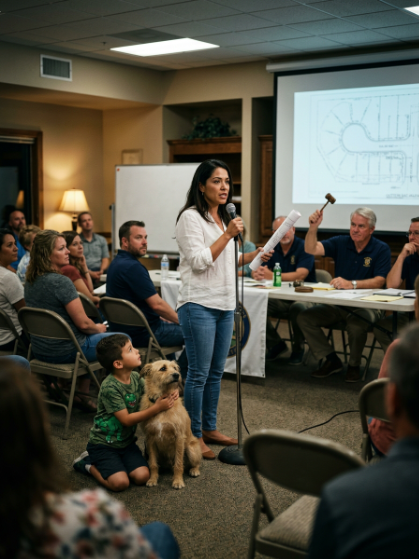
It cheered.
Not everyone. But enough. The Hendersons, who’d been fined for a basketball hoop. The Olunike family, fined for the wrong shade of beige. The widower on Aspen Court whose only company was a corgi the HOA kept threatening over a barking complaint that came, every time, from Gordon’s house.
Gordon went the color of his polo. “You can’t just — there are easements, there are—”
“There aren’t,” I said. “I had a real estate attorney check before we closed. You’d know that, except the association’s been operating for years like it owns land it never bought. Which, funny enough, is the other thing I came to mention.”
This is the part Gordon should have seen coming, and didn’t, because bullies never think the person they’ve been grinding down is taking notes.
Eighteen months earlier, I’d asked why the HOA’s reserve fund was forty thousand dollars short. Gordon had buried me in committees and called me a troublemaker until I gave up asking out loud.
I hadn’t given up. I’d just gotten quiet, which is a different thing.
While I was buying the lot, I’d also requested — in writing, certified, the way the bylaws actually require the board to honor — five years of HOA financial records and the minutes of every election. Gordon had stalled. The bylaws give him thirty days. Day thirty-one, my attorney sent a letter that used the words “statutory violation,” and the records arrived the next morning.
They told a story.
Gordon Pike had run unopposed for six years because Gordon Pike counted the ballots. The “election” was a box in the clubhouse and Gordon’s word about what was in it. The forty-thousand-dollar gap traced to a landscaping company that did suspiciously little landscaping and shared a P.O. box with Gordon’s brother-in-law.
I didn’t say all of that in the meeting. You don’t fire your best shot into a clubhouse full of folding chairs. I said the part that mattered:
“There’s going to be a real election. Secret ballots, counted by three volunteers who aren’t named Pike, supervised by the management company we’re going to hire to replace the one that’s been rubber-stamping these books. I’ve already got the signatures to force it. Same petition process you just spent twenty minutes pretending to respect.”
I held up the second roll of paper. Not the site plan. The recall petition.
Two hundred and forty signatures. More than the dog park ever needed.
Gordon didn’t bang the gavel again.
The dog park opened six weeks later. My son Eli cut the ribbon — well, Biscuit cut the ribbon, by running through it after a tennis ball, which is better. Half the subdivision came. The widower brought his corgi. The Hendersons brought a cooler. Somebody planted a little free library by the gate that, the last time I checked, was full of dog-eared paperbacks and exactly zero violation notices.
Eli talks again, all the time now, mostly to the dogs, which is its own kind of healing I won’t pretend to fully understand. He named the park, technically. There’s a hand-painted sign — Biscuit’s Run — that no HOA has the authority to make us take down, because it’s our land, and that, it turns out, was the whole point.
The recall election ran in the fall. Secret ballots. Three volunteers, none named Pike. Gordon lost his seat by a margin that suggested a lot of people had been waiting a long time for a real ballot box. The new board’s first act was to hire an outside firm to audit five years of books. The second was to repeal forty-one fines that had been levied, as far as anyone could tell, on the basis of who’d annoyed Gordon that month.
He still lives here. I see him on his evening walk sometimes, past the park he tried to kill, where a dozen dogs are usually losing their minds with joy in the gravel he said would never go down.
He doesn’t look over.
I don’t make him.
I learned a long time ago that you don’t beat a man like Gordon by yelling louder at the microphone.
You beat him by reading the bylaws he assumed nobody would, buying the land he forgot to check, and counting the ballots he was sure no one would ask to see.
The dogs don’t know any of that.
They just know the gate’s always open now.