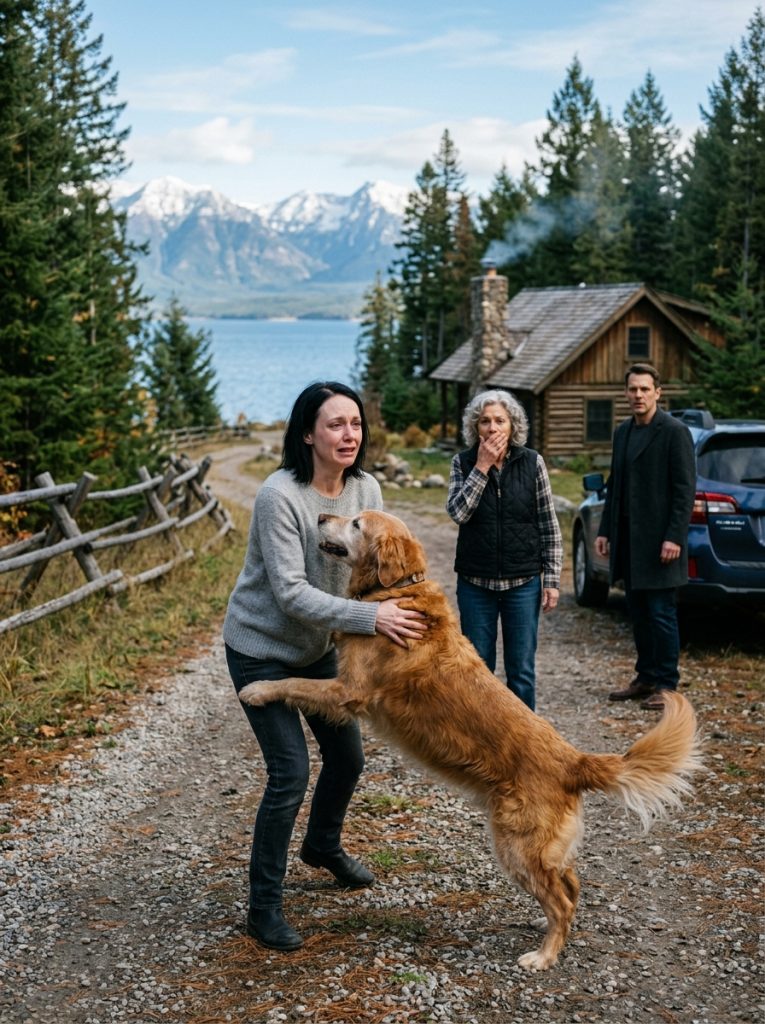
The dog’s name was Biscuit. I knew it before the neighbor said it.
It came up out of nowhere, the way you suddenly remember a word in a language you thought you’d lost. I buried my face in his fur and the name was just there. Biscuit. And then more than the name.
A porch. A red door. A man who was not Vincent, laughing, throwing a tennis ball into a lake while this same dog — younger, faster — tore down a dock after it.
“Sarah.” The neighbor was crouched in front of me now. Margaret, her name tag from the church thrift store still pinned to her vest. “Sarah, honey, do you know me?”
“I don’t—” My voice cracked. “He told me I was Nora. He told me I had an accident. He told me there was no one.”
Margaret’s face went from shock to something harder.
“There was a funeral,” she said. “Two years ago. Closed casket. Vincent stood up and gave a eulogy and we all cried. He told us you drowned off the boat. He sold your lake house six months later. He told everyone he couldn’t bear to keep it.”
My lake house.
The red door. The dock. The man with the tennis ball — not Vincent. My brother. I had a brother.
It came back not gently but all at once, the way Margaret said it always does after a head injury when the lie stops being reinforced. There had been a boating accident. That part was real. I hit my head. I washed up two coves over with no memory and no ID, and Vincent — my boyfriend of four months, the one my brother never trusted — Vincent had found me in the county hospital before anyone else did.
He told them he was my husband. He told them my name was Nora.
And then he went home and held a funeral for me, so that no one would ever come looking for the woman he was keeping at a different lake, in a different state, with brown-dyed hair and no past.
Because the house was in my name. The accounts were in my name. A dead woman can’t sign, but a confused one who thinks she owes you her life — she’ll sign anything.
“Nora.” Vincent’s hand closed around my arm. Still calm. Still that doctor’s-office voice. “You’re having an episode. These people are strangers. Let’s go home and call Dr. Hale.”
Dr. Hale. His cousin. The one who prescribed the pills that made the days go soft.
“Let go of me,” I said.
“Sarah.” He flinched at the name. “You don’t know what you’re saying.”
“I know my dog,” I said. “I know my dog knew me before I knew myself. A stranger doesn’t get that.”
Biscuit pressed between us and growled at Vincent — low, certain, a sound I felt against my leg.
Margaret had already pulled out her phone. “I’m calling Sheriff Dunne,” she said. “And I’m calling your brother. Daniel’s been a ghost for two years, Sarah. He never believed that funeral. He kept Biscuit because he couldn’t stand to let your dog go to a shelter.”
Daniel. My brother had kept my dog.
Vincent’s grip tightened, and that was his mistake, because by then there were three other neighbors on the lane and one of them was a retired EMT who did not care for the way a grown man was holding a shaking woman by the arm.
He let go.
He tried the calm voice one more time, to the crowd this time. “She’s not well. She’s been through trauma. I’ve been caring for her—”
“You held a funeral for a living woman and sold her house,” Margaret said. “You can explain the caring part to the sheriff.”
He ran. Of course he ran. Men like Vincent always do the math, and the math had turned against him on a gravel road because of a dog.
They picked him up that night at a motel two counties over with a packed bag and a folder of forged documents — the death certificate he’d fabricated, the power of attorney he’d had me sign as “Nora,” the deed to my lake house. It was all the evidence the state needed. Fraud. Forgery. Unlawful imprisonment. The charges stacked up fast once my real name was attached to them.
My brother drove through the night to get to me. When he pulled up, Biscuit lost his mind all over again, and Daniel got out of the car and just stood there looking at me like I was the funeral, finally undone.
“I knew it,” he kept saying. “I told them. Nobody listened. I knew you weren’t gone.”
It took months to undo the paperwork of being declared dead. There’s a strange humiliation in proving you’re alive to a government that has you on file as drowned. But the lake house transfer was reversed once the forgery was proven. I got the red door back. I got the dock back.
I let my hair grow out auburn again.
Vincent took a plea. He’ll be inside for a while. He never did explain the funeral, not really. I think the truth is simple and ugly: it was easier to bury me than to let me remember who I was.
He almost managed it.
He didn’t count on a dog with a gray muzzle and a longer memory than mine, who crossed a gravel road one cold morning and gave me back my own name.
These days Biscuit can’t make it to the end of the dock anymore. That’s all right.
I sit out there with him every evening, my brother’s number saved under my real name, the lake going gold, and I scratch the ears of the only one who never once forgot me.