I played the footage three times before I trusted my own eyes.
Tyler Brooks walked into Rosa’s Corner at 11:40 on a Tuesday. He set up his ring light. He filmed himself frowning at a plate.
But he never ordered that plate.
The timestamp told the whole story. He was inside for six minutes. My mother’s kitchen doesn’t turn an order in six minutes — she cooks everything fresh, it’s the whole point. The “garbage food” he gagged over on camera was a prop he carried in. You could see the corner of a plastic takeout container in his bag when he leaned down.
The “dirty floor” was a smear he made himself with the heel of his sneaker, twenty seconds before he started recording. The camera caught that too, in the reflection of the pie case.
He didn’t review a meal. He manufactured a meltdown. Because outrage gets more views than a good Tuesday lunch.
“Ma,” I said. “He set you up. And I can prove it.”
She looked at the monitor for a long time. Then she said the thing that broke my heart.
“Marcus, it doesn’t matter what’s true. Two million people already saw the lie.”
So I decided to make the truth louder.
I’m not an influencer. But I know how to edit a video, and I know this town.
I cut Rosa’s security footage against Tyler’s viral clip. His “rotten food” beside the takeout container in his bag. His “filthy floor” beside the shoe that made the smear. His six-minute visit beside his claim that he “suffered through a full meal.”
Then I posted it. One sentence: “This is the woman he called garbage. Come judge for yourselves Saturday.”
I didn’t expect much.
Millhaven expected differently.
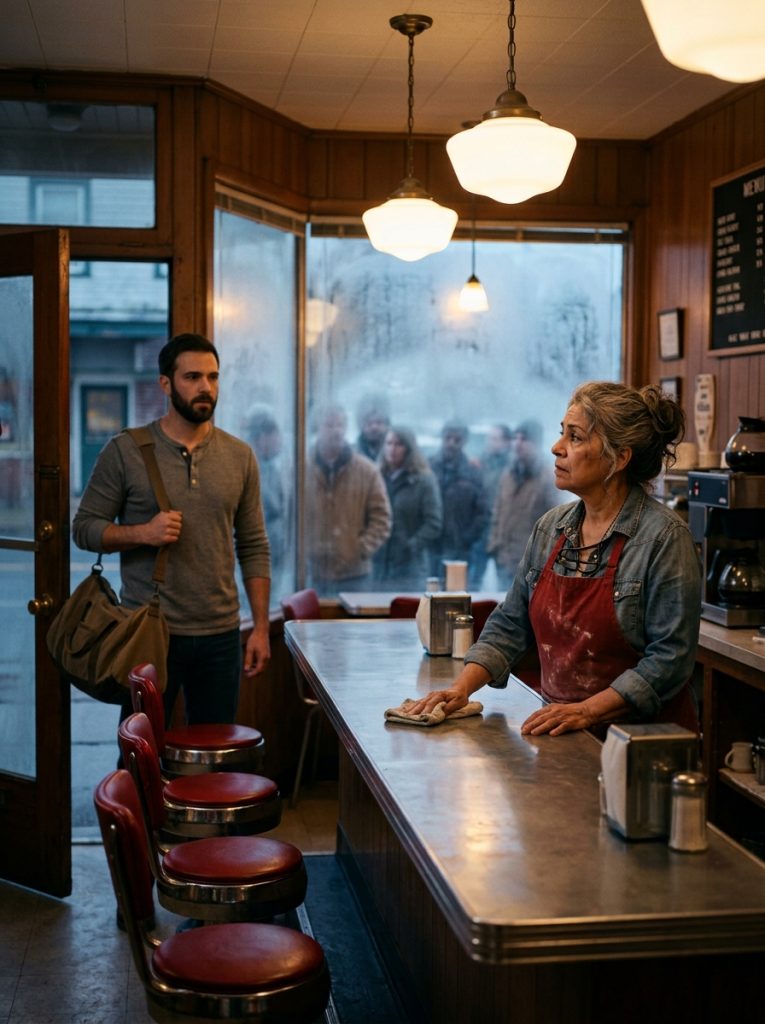
By Saturday morning there was a line down the block before the sun was up. People I hadn’t seen since high school. The mailman. Two retired teachers. A whole youth hockey team and their parents. The fire department came on their break and ordered forty slices of pie.
My mother stood behind her counter in her flour-dusted apron and just — froze. She hadn’t seen the place that full in years.
“Marcus,” she whispered. “What did you do?”
“I didn’t do anything,” I said. “They came on their own.”
A woman near the front turned out to be a food writer for the regional paper. She’d seen both videos. She ate a full lunch — ordered, cooked fresh, on the record — and she wrote it up exactly as it happened. The headline ran Monday: a small-town diner, a faked review, and a town that didn’t buy it.
That’s when Tyler’s world started to fall.
His own comment section turned on him first. Then the brands. The energy drink that sponsored him pulled out by Tuesday. The “honest reviews” series he’d built his whole channel on collapsed, because once people know you’ll fake one, they assume you faked them all.
He posted an apology. Filmed in a dim room, no ring light this time. He said he “took it too far for content.” He offered to come back and “make it right.”
The platform was less forgiving. Once the side-by-side hit a million views of its own, they slapped a warning on the original clip, then pulled it for “manipulated media.” His follower count, the only number he ever really cared about, dropped by half in a week. The boy who built a brand on tearing down small places had nothing left to monetize but the wreckage.
A few of his fans drove out to Millhaven to film their own takedowns. They walked in expecting a sad little diner they could mock for clout.
They walked out with full stomachs and nothing to post. You can’t fake a bad meal when the whole town is sitting at the counter telling you you’re wrong.
My mother watched it on my phone. Then she handed the phone back.
“Tell him the door’s open,” she said. “He can come in like anybody else. He can order off the menu, and he can pay his check, and he can sit at the counter with the people he insulted.”
He never came. People like Tyler only show up when there’s a camera and a crowd on their side.
But the crowd stayed ours.
The diner didn’t just survive. Rosa had to hire two more people. She put a new sign in the window — hand-painted, like the first one — and under “Rosa’s Corner” she added a line in her own careful letters: “Everybody eats. Nobody’s garbage.”
I stayed in Millhaven. Turns out the thing I came back to fix was the thing that fixed me, too.
Some nights, after we lock up, my mother and I sit at the counter with two slices of pie and watch the empty street.
“You know what saved us?” she said one night.
“The video,” I said.
She shook her head and patted my hand.
“The town,” she said. “The video just reminded them where the door was.”