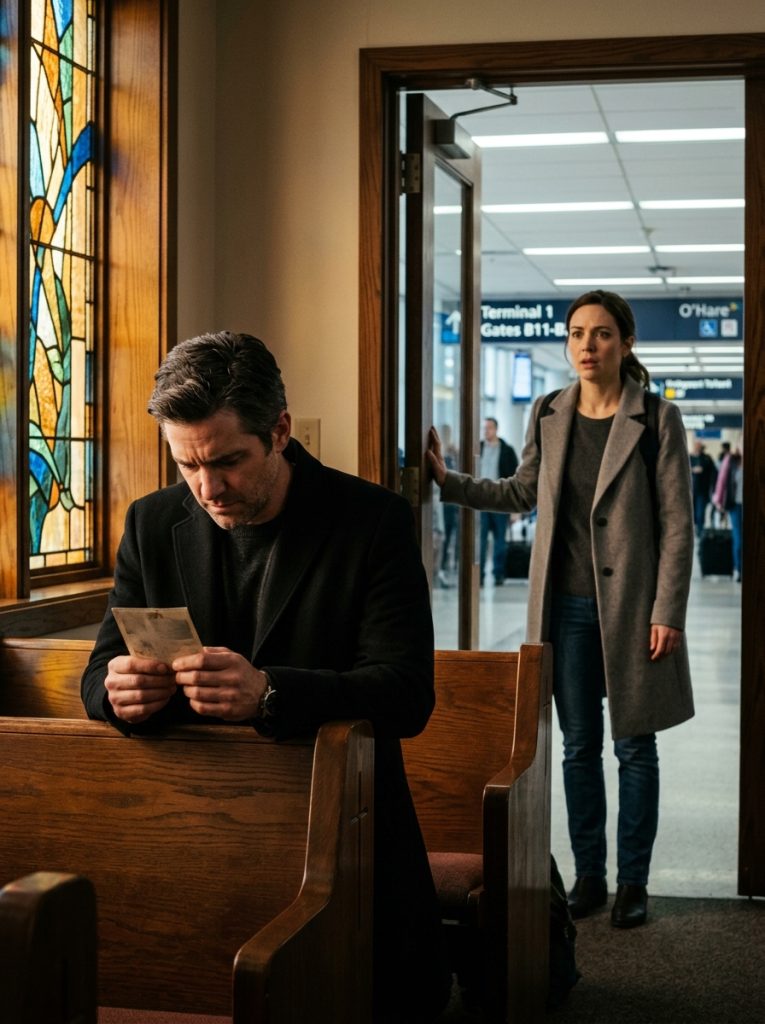
Nathan stood up from the front pew of the airport chapel on shaking legs, with the photograph of our daughter still cupped in both his hands.
He did not move toward me.
He did not need to.
I crossed the chapel slowly, one careful step at a time, the way a person crosses a frozen pond.
I stopped two feet from him.
I held out my hand without speaking.
He gave me the photograph.
Maeve, four years old, in a blue puffer coat, with chocolate ice cream on her chin, in a park with red maple leaves on the ground.
The angle was wrong.
It was a long-lens photograph, taken from across a playground.
A surveillance shot.
I looked up at Nathan.
He saw the question on my face before I asked it.
“I have a private investigator,” he said. “I have had one since 2021. I did not know about her. I knew about you. I have been looking for you.”
I sat down in the pew.
He sat down beside me.
He did not touch me.
He told me everything in that pew over the next hour and twenty minutes, and a chaplain quietly stood at the back of the chapel with her arms folded, refusing to let anyone else come in.
In April of 2021, eleven months after I left, Nathan had been going through his mother Beatrice’s home office for tax documents while she was at a conference in Geneva.
He had found a USB drive in the back of a desk drawer.
It contained the original digital files of every “photograph” of me with Daniel Voss.
The metadata showed the photographs had been timestamped from 2018, before I had ever met Daniel Voss in person.
The metadata also showed the photographs had been edited in Photoshop in February of 2019.
He had pulled the original hotel keycard logs through a third-party security firm that consulted for his foundation.
The keycards listed in his mother’s “evidence” had never been issued.
The hotel had no record of either of us, ever, on any of the dates.
He had carried that USB drive into his mother’s living room the day she came home from Geneva.
He had set it on the coffee table.
He had asked her one question.
He had asked her, “Mother. What did you do.”
Beatrice Ashford had not denied it.
Beatrice Ashford had told her son, with the chilly precision she had used on every business adversary she had ever crushed, that Lauren had been “an architect’s daughter from Ohio without the right inheritance,” that the marriage had been “a tactical error,” and that her job, as the matriarch of the Ashford family, had been to correct that error before any children had been brought into “a compromised line.”
Nathan had asked her if she knew I had been pregnant when I left.
She had not said anything for a long time.
Then she had said, “Yes. I knew.”
She had paid an OBGYN at a clinic in Manhattan in early 2020 for a copy of my chart.
She had known about Maeve before Maeve was born.
She had told Nathan, with a logic that to her was perfectly clean, that she had not informed him because she had not been sure the child was his, and she had wanted to “protect him from any misattribution.”
Nathan had looked at his mother, in her own living room, on a Sunday afternoon in April of 2021, and he had told her she would not see him again.
He had walked out.
He had filed for legal separation from his mother’s family trust the next morning.
He had hired a private investigator that afternoon.
The investigator’s first job had been to find me.
The investigator had not found me.
I had been very careful.
I had changed my name through a court process in Indiana that he could not access.
I had not used my old social.
I had not opened a new credit card under my new name.
I had paid in cash for almost everything for the first eighteen months.
The investigator had eventually given Nathan one piece of information.
In late 2022, a woman matching my description had been seen taking a child to a park in a small town in Indiana.
The investigator had taken three photographs from a long lens.
He had not approached.
He had not followed me home.
He had given Nathan the photographs and told him, very firmly, that the next move belonged to me.
Nathan had not approached either.
He had not flown to Indiana.
He had not knocked on my door.
He had told the investigator to confirm only that we were safe, healthy, and not in any immediate need.
The investigator had updated him every six months with a single one-line text.
Advertisement
“Mother and child stable.”
That had been the entire correspondence for three years.
Nathan looked at me in the pew.
He said, “Lauren. I did not come for you. I do not have the right. I came because if you ever decided to come find me, I wanted to be findable. I wanted to be a man who had spent three years making it impossible for me to disappoint you the way my mother disappointed both of us.”
I asked him, very quietly, what he had been doing in the chapel.
He said, “Today is Maeve’s birthday.”
I had not realized.
I had been so caught up in the layover that I had forgotten what month it was.
It was August 11.
Maeve was turning five years old that day.
I had a small cake waiting for her in my mother’s kitchen in Indianapolis.
He had not known.
But somewhere in the rotation of his quiet, careful grief, the date had landed on his calendar.
He had been kneeling, alone, in the front pew of an airport chapel, on the birthday of a child he had been told was not his and had spent three years quietly proving was.
I started crying.
He did not touch me.
He did not push.
He just sat beside me and waited, the way he had waited for three years.
When I could speak again, I asked him one question.
I asked him what he had decided he would do, if I ever came back.
He told me he had decided one thing only.
He would never ask me to share custody.
He would never sue.
He would never use any of the resources of the Ashford family to take or compel anything from me, ever, under any circumstance.
If I let him meet his daughter, he would be grateful.
If I did not, he would still send me, every month, an envelope with cash and a single letter for Maeve to read whenever I felt she should read it.
He would not contest my decision.
He would not argue.
He had drafted a sworn legal document to that effect in 2021.
He pulled it out of the inside of his coat.
It had been in his coat for three years.
I did not read it.
I folded it and put it in my own bag.
I would read it later, on the plane.
I asked him about Beatrice.
He told me his mother had passed in 2024 of a stroke.
He had not gone to the funeral.
He told me he had inherited the foundation, the brownstone, and the trust.
He had restructured the foundation around the same kind of clean-water programs in Appalachia that I had once curated.
He had renamed one of the programs after the small town in Ohio where I had grown up.
He had not made the renaming public.
He had not done it as bait.
He had done it because, in his own words, it was the only way he had been able to stand to walk into that office every morning.
I asked him if he wanted to meet Maeve.
He looked at me.
He said, “Yes. More than anything in the world. But only on your terms. Only if you want it. Only if she wants it. I have waited three years. I can wait another.”
I did not promise him an answer that day.
I told him I had a flight to catch.
I told him I would call him.
He gave me his number on the back of a chapel program.
I gave him nothing.
I did not have a card.
I did not have a stable phone.
I just told him I would call.
I left him kneeling in the pew with the chaplain still at the back of the chapel.
I cried in the bathroom for twenty minutes.
I made my flight.
On the plane to Indianapolis, I read the legal document he had drafted.
It was real.
It was binding.
It had been notarized in 2021 and updated three times since.
I called him from a cab two days later.
We talked for three hours.
We did not make a plan.
We just talked.
A month later, I drove Maeve to a quiet park in Indianapolis and Nathan flew in alone, with no entourage, no photographers, no PR, and met his daughter for the first time on a bench by a duck pond in Holliday Park.
She did not know who he was.
I did not tell her.
I told her he was an old friend of mine.
She handed him a stick she had picked up because she handed sticks to everyone she liked.
He took the stick the way a man takes a sacrament.
He thanked her.
He asked her about the ducks.
She told him about the ducks for forty minutes.
He listened to all of it.
That was a year and three months ago.
We are not back together.
I do not know if we will be.
We are something quieter and slower.
He flies in once a month.
He stays at a hotel near the airport.
He takes Maeve to the park, or the children’s museum, or the small zoo in Indianapolis, with me always nearby.
She has begun to call him Nathan.
She has not yet been told he is her father.
We have decided, together, that she will be told when she is six, in a way that gives her room to ask questions.
I have not given Nathan back the photograph.
He told me to keep it.
He told me, the night we met in the chapel, that the photograph had been the closest thing to a daughter he had been allowed to have for three years.
He told me it had been kept in his coat pocket against his chest, because that was the closest he could get her to his heart.
I kept it.
It lives in a small frame on Maeve’s nightstand now.
She does not know what it is.
She knows only that her mother loves it.
That is enough, for now.
Beatrice Ashford’s portrait still hangs in the lobby of the Manhattan brownstone.
Nathan has not taken it down.
He told me he plans to take it down the day he is finally allowed to walk through that door holding his daughter’s hand.
I told him I would let him know.
I am still letting him wait.
But the wait is shorter now than it has been in five years.
And the chapel at O’Hare still keeps a small note on the bulletin board in the back, in the chaplain’s careful handwriting, that says only: “If you have ever needed this room, you are welcome to keep needing it. Whatever you came in carrying, you are not the only one carrying it.”
I read it every layover.
I have not had a panic attack in fourteen months.