“I’m sure about the letters,” I told the officer. “I said them out loud the whole time the ambulance was coming. I’m a nurse. I don’t lose a number once I’ve decided to keep it.”
He wrote it down again, slower. Then he keyed it into the laptop in his cruiser, and I watched his shoulders change.
“Ma’am,” he said, “I’m going to ask you to come give a formal statement. Tonight. Don’t post anything. Don’t talk to anyone. Can you do that?”
I learned why at the station, after Marcus was stable enough that the surgeon let me stop holding my breath.
The plate belonged to a black SUV registered to Bret Hollis.
If you’re not from Buncombe County, that name means nothing. If you are, it means the Hollis family — the ones with their name on the hospital wing, the community college gym, and three of the seven seats that decide who gets prosecuted around here. Bret was the youngest. Twenty-six. Two prior DUIs that had somehow evaporated before they reached a courtroom.
The first report I gave got filed.
Then it got “lost.”
A detective named Reyes called me four days later, quietly, from her personal cell. She’d been handed the case and then watched the plate I’d reported get replaced in the file with a vague description of “an unknown dark vehicle.” She wanted to know if I still had the number.
I did. I’d written it on my forearm in the ambulance bay in permanent marker, and then, when it started to fade, on a card I kept in my wallet, and then in three different places because I am not a woman who trusts a single copy of anything.
I also had something I’d forgotten in the chaos of that night.
A dashcam. Cheap one, suction-cupped to my windshield, the kind that loops over itself every few hours. I’d been so focused on Marcus and the plate that I never thought about it. When I got home that night and finally sat down, I pulled the card.
It had all of it. The SUV clipping Marcus from behind without braking. The plate, lit clear in my headlights for a full two seconds. The car not slowing down.
I made four copies before I made breakfast.
Detective Reyes took one. A lawyer Marcus’s family found took another. The third I mailed to myself, sealed, and never opened — my father’s trick, a postmark you can’t argue with. The fourth I kept.
When the department tried to tell Reyes the dashcam was “inconclusive,” she walked it across the street to the DA’s office herself, around the people who’d lost my first report. The DA’s office had a new prosecutor that year, hired specifically because the last one retired under a cloud of cases exactly like this one.
She watched fourteen seconds of footage and opened a file the Hollis name couldn’t close.
Bret Hollis was charged with felony hit-and-run and reckless endangerment. The two officers who’d “lost” my report were placed under internal investigation; one resigned. It turned out I wasn’t the only person whose statement had gone missing over the years. I was just the one who’d written the plate on her own arm and backed up her dashcam four times.
Marcus spent three weeks in the hospital. Shattered pelvis, two surgeries, a long road. The dog that had been waiting at home — a senior beagle named Captain — got walked by half the neighborhood until Marcus could do it himself.
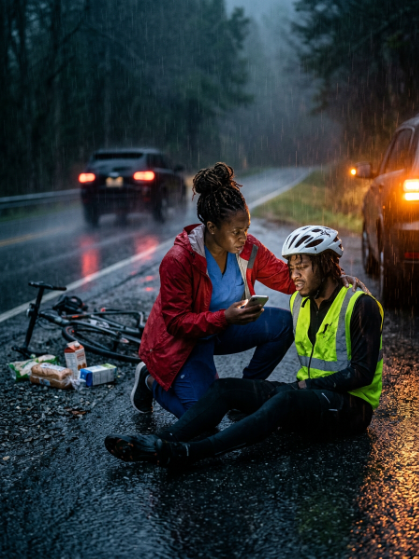
I went to see him every few days. I’d held his shoulder on the asphalt; it felt strange to let go just because he was off the road. We’re friends now, the deep kind that gets forged in fourteen terrible minutes in the rain. He calls me his “guardian in the red jacket,” which is mortifying, and which I secretly love.
The thing I keep coming back to isn’t the verdict, though Bret took a plea that put him where two DUIs and a hit-and-run should have put him long ago.
It’s the cars.
I counted them later, from the timestamps on the dashcam. Between the moment Marcus went down and the moment I stopped, four vehicles drove around a man bleeding in the road and kept going.
Four people decided someone else would handle it.
I almost did too. I was on hour seventeen of a double shift. My bed was twenty minutes away. There’s a version of that night where I tell myself a nurse needs her sleep and I drive around him like the rest.
I didn’t, and I’ve thought a lot about why.
I think it’s because I knew, even tired, even soaked, that the only thing standing between a powerful family’s bad night and a young man’s life was whether one person decided to be a witness instead of a bystander.
So I stopped. I knelt. I held his shoulder. And I memorized seven characters in the rain like they were the most important thing I’d ever learn.
They were.
Marcus rode a bike for the first time again this spring, slow, on a flat trail, Captain trotting beside him.
I drove out to watch. I wore the red jacket.
He saw it from a hundred yards off and started laughing before he even reached me.