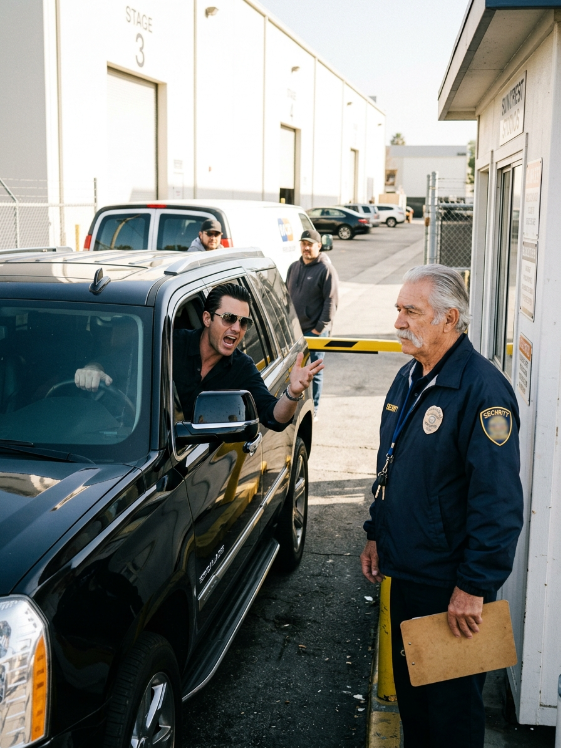
Chase Renner was still leaning out of the black SUV when someone from the executive building started walking quickly toward the gate.
At Suncrest Studios, people learned to read pace. A production assistant running meant a missing call sheet. A lawyer walking slowly meant trouble with a contract. Evelyn Park, the studio CFO, crossing the lot at a near-run in Monday morning sun meant something had gone wrong enough to burn through hierarchy.
Chase did not know her by sight. That was his first mistake after insulting Milo Grant. His second was assuming the old guard was simply old.
‘Finally,’ Chase said, one hand still thrust through the open window. ‘Tell security to stop power-tripping. I have a budget meeting in nine minutes.’
Milo stood beside the gate booth with his clipboard held low. His navy jacket was faded at the shoulders, his silver mustache trimmed with almost military neatness, and the vintage badge on his chest sat turned partly sideways. It caught the Burbank sun whenever he shifted, a dull flash against fabric worn thin by years of mornings like this.
Behind Chase’s SUV, two production vans idled. Crew members watched through windshields. A driver stared forward like a man trying to become upholstery.
The gate arm stayed down.
Evelyn reached the booth breathing hard. She did not look at Chase first. She looked at Milo.
‘Mr. Grant,’ she said.
Chase gave a short laugh. ‘Mr. Grant can open the gate.’
Evelyn turned. Her expression had the calm, dangerous flatness of someone who had signed checks large enough to ruin moods permanently. ‘Mr. Grant can close the studio if he wants to.’
The vans went quiet except for engines.
Chase’s sunglasses hid the first flicker of doubt, but not the way his mouth paused around the next complaint. He was thirty-four, slick-haired, freshly expensive, a streaming executive brought in to package old studio property for new platforms. His first limited series had trended for six days. Since then he had treated every person between the parking lot and the boardroom as set dressing.
Milo had seen hundreds like him pass through the gate. Some became better. Most became louder first.
‘Is this a joke?’ Chase asked.
Milo checked the clipboard. ‘Your convoy was scheduled for eight-ten. It is eight-oh-three. Your temporary access starts at eight-ten.’
‘I am the showrunner.’
‘You are seven minutes early.’
A crew member in the first van coughed into his sleeve. The line producer, Nadia, who had made the call, stepped down from the passenger seat and kept her eyes on Evelyn. She knew enough to be afraid quietly.
Chase pushed open the SUV door and climbed out, designer sunglasses still on though the sun had moved behind the stage wall. ‘I have a greenlight from the platform and a meeting with physical production. If this guard wants to play museum, he can do it after my team is inside.’
Milo’s thumb rested near the edge of his badge. The number was not readable from the SUV, not cleanly. But Nadia had seen it when the sun hit: 001, half-polished from age.
She had also seen the framed photograph in Building A, the one every intern passed without reading. The first day Suncrest opened, 1978. A younger Milo Grant in a security jacket, standing beside a woman cutting ribbon and a dirt lot where Stage 4 would rise. Founder. Owner. Seller. Retained rights holder. The man whose signature still sat under a clause that allowed him final approval over any production using the original Suncrest name.
Evelyn said, ‘Milo, do you want him removed from the lot?’
Chase’s head snapped toward her. ‘Excuse me?’
Milo studied him for a long second. He did not look offended. That somehow made it worse. Offense could be negotiated. Disappointment could not.
‘Not yet,’ Milo said. ‘He should hear why the gate was closed.’
At that, the gate booth door opened and an old intercom speaker crackled. The morning security supervisor, who had been listening from inside, lowered his eyes and stayed silent.
Milo turned to Chase. ‘This studio ran eighty-three productions last year. Six had preventable safety violations before first lunch because executives decided schedules mattered more than procedures. Two crew members went to urgent care. One grip never came back to work. So when a convoy arrives before its access window, before the safety officer is posted, the gate stays down.’
Chase’s jaw tightened. ‘You could have said that.’
‘I did. You called me a fossil and asked if my badge came with the building.’
The driver closed his eyes.
Evelyn took off her glasses slowly. ‘He said what?’
Milo lifted one hand, stopping her. ‘Let him answer.’
Chase looked at the vans, the booth, the closed gate, the CFO, and finally the badge. Now he saw the number clearly. The confidence left him in pieces.
‘Look,’ he said, changing voices, ‘I was frustrated. We are under pressure. The platform wants speed.’
‘Platforms always want speed,’ Milo said. ‘Studios are supposed to remember bodies.’
The line landed across the asphalt with more force than Chase’s shouting had managed.
Evelyn opened the folder tucked under her arm. ‘Your meeting this morning was to finalize budget authority for Stage 4 reshoots. Under the Suncrest legacy agreement, Milo signs off on any budget over five million tied to original studio facilities. He asked to review your crew conduct after three complaints last week.’
Nadia looked down.
Chase swallowed. ‘Complaints from who?’
Milo glanced toward the vans. No one moved. That answered him.
The reveal did not require drama. It required paperwork. Evelyn held out a single page with Milo’s signature line at the bottom and Chase’s project code at the top, both angled away from anyone’s camera. Chase stared at it as if money might rearrange itself if he refused to blink.
‘I built this gate before I built Stage 1,’ Milo said. ‘I stand here twice a month because a gate tells the truth about a company faster than a boardroom does. People show you who they think is disposable.’
For the first time all morning, Chase took off his sunglasses.
‘Sir, I apologize.’
Milo nodded once. ‘To me, then to them.’
Chase turned toward the vans. The apology that followed was stiff, then less stiff when nobody accepted it quickly. He apologized to the driver for shouting across him, to Nadia for making her call in panic, to the assistant in the second van whose name he did not know and had to ask twice.
Evelyn did not smile. When he finished, she handed him a revised agenda.
‘You no longer have independent greenlight authority on Suncrest property,’ she said. ‘Physical production reports to Nadia for the remainder of this block. You may attend today’s meeting as creative lead only.’
Chase looked like he might argue. Then he looked at the badge again.
‘Understood.’
Milo checked his watch. Eight-ten. He lifted the gate arm.
The vans rolled through slowly. Every driver nodded to Milo. Nadia stopped beside the booth and said, ‘Thank you, Mr. Grant.’
‘Run a clean set,’ he said.
Six weeks later, Stage 4 finished without a safety complaint. Chase still worked on the show, but from a smaller office with glass walls and fewer people pretending not to fear him. He learned names because Nadia made him put them on call sheets himself. Whether humility took root was not Milo’s business. The gate only measured behavior.
On the last day of shooting, a production assistant brought Milo coffee at the booth. No logo on the cup, no performance attached. Just coffee, black, the way Nadia had asked around and found out he liked it.
Milo set it beside the clipboard as the morning sun caught badge #001 again.
The gate rose on time, and nobody honked.