The first page was a signature card from Marigold Savings & Loan, dated four days after the burn-relief fund closed.
I held it up so the front rows could see it under the string lights.
“This is the card that lets someone move the Henley money,” I said. “The fire chief signed it. I signed it. And then a third signature was added two days later. Look at the loops.”
I set my own deposit log beside it.
“That third name forwarded the entire balance to a personal account. The bank gave my mother these copies last year, when she asked as next of kin. She was sick. She still drove forty minutes to do it.”
The room had gone so quiet I could hear the coffee urn ticking.
Marlene Tuck stood the rest of the way up.
“This is a stunt,” she said, and her voice didn’t have its column-confidence anymore. “Nora, you don’t get to ambush a town meeting because you’re bitter.”
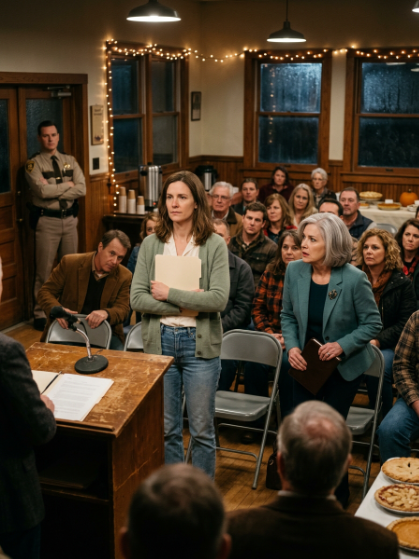
“Then sit down and let me read the bank’s letter,” I said. “It has the account holder’s name. Sheriff Mertens already has the original.”
Dale Mertens uncrossed his arms.
“I do,” he said quietly. “I got it this morning. I was going to bring it to her quietly, after the meeting.” He looked at Marlene. “But you’re already standing, so.”
That was when the leather notebook started shaking in her hands.
Because the name on the account wasn’t mine.
It was hers.
Marlene Tuck took the Henley fund. Sixty thousand dollars. She moved it the same week the bank flagged a foreclosure notice on her own house — the tidy blue Victorian on Sycamore that everyone in town admired, the one she’d somehow saved that spring while writing weekly about other people’s troubles.
And then she did the smartest cruel thing a person can do in a town like ours.
She picked someone to blame, and she put it in print.
Print is how Marigold knows things. She knew that better than anyone.
“You wrote about me for three years,” I said. My voice didn’t shake. I’d cried all the crying out of it a long time ago. “You sat two pews behind me at Easter and wrote that I ‘held the purse and called it a mistake.’ You knew. You knew every Thursday.”
“You can’t prove I wrote those columns to—”
“I can, actually.” I turned to the last pages in the folder. “My mother kept your drafts. The ones the paper recycles. She pulled them out of the bin behind the press office for two years. Your handwriting in the margins. ‘Push the treasurer angle.’ ‘Remind them she handled the deposits.’ You were steering it.”
Pastor Hardy stood up in the third row, slow, like his knees hurt.
“Marlene,” he said. “The Henley family slept in our church basement for two months. You let this town turn its back on Nora and you took the money that was meant for them.”
Nobody defended her. That’s the thing about a town that runs on a story. It will turn on a dime when a better, truer one walks in.
Marlene sat down hard. The notebook slid off her lap.
Sheriff Mertens crossed the floor and crouched beside her, not unkind, and said the words quietly enough that only the front row heard them. She didn’t argue. There wasn’t anything left to argue with.
The county charged her the following week. Theft, and a fraud count for the foreclosure paperwork. The Sycamore house went up for sale with a real lockbox this time. The paper ran a correction on the front page, three years too late, in the same column space she’d used to bury me.
The Henley family got their money back. The county recovered most of it; the volunteer department covered the rest with a fish fry that half the town showed up to, looking at their plates the way guilty people do.
I went to that fish fry.
I’d be lying if I said it felt like a victory. Three years is three years. You don’t get those Sundays back. You don’t un-hear the diner going quiet.
But Edith Henley found me by the lemonade and held both my hands and said, “I never believed it, honey. I should have said so out loud. I’m saying it now.”
“Out loud” is the whole thing, in a town like this. My mother knew that. She spent her last good months making sure the truth would have something louder than a whisper to stand on.
I keep the folder in her safe-deposit box still. I don’t need it anymore. It just feels like hers.
Last Thursday the new column ran. Different writer. The lead item was about the Grange Hall getting a fresh coat of paint, and a line at the bottom thanking “Nora Bellweather, treasurer, for her careful handling of the fund.”
I cut it out.
I put it on the back of one of Marlene’s old drafts, the one that started all of it, and I taped the two together and set them on my mother’s grave with a jar of marigolds.
Some stories take three years to finish.
This one finished in her handwriting.