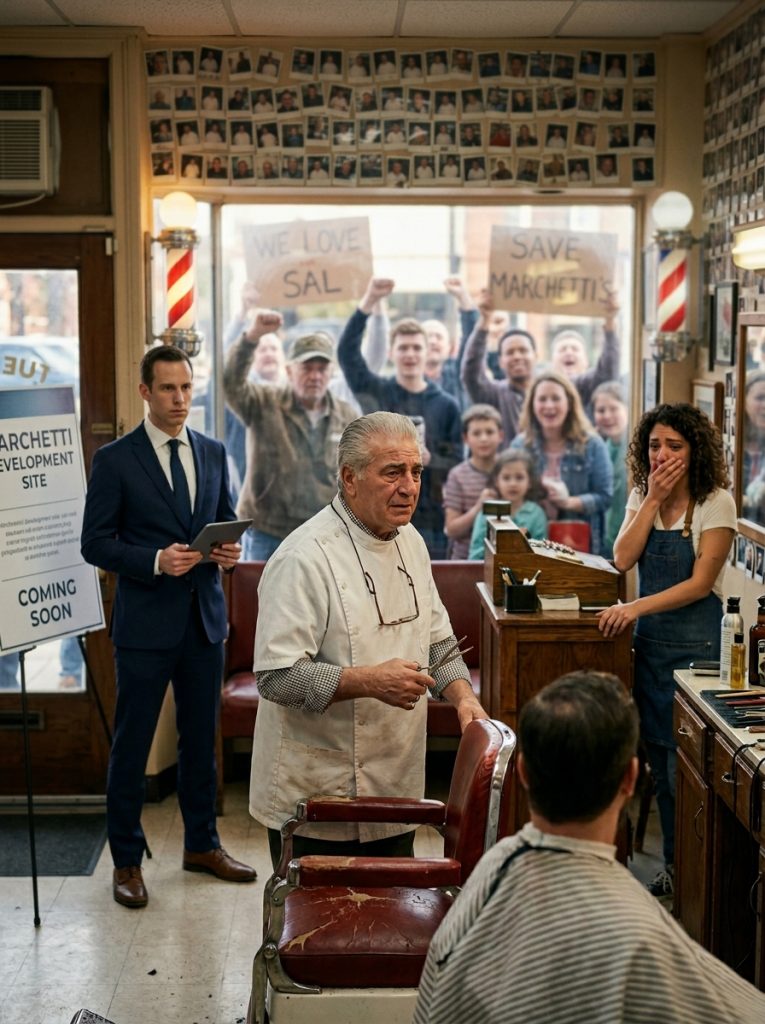
The man from the red chair walked into my shop, and the whole sidewalk crowd hushed behind him.
Fifteen years since I’d given him a free cut and a hot shave when he had nothing. He looked different now. Charcoal overcoat. Good shoes. The careful posture of a man people listen to. But the eyes were the same. I’d have known those eyes anywhere.
“Mr. Marchetti,” he said. “I don’t expect you’d remember me.”
“You sat in that chair,” I said, pointing to the cracked red leather. “Middle of January. Coldest week we had. You hadn’t eaten, but you were too proud to say so, so I sent Mia next door for soup and told you it came with the cut.”
His composure cracked, just for a second. “You remember.”
“I take a picture of everyone,” I said. “You’re on the wall. Third row, by the window.”
He walked over and found himself among the hundreds of faces. He stood there a long moment, and when he turned back, his eyes were wet.
“My name is Ray Okonkwo,” he said. “Fifteen years ago I’d lost my job, my apartment, and most of my reasons. The day you cut my hair and pretended the soup was free, I had a job interview the next morning I’d almost talked myself out of going to. I went because you made me feel like a man worth hiring.” He paused. “I got the job. And every job after it. I’m a city councilman now, Mr. Marchetti. And I chair the Landmarks and Historic Preservation Commission.”
Behind me, I heard Trevor Lasky’s tablet slip in his hands.
“That’s — Councilman, with respect,” Lasky started, “this is a private development matter, the parcels are already assembled—”
“Mr. Lasky.” Okonkwo didn’t raise his voice. He didn’t need to. “I know exactly who you are. My office has received eleven complaints about Crestline Partners’ conduct on this block in the last two months.” He pulled a folded paper from his coat. “Shall we discuss them here, in front of everyone, or would you prefer a hearing?”
Lasky’s mouth opened and closed.
“Let’s discuss them here,” Okonkwo said. “I think the neighbors have earned that.”
And he laid it out, plain, the way you’d explain a haircut to a kid.
The “code inspector” who’d written me up? Not a city employee. A contractor Crestline paid. The citations were withdrawn the moment Okonkwo’s office requested the paperwork, because there was no paperwork.
The sign permit my father got in 1971, suddenly “under review”? There was no review. Someone at Crestline had simply called the records office and asked them to flag it, hoping I’d panic.
The rumor that the city might take the block for “public benefit”? Never proposed. Never discussed. A lie whispered to frighten an old man into signing.
“You strong-armed a laundromat owner into selling by reporting her for violations that didn’t exist,” Okonkwo read. “You told the Wojcik family their bakery’s lease was void when it wasn’t. You tripled Mr. Marchetti’s rent through a shell company that, it turns out, Crestline controls — which means you were both his landlord and his buyer, and you never disclosed it.”
The crowd at the window had pressed inside by now. The veteran in the faded cap. The Wojciks in their flour-dusted aprons. The pancake kid, grown, standing with his arms crossed. They were listening to every word.
“None of that is illegal yet,” Okonkwo said. “But it’s about to be very expensive. And here is the part that ends it.” He turned to me. “Mr. Marchetti, did you know your building is one of the oldest continuously operating barbershops in the state? Your father’s pole out front is a documented 1971 original. The tin ceiling is older than that.”
“I knew it was old,” I said. “I didn’t know anybody cared.”
“The Commission cares,” Okonkwo said. “We voted this morning. Marchetti and Son is being granted historic landmark status, effective immediately. It cannot be demolished. It cannot be ‘assembled’ into anyone’s luxury complex. It is protected.”
The shop erupted.
I had to sit down in my own barber chair. Mia was crying into her hands at the register. The Wojciks were hugging strangers.
Trevor Lasky stood in the middle of it, gray-faced, holding a tablet that suddenly couldn’t help him.
“You can’t landmark a building just to spite a developer,” he said weakly.
“I’m not doing it to spite you,” Okonkwo said. “I’m doing it because this man gave free haircuts to the down-and-out for forty-five years and wrote each of us down on his wall so we’d know we mattered. There are city councilmen on that wall, Mr. Lasky. There are nurses and veterans and teachers and at least one judge. You wanted to bulldoze the single most valuable thing on this block, and you couldn’t even see it, because it doesn’t show up on your spreadsheet.” He nodded at the Polaroids. “That’s the landmark. The building just keeps it dry.”
Lasky left without another word. The bell over my door rang behind him.
It didn’t end there.
The complaints Okonkwo’s office had gathered went to the state attorney general. Crestline’s whole “block assembly” came under review. Within a month, the laundromat lady got her lease reinstated and an apology. The Wojciks’ bakery was never in real danger again. Two other shops that had already signed got their deals reopened, and the price suddenly went up now that everyone knew the threats had been bluffs.
The luxury complex got built — eventually, smaller, on a different lot three streets over. And do you know what they put on the corner of it, to make the project look “community-minded” for the cameras?
A plaque. About the historic barbershop down the road.
I laughed about that for a week.
The neighborhood threw what they called a “Cut-A-Thon” the following Saturday. A benefit. People lined up around the block, paid triple for a haircut, and the money went into a fund Mia set up so I’d never have to choose between paying rent and giving a cut to a man who couldn’t.
I cut hair for nine hours straight that day. My hands ached. I haven’t been that happy since Mia’s mother was alive.
Ray Okonkwo came by at the end and sat in the red chair again.
“For old times,” he said.
I cut his hair. He tried to pay. I waved him off.
“On the house,” I told him. “Come back when you’re on your feet.”
He laughed so hard he nearly fell out of the chair.
Mia asked me that night, while we swept up, whether I’d been scared. All those months. All those threats.
I told her the truth. Of course I was scared. I’m an old man and I’m not stupid. Money like that bends the whole world around it.
“Then why didn’t you sell?” she asked. “Even before you knew about Ray. Before any of it.”
I pointed at the wall.
“Because every one of those faces walked back out my door believing they were worth something,” I said. “If I’d sold, I’d have been telling all of them that a man with a big enough check could decide they weren’t. I couldn’t do that. Not to them. Not to your great-grandfather, who hung that pole. Not to your mother.”
She hugged me for a long time.
The barber pole still turns. Red and white, around and around, the way my father set it in 1971.
The wall has a few new faces on it now. It always will, as long as my hands work.
And when a young man comes in looking lost and broke and too proud to say so, I still sit him in the red chair, and I still cut his hair, and I still tell him the soup is free.
Because you never know who’s going to remember.
You never know who’s already on the wall.