The judge read the note a third time. Then she set it down and folded her hands.
“Mr. Honce,” she said, “I’m going to ask you one more question, and I want you to think about your answer. You’ve petitioned to be named guardian on the grounds that you are the involved family member and that your niece is, in your words, ‘rarely present and unstable.’ Is that still your testimony?”
Doug’s lawyer touched his sleeve. Doug shook him off. Men like Doug always think they can talk their way back uphill.
“She’s a kid,” he said. “She doesn’t understand what’s medically necessary. I’m trying to be responsible. Moving him to Maple Grove is the responsible —”
“Maple Grove,” the judge repeated. She looked at a paper in front of her. “The facility two counties away. The one with the open bed.” She paused. “And is it true, Mr. Honce, that your father’s home was listed with a realtor eleven days ago? While he is alive, and you do not yet hold guardianship?”
The room changed temperature.
Doug’s mouth opened. Nothing came out.
I hadn’t told the court that. I didn’t have to. The realtor’s sign had a phone number, and a granddaughter who drove past that house every day on her way to the hospital had taken a photograph of it, and a guardian ad litem had done the rest.
It’s a funny thing about people who only show up for the money. They’re so sure no one is keeping track.
I keep track. It’s the whole job.
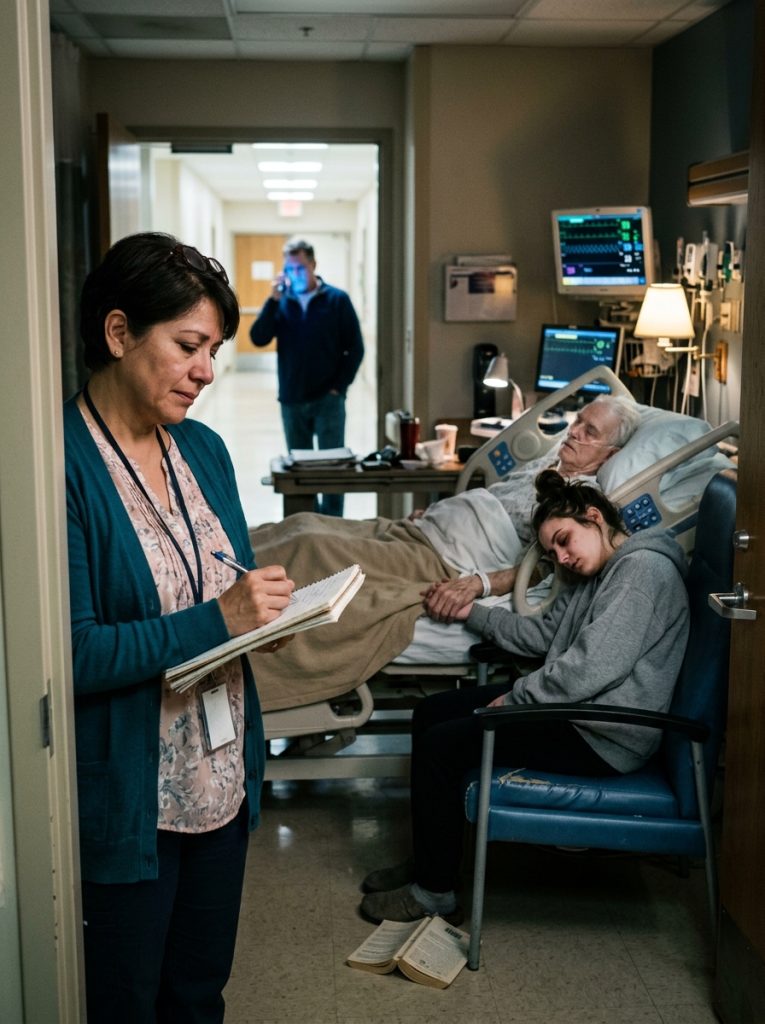
For five weeks I had watched this family from the doorway, the way I watch all of them.
I watched Emily learn the nurses’ names. I watched her bring a quilt from home because the hospital blankets were thin and her grandfather was always cold. I watched her read him Louis L’Amour in a voice that cracked on the sad parts.
And I watched Doug, too.
I watched him call the billing office more often than he called the nurses’ station. I watched him ask a charge nurse, on day nineteen, whether “comfort care” was cheaper than the current plan — standing at the foot of his sedated father’s bed when he said it.
I wrote it all down. Not because I’d decided he was a villain. Because writing it down is the job, and because I have learned, in twenty years of this work, that the truth is usually just a list of small things nobody thought anyone was counting.
The guardian ad litem the court appointed read my log in a single sitting. When she finished, she looked up at me.
“You documented everything,” she said.
I told her I always do. I told her the people who only call about money never believe anyone is writing it down.
The judge denied the petition from the bench. She named Emily as her grandfather’s medical decision-maker, effective immediately, and she said a sentence I wrote down word for word because I never want to forget it.
“Presence,” she said, “is not a phone call about insurance. Presence is a chair pulled up to a bed. This court knows the difference, and so, clearly, did Mr. Honce — the elder.”
Doug left before it was over. I watched him go. He didn’t ask how his father was doing on the way out. He never did, not once, in five weeks.
Emily stood in the hallway afterward with both hands over her face.
“I don’t know how to do this,” she said. “I don’t know how to be the one who decides.”
“You already are,” I told her. “You’ve been deciding to show up for forty-one nights. The paperwork just caught up to you.”
We went back to the hospital together.
Here is the part I have to tell you carefully, because it is the part that matters most, and it is the part that still sits on my chest some nights.
Walter had been slipping all that day.
By the time we reached his floor, the nurses had that look. The gentle, terrible look they get when the numbers stop being numbers and start being a clock.
Emily didn’t fall apart. I was proud of her for that, the way you get proud of someone who isn’t yours. She pulled the vinyl chair to the rail, exactly where it had lived for forty-one nights, and she took his hand, and she leaned close to his ear.
“I’m here, Grandpa,” she said. “You don’t have to go anywhere. Nobody’s moving you. You’re staying right here, in the room with the window. I made sure.”
I don’t know how much he heard. The doctors will tell you that hearing is the last thing to go, and I have stood in enough of these rooms to believe them.
But I’ll tell you what I saw.
I saw his hand, which had not moved on its own in two days, close around his granddaughter’s fingers.
Just once. Just barely.
Then it relaxed.
Walter Honce died a little after four in the morning, in the room he’d asked about every time he surfaced, with the window going gray-blue toward dawn, and his granddaughter’s hand in his.
Not in a discount facility two counties away. Not in a room he didn’t choose. Not alone.
The house never sold out from under him. The estate stayed exactly as he’d left it, which named Emily, because of course it did — Doug just hadn’t bothered to read it, because Doug only ever skimmed for the parts about money and missed the part where his father told everyone, in plain legal language, who he trusted.
I sat with Emily until the sun came up. She didn’t want to call anyone. There wasn’t really anyone to call.
“He wasn’t alone,” she kept saying. “He wasn’t alone, was he?”
“No,” I said. “He had the only person who came.”
I want to tell you the notebook saved him. It didn’t. Nothing could have. He was seventy-nine and his heart was tired and the kindest medicine in the world couldn’t have bought him another month.
The notebook didn’t save his life.
It saved the end of it.
It made sure that the last thing Walter Honce knew was a familiar hand and a familiar voice and the window he loved, instead of a stranger’s ceiling in a building his son picked for the price.
That is what social workers do, when we do it right. We don’t fix the heart. We make sure the right person is in the chair when it stops.
Doug contested the estate, briefly. His own lawyer talked him out of it once he saw the will, the ruling, and the dated photograph of a realtor’s sign. There are some hills even Doug could see weren’t worth dying on.
Emily kept the house. She told me she’s not sure she’ll stay in it, but she’s not ready to let it go, either. Grief has its own timeline. I never rush anyone through it.
She told me once that she keeps the quilt folded on the chair by the window — the one she used to cover him with. Just in case the room ever gets cold again, she said. I didn’t tell her that isn’t how it works. Some things you let a person keep.
She still texts me, now and then. A picture of the window in autumn. The light coming through it.
I closed Walter’s file the week after the funeral. Social workers write a final entry on every case. Most of mine are clinical. Discharge, deceased, transferred, closed.
For Walter, I wrote what was true.
Patient passed peacefully, in his chosen room, not alone. Granddaughter present, holding his hand. Family of the heart was here the whole time.
Then I closed the notebook, and I sat at my desk for a while in the quiet, the way I always do, before I went to meet whoever was in the next bed that needed someone to keep track.