The velvet box sat in his palm. The General’s hands were steady, but I could see the tension in his jaw. The gold braiding on his shoulders caught the light, casting long shadows across his face.
I didn’t reach for it. I couldn’t. My hands were locked in my lap, my fingers gripping the gold pendant so hard the metal bit into my skin.
“Open it,” General Sterling said softly.
The auditorium was packed. Three hundred officers in dress blues. The press in the back row. The flash of cameras was a constant, strobing rhythm. But in the front row, the air was thick and suffocating.
I reached out. My fingers trembled. I flipped the gold clasp. The lid opened with a soft snap.
Inside, resting on white satin, was the Medal of Honor.
The room didn’t just go quiet. It broke. A collective gasp sucked the air out of the room. The woman sitting next to me, a retired Colonel, covered her mouth with a gloved hand. The man in the row behind me shifted his weight, his chair squeaking loudly against the floor.
“This isn’t for me,” I whispered. My voice cracked. It sounded thin, reedy. “David is gone. You can’t give it to a ghost.”
“It’s not for David,” Sterling said.
My head snapped up. I looked at his face. His eyes were bright, unblinking. The harsh stage lights reflected in his pupils.
“It’s for you, Eleanor.”
I stared at the medal. The light blue ribbon. The gold star. The weight of it suddenly felt like it was crushing my chest. My heart hammered against my ribs, a frantic, trapped rhythm.
“I don’t understand,” I said. I looked at the other officers on the stage. They were staring at their shoes. None of them would meet my eyes.
Sterling stepped closer. He reached into his other pocket and pulled out a thick, declassified file. The paper was stamped with red ink. EYES ONLY. The edges were worn, like it had been read a hundred times.
“In 2004, your son didn’t abandon his post,” Sterling said. His voice was steady, carrying the absolute authority of a man who had seen the darkest corners of the world. “He was following a direct, off-the-books order from the Pentagon. He held the perimeter at the Khost airfield alone for four hours so a covert extraction team could get out.”
My breath hitched. The air in the auditorium felt suddenly thin. I gripped the arms of my chair. The vinyl was cold and slick under my palms.
“The extraction team was carrying a high-value defector,” Sterling continued. He opened the file. He didn’t look at the papers. He just looked at me. “A defector the government couldn’t acknowledge. If the mission was publicized, the diplomatic fallout would have been catastrophic. So, the brass buried it. They court-martialed David to protect the narrative.”
The words hit me like physical blows. My stomach dropped. The floor tilted. The blue curtains behind the stage seemed to blur and swim in my vision.
“They let him die in disgrace,” I choked out. The tears finally came. Hot, fast, cutting tracks through the powder on my cheeks. “They let my boy die thinking he was a coward. They let him die alone.”
“He wasn’t alone,” Sterling said. His voice dropped, becoming a harsh whisper that only I could hear. “And he didn’t think he was a coward. He knew exactly what he was doing.”
He stepped closer. He leaned down, his face inches from mine. I could smell his peppermint breath and the starch of his collar.
“He took the fall to save his squad,” Sterling whispered. “And he took the fall to protect you.”
I froze. The tears stopped. I looked up at him, my eyes wide, my breath caught in my throat.
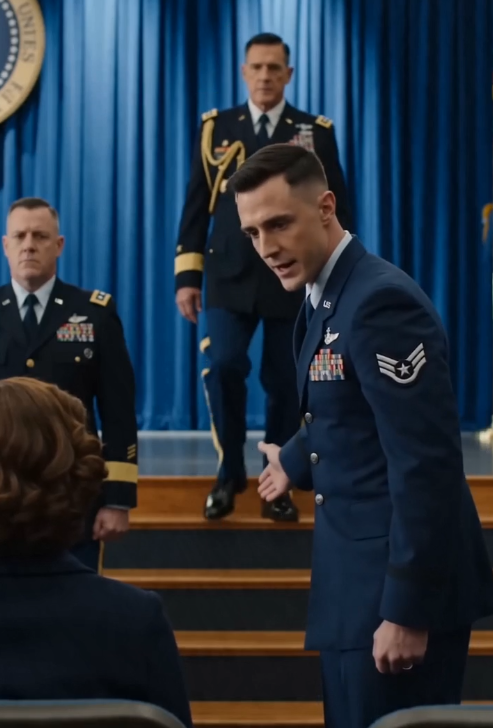
“If they had known you were the one who translated the defector’s intel from the embassy in Kabul, they would have come for you next,” Sterling said. “David knew they were looking for the translator. He took the blame so you could live.”
The silence in the room was absolute. The only sound was the distant, muffled hum of the ventilation system and the ragged sound of my own breathing.
I looked down at the gold pendant resting against my collarbone. David had given it to me the day before he left. He had told me it was a compass. To always find your way back to me, he had said.
It wasn’t a compass. It was a thank you.
Sterling stepped back. He unclasped the medal from the velvet box. The gold chain caught the light, gleaming like a tiny, bright star. He leaned over me. His hands were gentle as he draped the heavy ribbon around my neck. The cold metal rested against my chest, right next to the gold pendant.
“The President authorized this this morning,” Sterling said. He stepped back. He raised his hand to his brow. The movement was crisp, perfect. “For conspicuous gallantry. For sacrifice. For the truth.”
The woman next to me stood up. Then the Colonel behind her. Then the entire front row. The sound of three hundred chairs scraping against the floor echoed like thunder. The entire auditorium was on its feet. The flash of the cameras started again, a blinding, strobing light.
I sat there, the heavy gold medal resting against my heart. I looked down at the blue velvet box in my lap. I closed the lid with a soft snap.
I didn’t look at the General. I didn’t look at the cameras. I just closed my eyes, and for the first time in twenty years, I let my son rest.