The wind whipped the American flag above the guard booth. The red and white stripes snapped against the gray sky. The sound was like a gunshot.
I couldn’t breathe. The General’s words echoed in my skull. He died saving you.
My mother, Martha, took a step forward. Her blue coat fluttered. Her face was pale, her eyes wide and frantic.
“That’s a lie,” she said. Her voice shook. “The casualty report said it was a roadside IED. It said the Humvee took a direct hit. It was random. It was just bad luck.”
General Sterling didn’t flinch. He kept the bouquet of red roses, yellow mums, and white daisies held out toward me. His arm was steady. Like a statue.
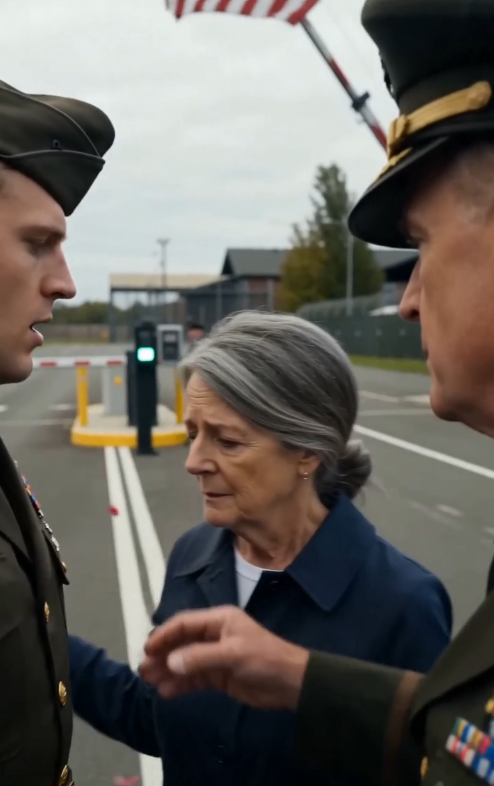
“The casualty report is a summary, Martha,” the General said. His voice was gentle now, but it carried the absolute weight of command. “It’s written for the public. It’s written to protect the families from the gruesome details of close-quarters combat.”
He reached into the breast pocket of his dress tunic with his free hand. He pulled out a thick, manila folder. The edges were worn. The paper was stamped with red ink: CLASSIFIED – EYES ONLY.
“This is the unredacted after-action report,” he said. He held it out to her. “Read page four.”
Martha’s hands were trembling so badly she could barely take the folder. She dropped her purse. It hit the asphalt with a dull thud. She didn’t look down. She opened the folder.
I stood there. My boots felt like they were nailed to the tarmac. I wanted to run. I wanted to get back on the C-130 and fly back to Kandahar. The guilt had been eating me alive for six months. I had nightmares every night. I saw Michael’s face. I saw the fire. I heard him screaming my name.
I thought I had failed him. I thought I had frozen.
Martha read the page. Her eyes scanned the typed text. Her lips moved silently.
At 1400 hours, convoy struck by IED. Sergeant Vance (Leo) was thrown from the vehicle, pinned under the roll bar. Corporal Michael Gable (Martha’s son) exited the vehicle under heavy fire. Corporal Gable manually lifted the roll bar, sustaining fatal shrapnel wounds to the chest and abdomen, to extract Sergeant Vance.
The folder slipped from her fingers. It hit the ground.
“He lifted it,” she whispered. The words were barely a breath. “He lifted the truck.”
“He lifted the truck,” General Sterling confirmed. He didn’t lower the flowers. “He traded his life for yours, Leo. And you have been carrying the weight of his death like it was your fault.”
Martha looked up at me. The anger in her eyes was gone. It was replaced by a profound, devastating sorrow. The kind of sorrow that breaks you open.
“You didn’t freeze,” she said. Her voice cracked. “You were pinned.”
“I should have been stronger,” I choked out. The tears finally came. Hot, fast, cutting tracks through the dust on my face. “I should have gotten out. I should have saved him.”
“You can’t save a ghost, son,” the General said. He stepped closer. He pressed the stems of the bouquet against my chest. The thorns of the red roses scratched through my uniform shirt. “But you can honor him. By living. By taking these flowers.”
I looked at the bouquet. The yellow mums were bright against the dull green of my uniform. The white daisies looked like stars.
I reached out. My hands were shaking. My scarred fingers wrapped around the stems. I took the flowers from the General.
The General stepped back. He gave me a crisp, perfect salute. The gold stars on his shoulder caught the light.
I turned to my mother. She was crying. Silent, heavy tears. She didn’t look at me like a stranger anymore. She looked at me like I was the last piece of her son she had left in the world.
She stepped forward. She wrapped her arms around my neck. She buried her face in my shoulder. She smelled like rain and old paper.
I held her tight. I held the flowers in one hand, and my mother in the other.
The guard at the booth lowered the barrier arm. The red and white stripes swung up, opening the gate.
I walked my mother through the gate, the red roses resting against my chest, and stepped onto the base.