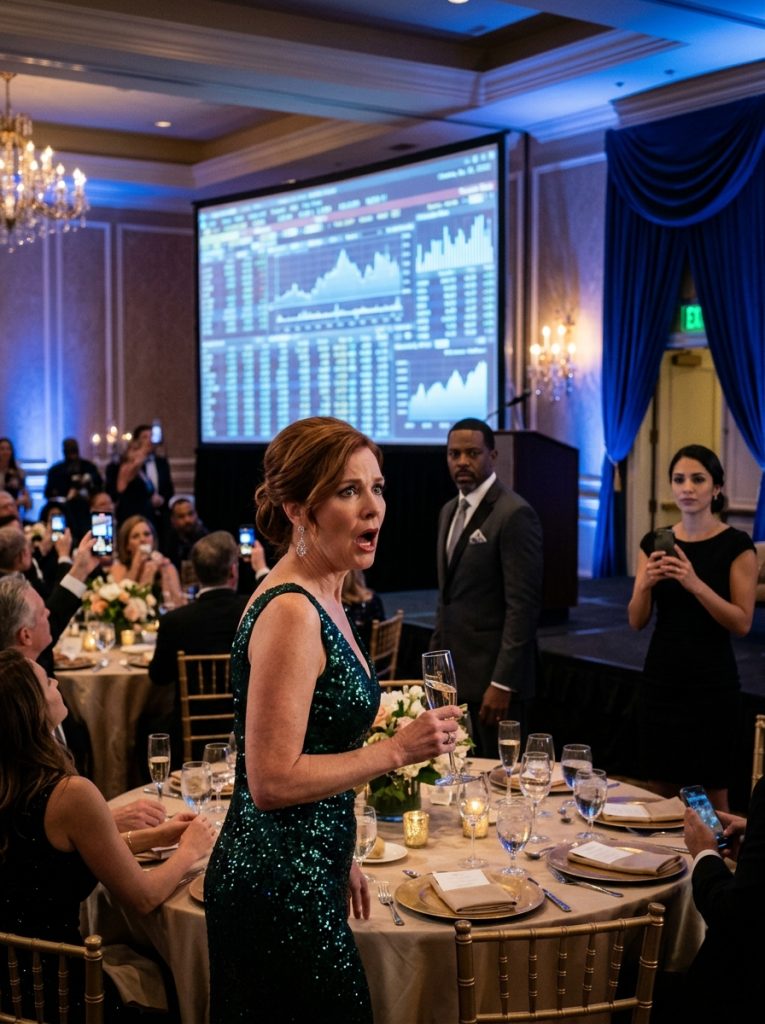
The second file was twenty-seven pages.
Elena had emailed it to Marcus Webb’s office at exactly 9:00 p.m. — forty-seven minutes before the screen changed at the gala. She titled the email simply: “Hearts of Hope — Supplemental Evidence.”
It wasn’t just about Vivian.
It was about who helped her.
The twenty-seven pages contained bank statements, wire transfer confirmations, and email correspondence between Vivian Ashford and three other board members who had cosigned transfers to Ashford Wellness LLC — the shell company registered to Vivian’s home address.
Board treasurer Kenneth Hollis.
Vice chair Patricia Stanton.
And the foundation’s legal counsel, a Scottsdale attorney named Robert Dryer, who had drafted the shell company’s articles of incorporation.
Three people.
Three signatures.
Three years of complicity.
The morning after the gala, Scottsdale woke up to the story. A local reporter who’d attended the event — originally there to cover the charity angle — had filmed the screen from her table. The video went up at midnight. By 6 a.m., it had forty thousand views.
By noon, the national press picked it up.
“CHARITY BOARD CHAIR EXPOSED BY HER OWN GALA SCREEN” ran across every local affiliate. The national outlets were more restrained but no less damaging: “Arizona Charity Under Investigation After Financial Data Projected at Annual Fundraiser.”
Vivian hired a PR firm by 8 a.m. and an attorney by 9.
Neither could help her.
Because Elena’s evidence wasn’t a stunt. It wasn’t a disgruntled employee’s tantrum. It was fourteen months of forensic documentation — organized chronologically, cross-referenced with bank statements, annotated with timestamps and source documents.
It was the kind of work that takes a first-year accounting graduate working nights and weekends in a one-bedroom apartment with spreadsheets on the walls.
Which is exactly what Elena was.
She’d moved to Scottsdale fresh out of Arizona State’s accounting program, grateful for the foundation job, eager to make a difference. The salary was modest but the mission felt real. She believed in Hearts of Hope.
She believed in it until month four.
The first discrepancy was small — a vendor payment of ,200 to a company called AW Consulting that had no website, no physical office, and no listed employees. Elena flagged it.
Her supervisor told her it was a “consulting retainer” and to move on.
She moved on.
But she kept a copy.
The second discrepancy was larger — 8,000 to the same company for “event coordination services” that coincided with a gala that Elena had personally coordinated. She’d done the work. No outside consultant had been involved.
She flagged it again.
This time, Vivian called her into her office.
“Elena, dear.” The smile. The charm. The emerald earrings catching the light. “I appreciate your thoroughness. But some of our vendor relationships predate your time here. Trust the process.”
Elena nodded.
And kept copying.
By month eight, she had tracked 40,000 in disbursements to Ashford Wellness LLC and two related entities. She had bank routing numbers. Wire confirmation codes. Board meeting minutes where the transfers were approved under the line item “Operations & Infrastructure” — a category so vague it could hide anything.
She brought her findings to the board’s audit committee.
Three days later, she was fired.
“Restructuring,” the letter said.
Her access was revoked within the hour. Her desk was cleared by security. Her final paycheck included two weeks of severance and a non-disparagement clause she refused to sign.
She refused to sign because she’d already saved everything.
Every document. Every email. Every screenshot.
On a personal USB drive she’d taken home every night for eight months.
After the firing, Elena spent six weeks organizing the evidence. Formatting it. Annotating it. Building the kind of presentation that a prosecutor could take straight to a grand jury.
She considered going directly to law enforcement.
But she knew how these cases work. White-collar fraud investigations take years. Evidence gets buried in legal motions. Wealthy defendants hire teams that outspend prosecutors. And charities — organizations that exist to do good — get the benefit of the doubt far longer than they deserve.
Elena wanted the public to see first.
She wanted three hundred people — donors, supporters, community leaders — to read the numbers with their own eyes and understand what their money had paid for.
So she planned the gala.
The plus-one invitation came from David Orozco — a legitimate donor who shared Elena’s suspicions after his own donation went unacknowledged in the foundation’s annual report. He’d been asking quiet questions for months. When Elena reached out, he agreed immediately.
The AV system was unguarded during cocktail hour. Elena uploaded her presentation to the rotation queue and set a timer. By 9:47, she was standing in the back row with her phone recording.
Not for evidence.
For proof that it happened publicly.
Marcus Webb’s office moved fast.
Subpoenas were issued within forty-eight hours. Kenneth Hollis turned over his records voluntarily — hoping cooperation would reduce his exposure. Patricia Stanton hired a defense attorney and stopped answering calls.
Robert Dryer, the foundation’s legal counsel, attempted to delete his email archives. The forensic team recovered them in full.
The grand jury was empaneled in six weeks.
Indictments came in eight.
Vivian Ashford. Kenneth Hollis. Robert Dryer.
Patricia Stanton cooperated and received immunity in exchange for testimony.
The trial lasted three weeks.
Elena testified for four hours.
She wore the same simple black dress she’d worn to the gala. She spoke calmly. Clearly. Without emotion or performance. She presented her evidence the way she’d built it — chronologically, precisely, undeniably.
The defense tried to paint her as a disgruntled employee seeking revenge.
Advertisement
The judge interrupted.
“The witness was terminated after raising legitimate financial concerns to her employer. The documentation she preserved is corroborated by independent bank records. Her motivation is not on trial here, counselor.”
Vivian was convicted on all counts.
Sentenced to four years.
Kenneth Hollis received two years, suspended.
Robert Dryer received eighteen months.
The Hearts of Hope Foundation was dissolved. Its remaining assets — roughly 80,000 after legal fees — were distributed to the three partner organizations it had claimed to support.
Those organizations reported they’d received less than 15% of what the foundation’s public filings had claimed to donate over three years.
Eighty-five cents of every dollar had gone to Vivian’s network.
Elena Ruiz was hired by Marcus Webb’s office two months after the trial as a forensic accountant for the financial crimes unit. She makes twice what the foundation paid her.
She still lives in the same one-bedroom apartment in Tempe.
The spreadsheets are gone from the walls.
But she kept one thing.
The gala invitation. Framed. On her desk.
Not as a trophy.
As a reminder that the truth doesn’t need a microphone.