The text Megan sent her father that afternoon was five words.
“This one. Promote him. Now.”
Arthur Hale read it in his office in Nashville. He didn’t question it. His daughter had never used the word “now” in a text before.
He picked up the phone.
Three days later, Craig Lyle walked into the conference room on the third floor of the Memphis hub — a room he’d never been inside.
The regional VP was there. HR was there. A woman Craig didn’t recognize sat at the far end of the table in a blazer and slacks, her hair no longer in a ponytail, her coveralls replaced by clothes that matched the company’s executive dress code.
Craig’s face went through three colors.
“Mr. Lyle,” the VP said. “Please sit down.”
He sat.
“We have documented testimony from fourteen employees regarding hostile workplace conduct over the past three weeks. This includes verbal harassment, destruction of personal property, retaliatory scheduling, and creation of a work environment that has resulted in a forty percent turnover increase at this facility.”
Craig’s mouth opened.
“I was enforcing policy—”
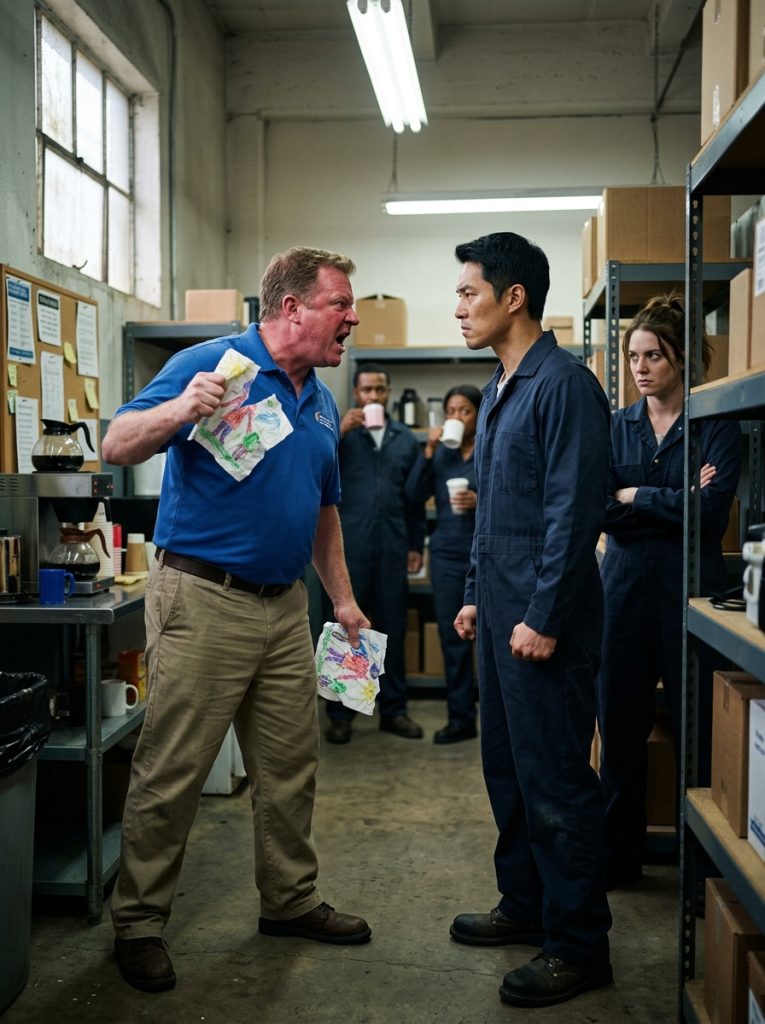
“You tore a child’s artwork off a wall and called it garbage in front of an employee and his coworkers.”
Silence.
The woman at the end of the table spoke for the first time.
“My name is Megan Hale. I’m the founder’s daughter. I’ve been on your floor for five days in plain coveralls, observing.”
Craig’s face drained.
“The man whose daughter’s drawing you destroyed has the highest efficiency rating in this region. He has trained six supervisors. He has never missed a shift. And in three years, not a single complaint has been filed against him — by anyone.”
She paused.
“You, on the other hand, have had three HR complaints in three weeks. A turnover spike that is costing this company roughly forty thousand dollars a month in rehiring and training. And a facility culture that went from highest morale in the network to lowest in less than a month.”
Craig said nothing.
“Your employment is terminated effective immediately.”
He stood. Looked around the room. Looked at Megan.
“This is — this is political. You’re doing this because of one drawing—”
“I’m doing this because fourteen people are afraid to come to work. And one man — a better worker than you will ever manage — stood in silence while you humiliated him, because he couldn’t afford to lose his job. That’s not leadership. That’s abuse of power.”
Craig left.
His badge was collected at the door. His locker was cleared by security. By the time the lunch bell rang, his name had been removed from the schedule board.
The floor was quiet that afternoon.
Not tense quiet. The other kind. The kind of quiet that comes after a storm passes and people are still deciding whether it’s safe to come outside.
David Park clocked out at his normal time. Drove home. Made dinner for Hana. Helped her with her reading assignment. Tucked her in. Sat on the couch in the dark for a while.
He didn’t know about the conference room.
Not yet.
The call came the next morning at 7:15 a.m. — before his shift started.
“Mr. Park? This is Sarah Owens, director of operations for the Southeast region. Do you have a moment?”
“Yes ma’am.”
“I’d like to talk to you about a position. Floor supervisor. This facility. Starting Monday.”
David was quiet for a long time.
“I’m sorry — did you say supervisor?”
“I did. The role comes with a salary increase, a family-flexibility schedule that allows adjusted start times for school drop-off and pickup, and full benefits effective immediately.”
David sat down on the edge of his bed.
Hana was in the kitchen eating cereal. He could hear her spoon clinking against the bowl. The morning sun was coming through the blinds in stripes.
A supervisor position. A schedule that let him drop her off at school.
He thought about the last three years. Every 4:45 a.m. alarm. Every babysitter he couldn’t quite afford. Every parent-teacher conference he missed because his shift didn’t end until six. Every time Hana drew him a picture and he wasn’t there to see her finish it.
“Ma’am, I’ve been on the floor for three years. Nobody’s ever—”
“I know. And that’s something we’re correcting. Your personnel file shows you’ve trained half the supervisors in this region. You should have been offered this role two years ago. The fact that you weren’t is our failure, not yours.”
David pressed the phone against his ear. His eyes burned.
“Can I — can I think about it?”
“Take the weekend. But Mr. Park — I want you to know this isn’t sympathy. This isn’t about what happened with Mr. Lyle. This is about your record. Your capability. And the fact that this company works because of people like you.”
He accepted Monday morning before his shift started. Called Sarah Owens from the parking lot with his coffee cooling in the cupholder and his hands steadier than they’d been in a long time.
“I’m in,” he said.
“Welcome aboard, Mr. Park.”
He sat in his truck for a moment after hanging up. Looked at the building. The loading docks. The break room window where — somewhere inside — a bare corkboard waited.
Then he went in.
His first act as supervisor was small.
He walked into the break room before the morning shift. The corkboard was empty — Craig had stripped everything off it during his policy purge.
David pulled a piece of folded paper from his jacket pocket.
The drawing.
Both halves.
Someone had taped them back together. Carefully. Precisely. With clear archival tape — the kind you’d use on something that matters.
He didn’t know who had done it. He’d found it in his locker on Thursday with no note.
Advertisement
He pinned it back on the corkboard.
The crayon sun. The stick-figure family. The word “DADY” in shaky purple letters.
He stood back and looked at it.
Then he went to work.
The Friday after David’s first week as supervisor, a package arrived at the facility addressed to him. Inside was a simple wooden frame — handmade, sanded smooth, with a backing that fit the exact dimensions of a child’s drawing.
No card.
But the shipping label said Nashville.
David framed the drawing that afternoon.
It hangs in the break room to this day.
Nobody has ever taken it down.
And every new employee who asks about it gets the same story: a father who stayed quiet when it mattered most, a daughter whose art was worth more than a policy, and a woman in plain coveralls who saw what everyone else was too afraid to say.
The company’s Memphis hub turnover dropped to its lowest rate in five years by the end of that quarter.
Megan Hale never returned to the floor.
But she kept David’s personnel file on her desk for a long time after — not because she needed it, but because it reminded her of something her father told her years ago:
“The best people in any company are the ones nobody notices. They don’t ask for recognition. They don’t perform. They just show up every day and hold the place together. Your job isn’t to reward them because they finally got loud. Your job is to find them before the world makes them small.”
David Park wasn’t small anymore.
He never had been.
It just took someone paying attention to see it.