The name on the recording was Gerald Ashton.
Sophia didn’t recognize it. Not at first. Not in the chaos of that morning — the process server, Dillon’s face, the frozen accounts, the annulment filing.
But Martin Cleary recognized it instantly.
“Say that again,” he said over the phone, his voice changing in a way Sophia had never heard from her unflappable attorney.
She replayed the clip.
Vanessa’s voice: “Gerald is handling the offshore piece. He’ll have the structure ready by the time she signs the post-nup addendum.”
“Sophia.” Martin’s voice was tight. “Gerald Ashton is under federal investigation. He’s been laundering money through real estate trusts for at least five families that the Bureau knows about. The FBI has been trying to connect him to a named client for two years.”
Sophia sat on the edge of the hotel bed, still wearing her bridal robe.
“And Vanessa just named herself.”
“On tape.”
“On tape.”
Martin exhaled slowly.
“I’m going to make a phone call. Don’t speak to Dillon. Don’t speak to Vanessa. Don’t speak to anyone until I call you back.”
He called back in forty minutes.
“What about Dillon?” Sophia asked.
“Dillon is a co-conspirator whether he knows it or not. But right now, the bigger fish is the money man. If we give the Bureau Vanessa on tape naming Ashton, they’ll move fast.”
“And my annulment?”
“Filed simultaneously. But Sophia — this isn’t just about your marriage anymore. This is about a pattern.”
She closed her eyes.
A pattern.
She’d married into a pattern.
What followed was not an annulment.
It was an avalanche.
Within two weeks, federal agents subpoenaed Vanessa Holt’s financial records. The offshore structure Gerald Ashton had built wasn’t just for Sophia’s money — it was a repeating pattern. Three other marriages in Vanessa’s circle had ended the same way: a targeted bride, a quick wedding, a financial drain disguised as marital collapse.
Dillon wasn’t the architect.
He was the tool.
Vanessa had done this before. Coached her son into relationships with women who had assets worth extracting. The previous brides had all walked away — broken, confused, blaming themselves. None of them had recorded anything. None of them were forensic accountants.
Sophia was the first one who caught it in real time.
She thought about that constantly.
The first. After three other women had been destroyed. After three other lives had been unwound by people who studied vulnerability the way engineers study load-bearing walls — looking for exactly the right point to apply pressure until everything collapsed.
The FBI case built rapidly. Sophia’s recording — eleven minutes and forty-three seconds — became the cornerstone exhibit. Not just for her case. For all of them.
Because once the other brides heard that someone had proof, they came forward.
One by one.
First was Kathleen Marsh from Wilmette. She’d been married to Dillon’s cousin for eight months before her “mental health spiral” led to a quiet divorce and the loss of a lakefront property.
Then came Jessica Liu from Evanston. Engaged to another man in Vanessa’s circle. The engagement ended after she was accused of infidelity — accusations that, like Sophia’s situation, were manufactured.
Then Rachel Odom from Lake Forest. She’d lost 00,000 in what she believed was a bad investment her ex-husband recommended. The investment firm was Gerald Ashton’s shell company.
Three women.
Three different men.
One family.
One playbook.
The pattern was identical every time. The charm. The whirlwind courtship. The wedding. Then the slow, methodical dismantling — financial first, then psychological, then legal.
It was a business.
Vanessa ran it like one.
Sophia met each of them separately. Not as a lawyer — Martin handled the legal coordination — but as a witness. As proof that they weren’t crazy. That what happened to them was real. Deliberate. Planned.
Kathleen cried for twenty minutes the first time they spoke.
“I thought I was losing my mind,” she said. “He kept telling me I was paranoid. That I was imagining things. And I believed him.”
Sophia understood.
Because for three hours on her wedding night — before she heard that recording — she had believed Dillon too.
The annulment was finalized in six weeks. Fastest in Cook County that year, according to Martin.
The criminal case took longer.
Months of depositions. Document review. Forensic accounting that Sophia could have done in her sleep — and in some ways did, because she volunteered her expertise to Martin’s team pro bono.
She traced every dollar. Every transfer. Every shell company. Every wire that moved through Gerald Ashton’s network back to Vanessa Holt’s accounts.
It wasn’t just therapeutic. It was necessary.
Because Sophia understood something the prosecutors didn’t: this family’s system wasn’t designed by a criminal mastermind. It was designed by a mother who believed her son deserved wealth he hadn’t earned. And that made the paper trail sloppy in places that only a forensic eye would catch.
Gerald Ashton was arrested in March. Vanessa Holt was indicted in April on charges of conspiracy to commit wire fraud and money laundering.
Dillon was offered a cooperation deal.
He took it.
He testified against his own mother in exchange for reduced charges.
Sophia watched the hearing from the gallery. She didn’t speak. Didn’t react. Just watched the man who’d promised her forever sell out the woman who’d taught him to steal.
The judge asked Vanessa if she had anything to say before sentencing.
Advertisement
She looked directly at Sophia.
“You were supposed to be easy,” she said.
The courtroom went silent.
“You were supposed to be grateful. Pretty. Simple. A girl with a good family and a nice smile who wouldn’t ask questions.”
Sophia held her gaze.
“I asked questions for a living, Vanessa. That’s what you never understood.”
Vanessa was sentenced to seven years.
Gerald Ashton got twelve.
Dillon received eighteen months of probation and a lifetime of being the man who married a woman to rob her.
Sophia moved to a different apartment. Smaller. Quieter. A one-bedroom in Lincoln Park with a view of the lake and no room-service trays in the hallway.
She kept the recording on a backup drive in her safe.
Not as evidence anymore. The courts had their copies.
She kept it as a reminder.
That the most dangerous people don’t announce themselves. They charm you. They marry you. They toast to forever while planning to take everything.
And the only defense is to trust yourself more than you trust their performance.
Six months after the sentencing, Sophia received a letter.
No return address. Handwritten.
It was from Kathleen Marsh.
Three sentences:
“You saved my life by being the one who recorded it. I was ready to believe I deserved what happened. Now I know I didn’t.”
Sophia read it once.
Then she put it in the safe next to the drive.
Because some things you keep not because they’re evidence.
But because they’re proof that one night of courage can undo years of someone else’s cruelty.
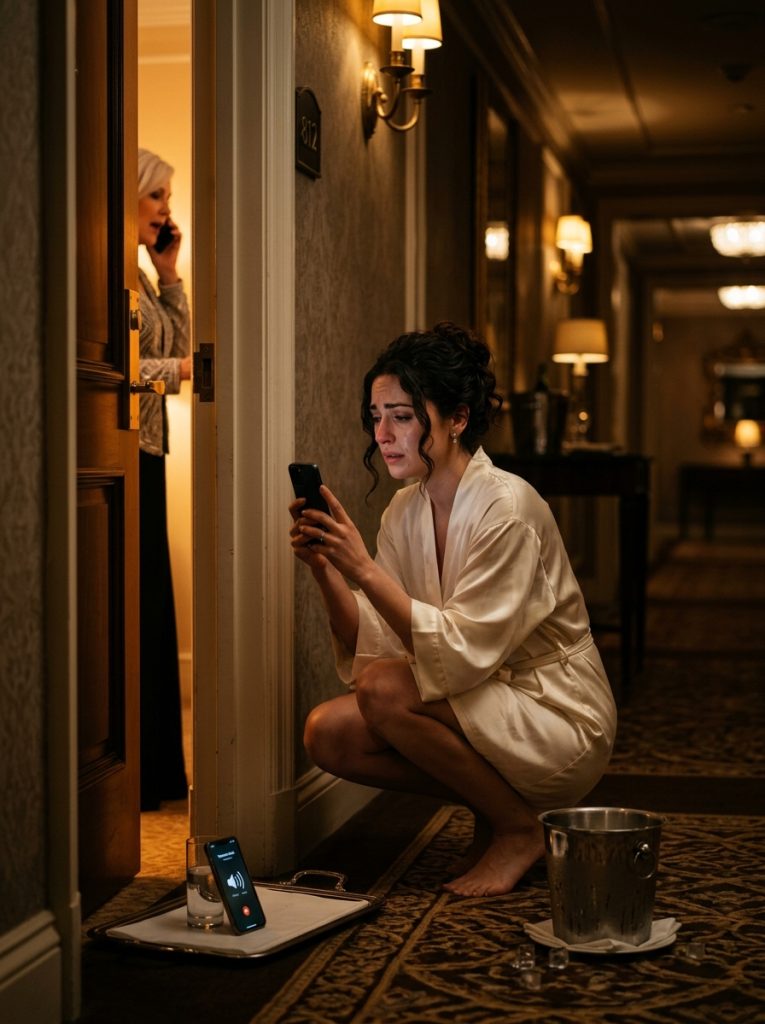
And that a woman crouching barefoot in a hotel hallway — recording the truth while everyone around her slept — was never the victim in this story.
She was the reason it ended.