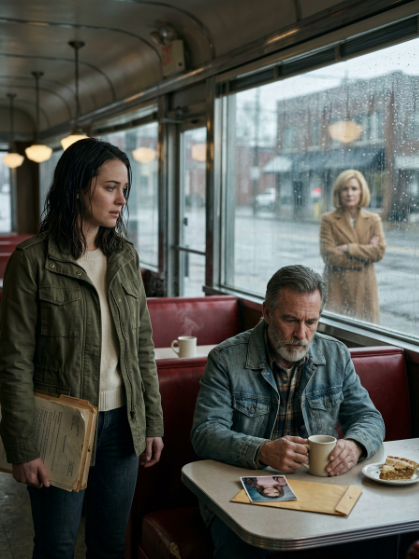
The first page wasn’t a court order at all.
It was a letter from a lawyer I’d never heard of, addressed to my father, dated when I was four years old. And clipped behind it was the original petition my mother had filed.
I read it twice before the words rearranged themselves into the truth.
The “danger.” The reason I’d been raised to fear his knock. It was one sworn statement, in my mother’s handwriting, claiming my father had threatened her.
And behind it, in the same file, was the thing that unraveled twenty years of my life.
A second affidavit. From my grandmother — my mother’s own mother — recanting it. Swearing under oath, two years later, that she had watched my mother write that statement, that none of it was true, that it had been filed to win a custody fight my father couldn’t afford to contest.
He hadn’t fought it. That was the part I couldn’t get past, sitting in that diner with the rain running down the glass.
He’d had my grandmother’s affidavit. He could have reopened the case. And he’d let it stand.
I found him the next Tuesday. Same booth. The photo of four-year-old me already face-up on the table, like an offering.
I slid into the seat across from him. The first time in twenty-five years.
“Why didn’t you fight it?” I said. No hello. I couldn’t manage hello.
Raymond Cole wrapped his weathered hands around his coffee mug and took a long time to answer.
“Because fighting it meant a war,” he said finally. “Lawyers. Hearings. You, four years old, in a room with a judge while two adults called each other liars. Your grandmother begged me not to put you through it. She said, ‘Ray, you can be right, or you can let that baby grow up without a courtroom in her memory.'” He looked at the photo. “I chose the second one. I thought I’d have time to explain it to you when you were grown. Then your mother moved you three states away, and the years just… went.”
“You let me think you were dangerous,” I said. “For twenty years.”
“I know.” His voice cracked. “I wrote you a letter every birthday. Your mother sent them all back unopened. I’ve got twenty-five of them in a box in my truck. I didn’t come here to make you read them. I came to give you the file, and the truth, and then leave you be. You don’t owe me a thing. Not after this long.”
I thought about my mother. About the woman in the camel coat who’d stood in that doorway across the street watching us, arms crossed, the same way she’d stood between me and the truth my whole life.
I’d called her on Sunday. Told her I’d seen the file.
She didn’t deny it. That was almost the worst part. “I did what I had to do to keep you,” she’d said, like that settled it. “He could have made my life very hard.”
“He could have made it hard,” I’d said. “He chose to make it quiet instead. For me.”
She hung up on me. We haven’t spoken since.
Some walls, it turns out, were built by the person who told you they were protecting you from one.
I didn’t fall into my father’s arms in that diner. Twenty-five years doesn’t dissolve over a slice of pie. The man across from me was a stranger who happened to have my eyes.
But I took the box of letters out to his truck with him. Twenty-five envelopes, soft at the corners.
“I’m not promising anything,” I told him. “I don’t know how to do this.”
“You don’t have to know,” he said. “We’ve got time now. However much you’ll give.”
I read one letter that night. The one from my tenth birthday. He’d written about a fishing trip he imagined taking me on, in such detail that I cried — the lake, the bad jokes, the sandwiches my grandmother would’ve packed.
I read another the next week. Then another.
We have coffee now. Same booth, his idea of a joke. He still orders pie he doesn’t eat. I’ve stopped watching the door like something dangerous is coming through it.
Because something dangerous already had. Years ago. And it wasn’t him.
The photo of four-year-old me lives in my wallet now, the way it lived in his for twenty-five years.
We’re both just trying to grow it back. One careful Tuesday at a time.