The entry that broke me open was dated three months before we lost her.
“Mom thinks I’m mad at her,” Hazel wrote. “I’m not. I just don’t know how to say it out loud without us both falling apart, so I’m saying it here, in case I run out of time to say it any better.”
I had to put the journal down. Tom had come into the room by then. He sat beside me on the narrow bed and put his arm around me, and we read the rest together, slowly, the way you’d cross thin ice.
The decision I’d carried like a stone — the one about her care, in those last brutal months, when I chose to stop the treatment that was hurting her more than it was helping — she’d known about all of it.
“They keep asking Mom to decide things,” she wrote. “And she keeps choosing the thing that means more days with me, even when I can see it’s killing her to watch the medicine make me sick. I heard her tell Dad she’d carry it forever. I don’t want her to carry it. It’s the bravest thing I’ve ever seen anybody do. I hope someday she reads this and finally puts it down.”
For three years I had believed she died thinking I gave up on her.
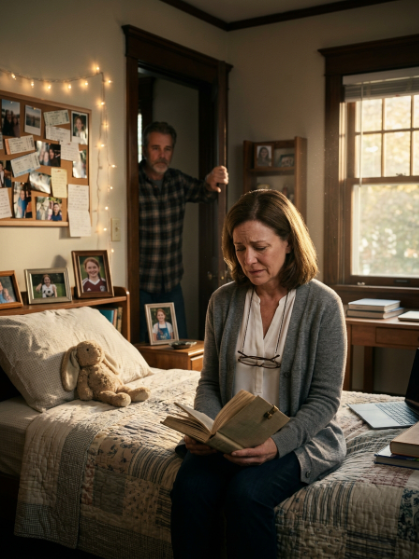
She died knowing I loved her enough to let her stop hurting.
There was more. There was so much more.
Pages about her friends. A boy named Theo she never told us about. A list, headed “Things I want Mom and Dad to do after,” that I could barely see through my tears.
“Don’t keep my room like a museum,” she’d written. “It’s just stuff. Give my books to the hospital school. Some of those kids never get visitors.”
Tom laughed wetly at that. We had, of course, kept the room exactly like a museum. For three years.
And then, near the back, folded between two pages, a sealed envelope. On the front, in her loopy hand: “For the next kid in Room 4. Please actually do this, Mom. It matters more than anything else in here.”
Room 4 was the pediatric oncology room she’d lived in, on and off, for two years.
Inside the envelope was a letter, and a plan.
While she was sick, Hazel had noticed that the long-term kids — the ones who stayed for weeks — had nothing of their own on the walls. Just hospital beige. So she’d been saving the cash from every birthday and holiday, hiding it in a sock in her drawer. Three hundred and forty dollars. And she’d written out, in detail, what she wanted it spent on: string lights, like hers. A corkboard. A good set of paints. “So Room 4 feels like somebody’s, not nobody’s.”
She’d run out of time to do it herself.
So we did it for her.
It took us a week to work up the courage to go back to that ward. The same hallway. The same hand-sanitizer smell. The nurse who’d held my hand the last night recognized us from the elevator and started crying before we said a word.
We hung the lights in Room 4 ourselves. The corkboard. The paints on the little rolling table.
There was a girl in the bed. Eleven, maybe. Bald, brave, suspicious of two grown strangers fussing with string lights.
“Who are these from?” she asked.
“A girl named Hazel,” I said. “She stayed in this room. She wanted you to have them.”
The girl looked at the lights for a while.
“Is she okay now?” she asked.
Tom’s hand found mine.
“She’s okay now,” I said. And I found, to my own surprise, that I believed it.
We didn’t stop there. We couldn’t. We took the three hundred and forty dollars Hazel had saved and we made it the seed of something — the Hazel Ellison Room Fund. Every long-term room on that ward has lights now. A board. Paint. A little card by the door that says a girl named Hazel thought you should feel at home here.
I still have the journal. I keep it on my own nightstand now, not behind a headboard.
I read the first line some nights, when the missing her gets sharp.
“Don’t be sad too long. I mean it. Mom especially.”
I’m still working on it, baby. I won’t pretend I’ve got it beat.
But the room isn’t a museum anymore. The books are with the kids who needed them. And somewhere on that ward tonight, a child I’ll never meet is falling asleep under string lights, in a room that finally feels like somebody’s.
That’s the answer I was so afraid to find.
It just took her writing it down, and me three years to be brave enough to read it.